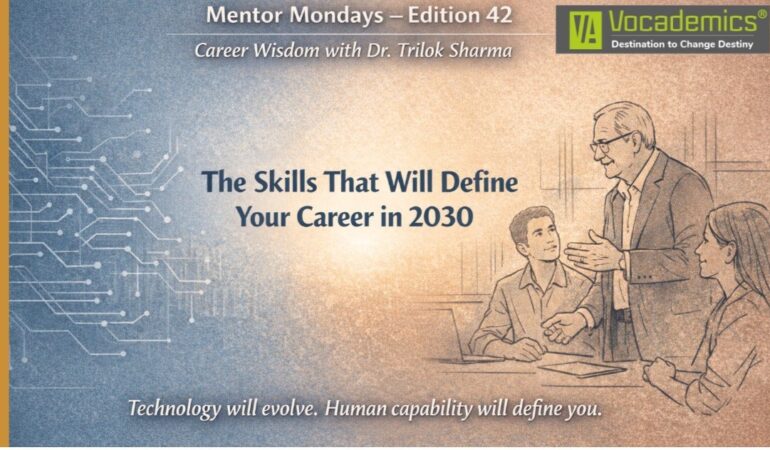
Every decade reshapes the way we work. But the coming decade may reshape it faster than any period in modern history. Artificial Intelligence is advancing rapidly. Entire industries are being redesigned. New roles are emerging even as traditional ones disappear.
According to global workforce studies, nearly 40% of the skills used in today’s jobs will change by 2030. That means the real question for professionals is no longer: “Which job should I choose?”
The real question is: “Which skills will make me valuable no matter how jobs change?”
Let us explore the answer.
The Future of Work: A Skill Transformation
The world of work is being influenced by several powerful forces:
A. Artificial Intelligence and automation
B. Digital transformation across industries
C. Climate and sustainability transitions
D. Global economic uncertainty
E. Changing demographics and workforce expectations
Together, these forces are redefining what organizations expect from professionals. But here is an interesting insight.

While technology is advancing rapidly, the most valuable skills of the future are becoming deeply human.
1. Creativity.
2. Resilience.
3. Judgment.
4. Empathy.
5. Leadership.
These are qualities that machines cannot easily replicate.
The future professional will not be defined only by technical expertise — but by a powerful combination of technology awareness and human capability.
The Core Skills of 2030
Research from global workforce studies highlights a set of skills that will become increasingly important by 2030.
Let us look at some of the most significant ones.
1. Analytical Thinking
The ability to interpret data, identify patterns, and make sound decisions will remain the most sought-after skill.
In an AI-driven world, the value lies not in data — but in interpretation.
2. Creative Thinking
Automation can process information, but innovation still requires imagination.
Creative thinkers will lead new product ideas, new business models, and new solutions to complex problems.
3. Resilience, Flexibility & Agility
Change will be constant.
The most successful professionals will not necessarily be the most knowledgeable — they will be the most adaptable.
4. Curiosity & Lifelong Learning
The traditional career model was:
Education → Job → Retirement.
The new model is:
Education → Work → Learn → Reinvent → Grow.
Professionals must become continuous learners.
5. Leadership & Social Influence
Organizations need leaders who can guide teams through uncertainty, inspire people, and build trust in complex environments.
Leadership is no longer limited to senior management — it is a career competency.
6. Motivation & Self-Awareness
In the future workplace, emotional intelligence will be as important as technical intelligence.
Understanding your strengths, motivations, and values will help professionals make better career decisions.
7. Technological Literacy
You do not need to be a programmer.
But every professional must understand how digital tools, AI systems, and data-driven technologies influence their work.
Technology literacy will soon become a basic professional requirement.
8. Empathy & Active Listening
As workplaces become more global and virtual, the ability to understand people, manage emotions, and communicate effectively will become invaluable.
Human relationships will remain the foundation of every successful organization.
9. Talent Management & Collaboration
Future workplaces will be highly collaborative.
Professionals must know how to:
• Work across cultures • Lead diverse teams • Develop and mentor talent
10. Systems Thinking
Modern challenges are interconnected.
Systems thinking helps professionals understand how different parts of a problem interact with each other — allowing better decision-making.
Emerging Skills to Watch
Alongside these core skills, several emerging competencies are gaining importance.
AI & Big Data Awareness
Understanding how AI systems function will help professionals collaborate effectively with intelligent technologies.
Cybersecurity & Digital Infrastructure
As the world becomes more digital, protecting data and systems becomes critical.
Sustainability & Environmental Literacy
Organizations are increasingly aligning with global climate goals. Professionals who understand sustainability will have an advantage.
User Experience & Design Thinking
In the digital economy, the success of products and services depends heavily on user experience.
Beyond Reskilling: The Mindset Shift
Many professionals believe the answer lies in reskilling — learning a new tool, a new software, or a new certification.
But the deeper shift is not technical; it is philosophical.
Future careers will reward those who embrace:
a) Curiosity
b) openness to change
c) growth mindset
d) self-reflection
e) lifelong learning
The goal is not simply to collect skills. The goal is to develop the ability to continuously evolve.
The Hybrid Professional

The future belongs to professionals who combine four dimensions of capability:
1. Technology Awareness
Understanding AI, data, and digital tools.
2. Cognitive Strength
Creative thinking, analytical thinking, and problem-solving.
3. Personal Resilience
Adaptability, learning agility, and emotional stability.
4. Human Intelligence
Leadership, empathy, communication, and collaboration.
This combination creates what experts call:
The Hybrid Professional
A person who works comfortably with both machines and people.
The Indian Perspective
India stands at a unique moment in history.
Our country has one of the largest young workforces in the world.
But this demographic advantage will translate into opportunity only if our workforce develops the right capabilities.
Employers across India are increasingly prioritizing:
a) Digital fluency
b) Critical thinking
c) Adaptability
d) Innovation
e) Collaboration
Educational institutions and training ecosystems must therefore focus not just on degrees, but on capabilities.
Action Steps for Future-Ready Professionals

If you want to prepare yourself for the next decade, start with these steps:
1. Become a Lifelong Learner
Make learning a continuous habit.
2. Strengthen Your Thinking Skills
Focus on problem-solving, creativity, and strategic thinking.
3. Build Emotional Intelligence
Empathy, communication, and leadership will differentiate professionals.
4. Understand Technology
Even non-technical professionals must understand how AI and digital tools affect their industries.
5. Develop Adaptability
Do not fear change — learn to navigate it.
Activity: Your Personal Skill Map
Take a moment to reflect. Draw four quadrants on a sheet of paper:
Technology | Thinking | Personal | Human
List your strengths in each area. Then ask yourself: Where are the gaps?
Those gaps represent your next learning journey.
From Dr. Trilok’s Mentor Desk
“In the coming decade, knowledge alone will not secure your career. Technology will change too quickly for that.
What will truly differentiate professionals is their ability to think clearly, learn continuously, adapt courageously, and lead with integrity.
Invest not only in skills — invest in your mindset.”

Closing Thoughts
The future of work is not a battle between humans and machines; it is a collaboration. Technology will automate tasks. But human intelligence will guide purpose.
1. Your creativity.
2. Your empathy.
3. Your judgment.
4. Your leadership.
These will define your value in the workplace of tomorrow. So, do not just prepare for your next job; prepare for the next version of yourself.
📩 Career Guidance & Psychometric Assessment Visit: https://vocademics.edumilestones.com