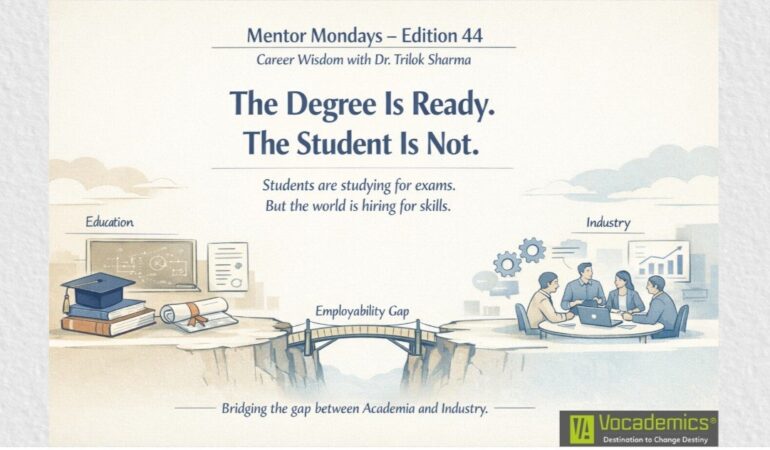
Students are studying for exams.
But the world is hiring for skills.
Every year, thousands of students graduate with degrees.
Many of them have good marks, good attendance, and good theoretical knowledge. Yet, when they enter the job market, they struggle. Not because they are not intelligent. But because the degree is ready -and the student is not.
This is not a student problem alone. This is not an institution problem alone. This is not a corporate problem alone.
This is a system problem, and unless academia and industry start working together, this gap will continue to grow.

The Education-Employability Gap
For decades, education followed a very simple model:
Study → Pass Exams → Get Degree → Get Job → Build Career
This model worked when industries were stable, technology changed slowly, and jobs were predictable.
But today the world has changed.
Today companies are not only looking for people who know things. They are looking for people who can do things.
They want people who can:
- Solve problems
- Communicate clearly
- Work in teams
- Use technology
- Learn quickly
- Adapt to change
- Take responsibility
- Think independently
Unfortunately, many students are still being trained mainly to remember and reproduce, not to understand and apply.
We taught them how to pass exams, but not how to handle work.

Traditional Education vs Modern Workplaces
Traditional education still focuses heavily on:
- Syllabus completion
- Theory
- Written examinations
- Marks
- Attendance
- Degrees
Modern workplaces focus on:
- Problem solving
- Communication
- Teamwork
- Technology usage
- Decision making
- Time management
- Adaptability
- Continuous learning
- Accountability
In simple words:
Education is still testing memory. Industry is testing ability.
This mismatch is the root of the placement problem, the employability problem, and the fresher training problem.

The Placement Problem – Two Sides of the Same Story
When I talk to academic institutions, they say:
Companies are not coming for placements.
When I talk to companies, they say:
Students are not job-ready.
Both are right. And both are incomplete.
Institutions are producing graduates. Companies are looking for professionals.
Institutions are completing curriculum. Companies are looking for capability.
Institutions measure results in marks. Companies measure results in performance.
Between these two systems stands the student – confused, underprepared, and often frustrated.
The Real Question Education Must Ask
The most important question for education leaders today is not:
- How many students passed?
- What was the university result?
- How many toppers did we produce?
The most important question is:
How many students are employable? How many students can solve real problems? How many students can work in real organizations?
Because life does not give question papers. Life gives situations.
Life does not test memory. Life tests judgment.
Life does not reward degrees alone. Life rewards value creation.

Bridging the Gap – Our Commitment
At Vocademics International LLP, we strongly believe that the future of education depends on collaboration between academia and industry, not on working in isolation.
We are committed to working with:
- Academic institutions
- Corporates
- Training organizations
- Placement cells
- Students
To develop:
- Employability skill frameworks
- Industry-oriented training programs
- Internship and live project models
- Career assessment and skill mapping tools
- Faculty development programs
- Corporate–academia interaction platforms
- Placement readiness programs
- Communication and professional skills training
Our goal is simple:
Reduce the gap between what students learn and what the industry expects.
We are always open to collaborating with institutions and corporates who are serious about improving student employability, industry readiness, and meaningful placements.

What Academic Institutions Can Do
If institutions want better placements and better career outcomes for their students, they may need to rethink a few things:
- Introduce more case studies and real-life business problems.
- Make internships compulsory and meaningful, not just certificate-based.
- Focus on communication, presentation, and writing skills.
- Encourage students to work on live projects with local industries.
- Invite industry professionals regularly for interaction.
- Evaluate students on projects and problem solving, not only exams.
- Start skill labs – Excel, Data, AI tools, Business Communication, Financial Literacy.
- Train faculty in industry trends and practical applications.
- Build long-term relationships with companies.
- Measure success not only by results, but by employability.
Institutions should remember:
Their real product is not the degree. Their real product is the student.
What Corporates Can Do
Corporates also need to become active partners in education.
Instead of only saying “students are not ready,” companies can:
- Provide curriculum inputs to institutions.
- Offer short industry training modules.
- Give live business problems as student projects.
- Offer structured internships.
- Conduct pre-placement training workshops.
- Mentor student groups.
- Create apprenticeship models.
- Identify talent early instead of only during final placements.
Companies should not see students as finished products, but as potential that can be shaped.
The Future of Education
Education in the coming years will not be defined by:
- How many subjects you studied
- How many exams you cleared
- How many degrees you collected
It will be defined by:
- What problems you can solve
- How fast you can learn
- How well you can communicate
- How you work with people
- How you adapt to change
- How you use technology
- How you create value
The future classroom must shift from:
“What to learn” → “How to apply”
From:
- Memorizing answers → Asking better questions
- Completing syllabus → Building skills
- Marks → Capability
- Degree → Employability
Final Thought
The biggest risk today is not that students will fail in exams.
The biggest risk is that they may pass exams but fail in employability.
Education must not produce only degree holders. Education must produce thinkers, problem solvers, creators, and responsible professionals.
Because the future will not belong to those who studied the most.
The future will belong to those who can learn, adapt, and apply the fastest.