
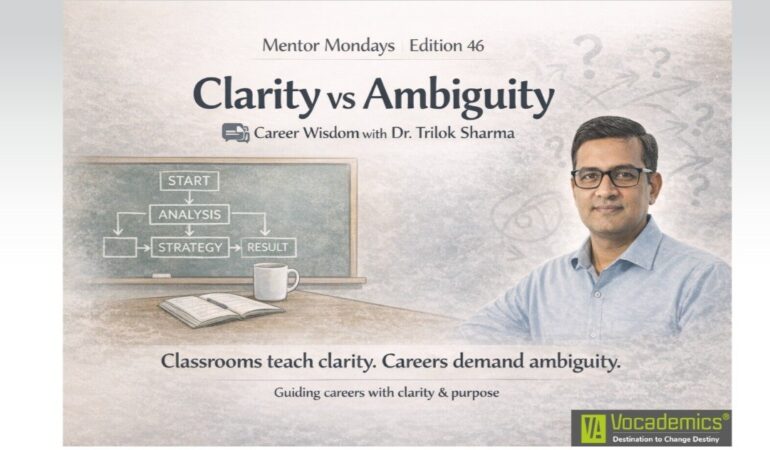
The real world rarely gives you a question paper. It gives you a situation.
In classrooms, we reward clarity. In careers, we reward those who can survive confusion.
That’s the gap no one talks about.
1. The Problem: A System Built for Clarity
Most MBA and graduate programs are designed like well-structured highways:
- Defined syllabus
- Clear frameworks
- Case studies with “expected answers”
- Exams with marking schemes
Students are trained to: ✔ Analyze structured problems ✔ Apply known models ✔ Arrive at logical conclusions
But here’s the catch…

👉 The real world is not a case study. It’s a messy, evolving situation.
Real-World Example
Sheetal learns SWOT Analysis perfectly in class.
First job: She is asked : “Why is our product not selling in Tier-2 markets?”
Reality:
- Data is incomplete
- Sales team blames marketing
- Marketing blames pricing
- Pricing depends on procurement
- Procurement depends on vendors
There is no neat “SWOT box” waiting.
Sheetal freezes; not because she lacks knowledge, but because she expects clarity before action.
2. The Consequence: Intelligent, Yet Unemployable
This mismatch creates a silent crisis.
We are producing: 🎓 Degree holders But not necessarily 💼 Decision makers
What Actually Happens
Many graduates:
- Wait for perfect instructions
- Avoid taking ownership in unclear situations
- Struggle in roles where ambiguity is high
- Get labelled as “not proactive”
And the harsh corporate truth:
👉 Employability today is not about what you know. It’s about how you respond when you don’t know.

Real-World Example
A bright MBA Hitesh joins a startup.
Day 3: Founder says : “We need to improve customer retention. Figure it out.”
No SOP. No manual. No clear direction.
Hitesh thinks: “Where is the framework? Where is the guidance?”
Another average student Sudhir says: “Let me talk to 10 customers first.”
Guess who survives?
3. The Reality: The World Runs on Ambiguity
Whether it is:
- Corporate decisions
- Government policies
- Social movements
- Startups
Everything operates in: 👉 Incomplete information 👉 Conflicting priorities 👉 Time pressure

Real-World Example
During the COVID-19 phase:
- Companies had no playbook
- Governments had no precedent
- Leaders had no certainty
Yet decisions had to be taken daily.
Those who waited for clarity failed. Those who acted amidst ambiguity led.
4. The Solution: Train for Ambiguity, Not Just Clarity
If we truly want students to be employable, we need a shift.
Not in syllabus alone…But in mindset.
What Students Must Start Practicing
1. Take Action Without Full Information
Don’t wait for 100% clarity.
Start at 40–50%.
👉 Clarity often comes after action, not before.
Example: Instead of analyzing endlessly, start with small experiments.
2. Learn to Ask Better Questions
In ambiguity, answers are rare, but questions are powerful.
Ask:
- What do we know?
- What don’t we know?
- What can we test quickly?
Example: Consultants don’t have answers on Day 1. They have sharper questions.

3. Build “Thinking on Your Feet” Ability
Real meetings don’t give you 24 hours.
They give you 24 seconds.
Example: In a boardroom, your value is not your notes : it is your response.
4. Exposure Over Theory
- Internships
- Live projects
- Field work
- Conversations with practitioners
👉 The more messy situations you see, the stronger you become.
5. Develop Emotional Stability
Ambiguity creates anxiety.
If you panic, you pause. If you pause, you fall behind.
Example: Leaders are not those who know everything. They are those who remain calm when nothing is clear.

5. The Shift We Need to Accept
Earlier: 📘 Knowledge = Power
Now: ⚡ Adaptability = Power
Final Thought
Your degree may get you an interview. Your ability to handle ambiguity will get you the job…and help you keep it.
If you are a:
🎓 Student — Start practicing decisions without waiting for perfect clarity
👨👩👧 Parent — Encourage exposure, not just marks
🏫 Educator — Create situations, not just solutions
Remember: The world will not simplify itself for you. You have to strengthen yourself for the world.