How AI Communication, Questioning and Clarity Are Becoming Career Skills
A few years ago, when we heard the word “prompt”, most of us thought of a school question paper. Today, “prompt” has entered offices, classrooms, boardrooms, consulting rooms, design studios, HR departments, marketing teams, legal desks, research cells, and even family discussions.
But let me say this very clearly: Prompting is not typing a question into ChatGPT. Prompting is the skill of thinking clearly before asking.

And this is why prompting is becoming a new professional skill.
In the age of AI, the quality of your answer will often depend on the quality of your question. This is not new wisdom. Good teachers, mentors, counsellors, researchers and leaders have always known this.
A confused question rarely produces a clear answer. AI has simply made this truth visible.
The New Career Divide
In the coming years, the real divide may not be only between those who know AI and those who do not. The deeper divide may be between:
- people who give vague instructions
- and people who can define problems clearly
- people who ask random questions
- and people who ask structured questions
- people who copy AI output blindly
- and people who guide, review, correct and improve it
- people who use AI as a shortcut
- and people who use AI as a thinking partner
AI is powerful, but it is not a mind reader. It responds to clarity. It improves with context. It performs better when the human user knows what he or she wants. In simple words:
AI does not replace thinking. It exposes the absence of thinking.

Why Prompting Is More Than a Technical Skill
Many people wrongly believe that prompting is a technical skill meant only for coders, engineers or AI specialists. No. Prompting is also a communication skill. It is a thinking skill. It is a questioning skill. It is a professional clarity skill.
A good prompt requires you to know five things:
- What exactly do I want?
- Why do I want it?
- Who is the audience?
- What context should the AI know?
- What output format will be useful?
This is not machine language. This is professional maturity.
For example, instead of asking: “Write a resume.”
A better professional prompt would be:
“Create a concise resume summary for a mid-level sales professional with 8 years of B2B experience, strong distributor management skills, and a target role in FMCG regional sales. Keep the tone confident but not exaggerated.”
See the difference?
The first prompt is a request. The second prompt is direction.
And direction is a leadership skill.
The Professional Who Knows How to Ask Will Move Faster
In every workplace, there are people who work hard but remain stuck because they cannot define the problem clearly.
They say: “Something is not working.” “My team is not responding.” “My career is not moving.” “My resume is not strong.” “My interview is not going well.” “My business idea is not clear.”
AI can help in all these situations, but only when the person learns to convert confusion into a clear question. A good prompt is not only about getting an answer from AI. It is about organizing your own mind.
That is why prompting can become a career accelerator.
A student who can ask better questions can learn faster. A manager who can frame better prompts can prepare better reports. A consultant who can brief AI properly can save research time. A teacher who can prompt well can design better learning material. A job seeker who can use AI wisely can improve resumes, interview answers and career planning. An entrepreneur who can question AI properly can test business ideas before spending money.

Prompting is not magic, but it can reduce confusion, save time, improve thinking and increase professional productivity. And in uncertain times, that matters.
Bad Prompting Creates Bad Confidence

There is one danger also- AI gives polished answers even when the question is weak, this creates false confidence.
A person may receive a well-written answer and assume it is correct, complete and suitable. But AI may miss context, misunderstand tone, generalize the issue, or give an answer that looks impressive but is not practical. So the future professional must learn not only prompting, but also reviewing.
The new skill is not:
“Ask AI and use the answer.”
The new skill is:
“Ask clearly, check carefully, improve thoughtfully, and apply wisely.”
This is where human judgment remains powerful. AI can generate, but humans must evaluate.
AI can suggest, but humans must decide.
AI can draft, but humans must own the final responsibility.
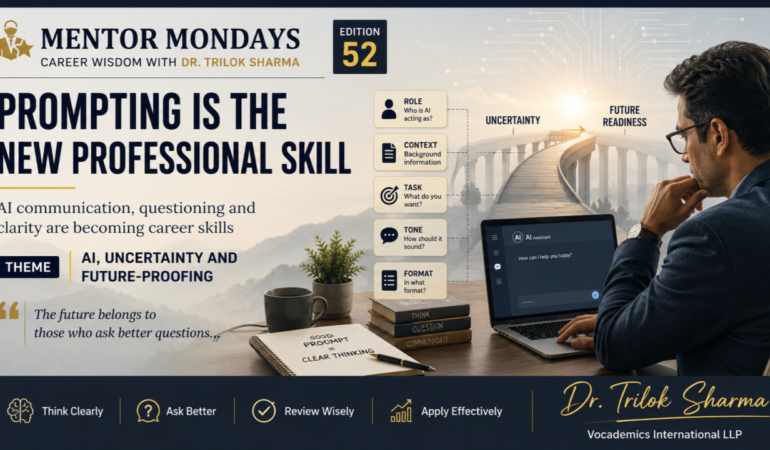
The Five-Part Prompting Habit
Professionals do not need complicated formulas to begin. They can start with a simple five-part habit.
1. Give the Role
Tell AI what role it should play. Example: “Act as a career mentor…” “Act as an HR interviewer…” “Act as a business consultant…” “Act as a communication coach…”
2. Give the Context
Explain the situation briefly.
Who are you? What is the problem? What is the audience? What is the background?
Without context, AI gives generic advice. With context, AI becomes more useful.
3. Give the Task
Say exactly what you want.
Do you want a draft, summary, comparison, checklist, plan, table, email, caption, speech, framework or analysis?
Clarity saves time.
4. Give the Tone
Mention the emotional and professional tone.
Formal. Warm. Simple. Persuasive. Academic. Conversational. Motivational. Crisp. Empathetic.
Tone is not decoration. Tone decides connection.
5. Give the Format
Ask for the output in the form you need.
Bullet points. Table. LinkedIn post. Email draft. 30-day plan. Interview answer. One-page note. Presentation outline.
A useful answer is not only correct, it must also be usable.
Prompting and Career Future-Proofing

In the AI age, every professional must become a better communicator.
Not only with people. But also with intelligent tools.
This does not mean we should become dependent on AI. It means we should learn to work with AI intelligently.
The future will need professionals who can:
- define problems clearly
- ask sharp questions
- give proper context
- verify information
- improve drafts
- connect AI output with human reality
- communicate with judgment
- protect ethics, originality and responsibility
This is why prompting is not a small trick, it is a career skill.
It teaches us to think before asking. It teaches us to clarify before acting. It teaches us to review before accepting. It teaches us to communicate with purpose.
A Mentor’s Note
Dear young professionals, students, teachers, managers and career seekers, do not fear AI, but do not worship it blindly either.
Treat it as a powerful assistant, not as your replacement. Your future value will not come from typing faster. It will come from thinking deeper.
AI may give you information. But you must bring wisdom.
AI may give you options. But you must bring judgment.
AI may help you write. But you must know what is worth saying.
So, start learning prompting today.
Not as a fashionable AI word. But as a discipline of clarity.
Because in the future workplace, the person who knows how to ask will often know how to lead. And sometimes, the best career skill is not having all the answers, it is learning how to ask the right question.
Prompting is not just an AI skill. It is the new language of professional clarity.
Need career clarity in the age of AI? Explore structured guidance, career counselling and future-readiness support at: https://vocademics.edumilestones.com