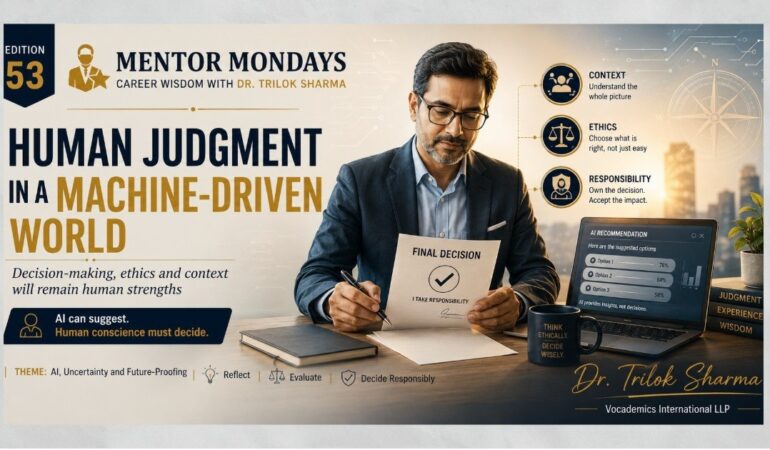
Why Decision-Making, Ethics and Context Will Remain Human Strengths

We are entering a world where machines can write, calculate, analyze, predict, summarize and even advise.
- AI can prepare reports.
- AI can compare resumes.
- AI can draft emails.
- AI can analyze data.
- AI can suggest decisions.
But here is the important question: Can AI take responsibility for the decision?
The answer is no.
And that is why human judgment will remain one of the most important professional skills in the AI age. AI may become faster than us. AI may become more informed than us. AI may process more data than us. But AI does not carry human responsibility. It does not understand consequences in the way a parent, teacher, doctor, manager, judge, entrepreneur, mentor or leader understands them.
A machine can suggest – A human must decide.
AI Can Process, Humans Must Interpret.
In professional life, decisions are rarely based only on data.
- A hiring decision is not only about qualifications. It is also about potential, attitude, team fit and growth possibility.
- A promotion decision is not only about performance numbers. It is also about consistency, responsibility, trust and leadership readiness.
- A business decision is not only about profit. It is also about timing, reputation, risk, ethics and people.
- A career decision is not only about salary. It is also about meaning, family, health, learning, stability and long-term growth.
This is where human judgment becomes important.
- AI can give options, but humans understand situations.
- AI can give patterns, but humans understand pain.
- AI can give probability, but humans understand priority.
- AI can give answers, but humans must ask: “Is this right?” “Is this fair?” “Is this practical?” “Is this humane?” “Is this suitable for this person, this family, this company, this society?”
That final layer of understanding is judgment.

The Danger of Outsourcing Thinking
One of the biggest risks of AI is not that machines will think too much. The bigger risk is that humans may start thinking too little.
When AI gives a polished answer, we may feel satisfied too quickly. When AI gives a confident recommendation, we may stop questioning. When AI gives a smart-looking report, we may forget to check ground reality.
This is dangerous, because:
- A well-written answer is not always a wise answer.
- A fast answer is not always a fair answer.
- A data-based answer is not always a complete answer.
- A machine-generated answer is not automatically a responsible answer.
In the AI age, professionals must develop a new habit: Do not outsource your judgment.
Use AI. Consult AI. Learn from AI. Take help from AI. But do not surrender your thinking.

Three Human Strengths AI Cannot Replace Easily
1. Context
AI can analyze what is given to it. But human beings understand the hidden background.
We know the tone of a meeting. We understand family pressure. We sense fear behind silence. We recognize when someone is technically correct but emotionally broken. We understand local realities, cultural meanings and personal histories.
Context is not always written in the file.
Sometimes context lives in memory, relationship, observation and experience.
That is why teachers, counsellors, mentors, managers and leaders cannot depend only on AI output. They must bring lived understanding.
2. Ethics
AI can tell us what is possible, but humans must decide what is right.
Just because something can be done does not mean it should be done.

- Can AI screen candidates? Yes. But can it be biased? Also yes.
- Can AI generate marketing content? Yes. But can it mislead people? Also yes.
- Can AI track employee productivity? Yes. But can it damage trust? Also yes.
- Can AI create academic content? Yes. But can it weaken originality? Also yes.
Ethics is the courage to ask uncomfortable questions.
Is this fair? Is this transparent? Is this respectful? Is this harming someone silently? Is this legal but still morally questionable?
Machines do not feel moral discomfort…Humans must.
3. Decision Responsibility
A decision is not complete when it is selected.
A decision is complete when someone owns its consequences.
- If a student chooses a career wrongly, a family suffers.
- If a company hires wrongly, a team suffers.
- If a hospital system recommends wrongly, a patient suffers.
- If a leader cuts jobs blindly, households suffer.
- If a government policy ignores ground reality, citizens suffer.
Responsibility is not a button. It is a moral burden. And that burden must remain on human.
The New Professional Skill: AI-Assisted Judgment
The future professional should not reject AI. That would be foolish.
But the future professional should not blindly obey AI either. That would be dangerous.
The real skill is AI-assisted judgment.
It means:
- using AI to gather information
- using AI to generate options
- using AI to compare possibilities
- using AI to challenge assumptions
- using AI to prepare drafts
- but using human wisdom to make the final decision
This is the balance we need.
- AI as assistant. Human as accountable decision-maker.
- AI as support. Human as conscience.
- AI as speed. Human as direction.

A Simple Human Judgment Checklist
Before accepting an AI-generated answer, ask these seven questions:
- Is this factually correct?
- Is the context complete?
- Is this ethical?
- Is it fair to all affected people?
- Is it practical in real life?
- What could go wrong if I follow this?
- Am I ready to take responsibility for this decision?
This checklist may look simple.
But in uncertain times, simple questions often protect us from big mistakes.
A Mentor’s Note
Dear students, professionals, teachers, managers and leaders,
AI will become part of your work. There is no point denying it.
But please remember:
Your career value will not come only from using AI tools.
It will come from your ability to think clearly, judge wisely and act responsibly.
Machines may become intelligent. But professionals must remain wise.
Machines may become fast. But leaders must remain fair.
Machines may become powerful. But humans must remain accountable.
In the coming years, the most respected professionals will not be those who blindly follow technology.
They will be those who use technology with maturity.
They will know when to ask AI. They will know when to question AI. They will know when to reject AI. And most importantly, they will know when to stand by a decision.
Because in a machine-driven world, human judgment will not become outdated.
It will become priceless.
AI can suggest. Human conscience must decide.
Need career clarity in the age of AI? Explore structured guidance, career counselling and future-readiness support at: https://vocademics.edumilestones.com