
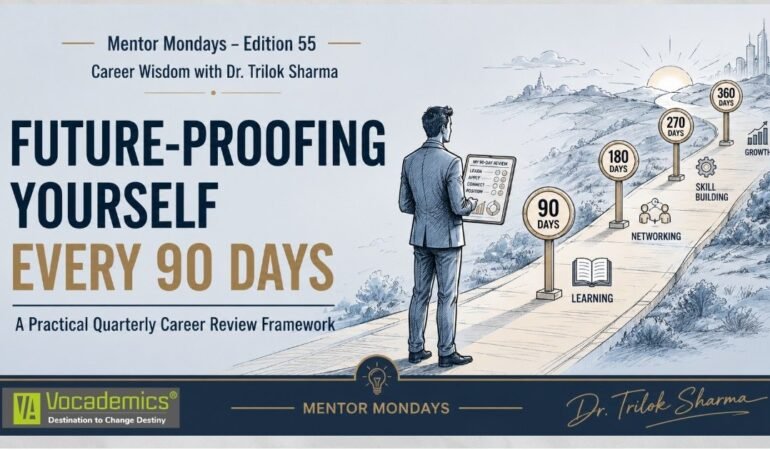
A Quarterly Career Review Framework for Staying Relevant
Your future is not protected by what you achieved yesterday. It is protected by what you choose to learn, build, and become today.- Dr. Trilok Sharma
Most professionals conduct a performance review once a year.
Unfortunately, the world no longer changes once a year.
Technology evolves every few months. Industries transform rapidly. New skills emerge. Old skills lose relevance. Business models shift. Customer expectations change.
Yet many professionals continue to operate with an outdated assumption:
“If I keep working hard, my career will automatically move forward.”
Hard work remains important.
But today, hard work without periodic reinvention can quietly lead to stagnation.
The professionals who thrive in the coming decade will not necessarily be the most intelligent, the most experienced, or even the most qualified.
They will be the ones who consistently adapt.
That is why I encourage professionals to adopt a simple habit:
Conduct a personal career review every 90 days.
Not every year.
Every quarter.
Because career growth is no longer an annual event. It is a continuous process.

Why Every 90 Days?
Think about how much can change in three months.
A new technology enters your industry.
A competitor launches a disruptive product.
A new leadership team arrives.
Customer expectations shift.
A skill that was considered advanced six months ago becomes a basic expectation.
Three months is long enough to make meaningful progress.
At the same time, it is short enough to correct mistakes before they become expensive.
Organizations conduct quarterly business reviews because markets move quickly.
Professionals should do the same for their careers.
If companies need quarterly reviews to remain competitive, individuals need them to remain employable.
The Biggest Career Risk Today
Many people believe their biggest career risk is losing a job.
I disagree.
The biggest risk is becoming professionally outdated without realizing it.
Career decline rarely happens suddenly.
It usually happens quietly.
One year without learning.
A few years without meaningful networking.
Several years relying on old expertise.
Gradually, the market moves forward while the individual stays where they are.
Experience remains valuable.
But experience without evolution eventually becomes history.
The question is not:
“How many years of experience do I have?”
The more important question is:
“How relevant is my experience today?”

The 90-Day Career Review Framework
Every quarter, review yourself in four areas:
Learn
Apply
Connect
Position
These four dimensions create a practical system for long-term career relevance.
1. LEARN
What Have You Learned During the Last 90 Days?
Learning is no longer a phase of life.
It is a permanent professional responsibility.

Ask yourself:
- What new skill have I learned?
- What industry trend do I understand better today?
- What book, course, certification, podcast, workshop, or project expanded my thinking?
- What knowledge will make me more valuable in the next three years?
Many professionals proudly discuss what they learned ten years ago.
Future-ready professionals can explain what they learned during the last ten weeks.
Continuous learning is no longer a competitive advantage.
It is becoming a survival skill.
2. APPLY
What Have You Actually Used?
Learning creates potential.
Application creates value.
Many people consume endless content but never convert knowledge into capability.
Ask yourself:
- Which new skill have I applied?
- What process have I improved?
- What problem have I solved differently?
- What measurable result was created because I learned something new?
Reading about leadership does not develop leadership.
Leading people does.
Studying communication does not improve communication.
Practicing communication does.
The market rewards demonstrated capability, not accumulated information.
3. CONNECT
Who Knows You and Trusts You?
Career opportunities often arrive through relationships before they appear through job portals.
Networking is frequently misunderstood.
It is not about collecting contacts.
It is about building credibility and trust.

Every 90 days ask:
- Which professional relationships have I strengthened?
- Which former colleagues have I reconnected with?
- Which industry conversations have I participated in?
- Who have I helped without expecting immediate returns?
Relationships compound over time just like investments.
Many career opportunities emerge not because someone was searching for a job, but because someone remembered them when an opportunity appeared.
Your network is not merely a list of contacts.
It is your professional ecosystem.
4. POSITION
Can Others Clearly See Your Growth?
One of the most common career mistakes is invisible excellence.
Many professionals do excellent work.
Very few communicate it effectively.
Ask yourself:
- Have I updated my LinkedIn profile recently?
- Have I shared meaningful insights?
- Have I documented my achievements?
- Can someone easily understand my expertise?
Visibility is not self-promotion.
Visibility is clarity.
If people cannot understand your value, they cannot recommend you, hire you, promote you, or collaborate with you.
The objective is not to become famous.
The objective is to become discoverable.
The Quarterly Career Scorecard
At the end of every 90 days, rate yourself from 1 to 10.
Area
Score
Learning ___ /10
Application ___ /10
Networking ___ /10
Positioning ___ /10
Total Score: ___ /40
Track your score every quarter.
Do not compare yourself with others.
Compare yourself with the person you were 90 days ago.
Small improvements repeated consistently create extraordinary results over time.
A Simple Rule for the Next Decade
If every 90 days you:
✔ Learn one meaningful thing
✔ Apply one new capability
✔ Strengthen a few professional relationships
✔ Improve your professional visibility
You will remain ahead of most professionals.
Not because you are working harder.
But because you are evolving faster.

Final Reflection
The future cannot be predicted perfectly.
But it can be prepared for consistently.
Career security no longer comes from a designation.
It no longer comes from a degree earned years ago.
It no longer comes from staying in the same organization for decades.
Career security now comes from adaptability.
And adaptability is built through small, regular upgrades.
So before the next quarter begins, ask yourself one simple question:
“If my industry changes tomorrow, how prepared am I today?”
Then schedule a meeting with the most important person responsible for your career -“Yourself”
Because the most successful professionals are not those who resist change.
They are the ones who review, learn, adapt, and grow—every 90 days.