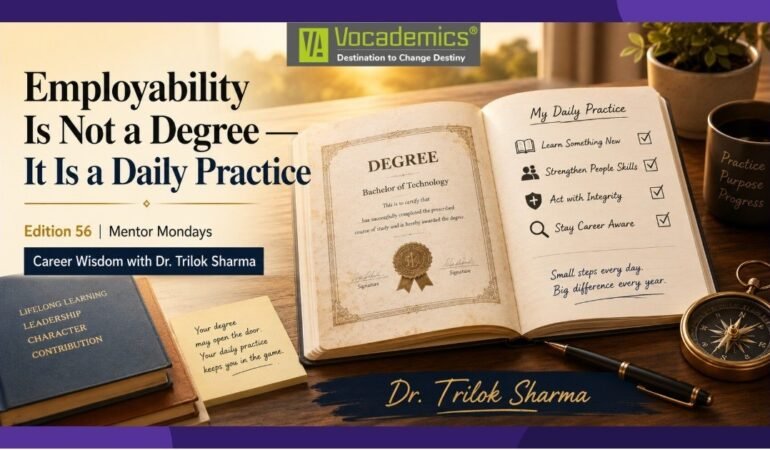
Your degree is history, your practice is your future. – Dr. Trilok Sharma
Dear Thinking Professional,
Your degree may have opened the first door. But it will not keep every future door open.
This is the uncomfortable truth of today’s workplace: employability is no longer something we earn once and preserve forever. It is something we practise, renew, and prove every day.
For decades, we told young people:
Get a degree. Get a job. You are set for life.
That idea was never fully true. But today, it is dangerously outdated.
Let me say it directly: Your degree is not your employability. Your daily practice is.

A degree is evidence that you studied something at a particular stage of life. Employability is evidence that you are still learning, still adapting, still solving problems, and still adding value.
A degree is a milestone. Employability is movement. And movement has to continue.
The Big Lie We Believed
We were trained to think of careers like fixed ladders. Study well. Get a qualification. Enter a good organization. Work hard. Move upward. Retire respectfully.
That model still has emotional appeal, but the world of work has changed.

This is not a small shift. It is a complete rewiring of how we must think about careers.
The question is no longer only: “What qualification do I have?”
The better question is: “What value can I create today?”
The Five Pillars of Daily Employability Practice
Employability is not one skill. It is a combination of habits, abilities, attitudes, and awareness.
In today’s workplace, I see five pillars that every professional must strengthen consistently.
Not once a year.
Not only before an interview.
Not only when a job is at risk.
Every day.
Pillar 1: Skill Currency
Your technical skills have a shelf life.
This is difficult to accept, especially when we have worked hard to acquire those skills. But every professional must understand one truth: skills expire when they are not updated.
A tool that was powerful five years ago may be basic today. A method that was respected ten years ago may be inefficient now. A qualification that once made you stand out may now be common.
Recent global employer research, including the World Economic Forum’s Future of Jobs Report 2025, points toward a changing skill landscape. Skills connected with AI, data, cybersecurity, digital fluency, analytical thinking, and technological literacy are becoming increasingly important across many sectors.
This does not mean every person must become a coder. It means every person must become skill-aware.
You must know which skills are rising in your field, which skills are becoming ordinary, and which skills are slowly becoming irrelevant.
Daily Practice: Spend at least 30 minutes a day strengthening one current skill.
It could be data analysis. It could be AI tool usage. It could be writing better prompts. It could be project management. It could be automation. It could be digital communication. It could be learning how your industry is changing.
The skill does not matter as much as the habit.
Your salary is not a reward for your degree. It is a reward for the problems you can solve today.
Pillar 2: Human Capability
Technology can make you faster. But humanity makes you trusted.
AI can write, analyze, summarize, predict, and automate. It can support our work in powerful ways. But there are still areas where human capability remains central.
AI cannot build genuine trust in a team. AI cannot take moral responsibility for a decision. AI cannot show real empathy to a distressed colleague. AI cannot inspire people through lived experience. AI cannot understand the silent emotional climate of a workplace the way a sensitive leader can.
This is why human capability is not becoming less important. It is becoming more visible.
Communication, emotional intelligence, accountability, collaboration, resilience, ethical judgment, and respect for others are no longer “soft” skills in the weak sense. They are survival skills.
In many workplaces, people do not fail only because they lack technical knowledge. They fail because they cannot communicate clearly, handle feedback, manage conflict, collaborate with maturity, or take responsibility.

Daily Practice: Every day, practise one human skill consciously.
Listen without interrupting. Respond instead of reacting. Give credit where it is due. Accept feedback without defensiveness. Help one person without expecting immediate return. Take responsibility without excuses.
AI may make you efficient. But humanity makes you indispensable.
Pillar 3: Learning Agility
The World Economic Forum’s Future of Jobs Report 2025 notes that employers expect 39% of workers’ core skills to change by 2030.
That is not a distant warning. That is already happening.
The professionals who will thrive are not necessarily those who know the most today. They are those who can learn, unlearn, and relearn faster.
Learning agility has three simple steps:
- Unlearn: Let go of outdated methods, assumptions, and ego.
- Learn: Absorb new tools, concepts, frameworks, and perspectives.
- Relearn: Apply new learning in real work until it becomes useful.
Many professionals are willing to learn. Fewer are willing to unlearn.
That is where the real difficulty lies.
Because unlearning often hurts the ego. It forces us to admit that what once worked may no longer be enough. It asks us to move from comfort to curiosity.
But without unlearning, learning becomes decoration.
Daily Practice: Read one useful article. Watch one short tutorial. Study one job description in your field. Ask one intelligent question. Reflect on one mistake. Learn one small thing that makes tomorrow better than today.
No day without learning. Small learning, repeated daily, becomes career strength.
Pillar 4: Work Integrity
Your character is your most portable career asset. Skills may get you noticed. Integrity makes you trusted.
In every organization, people quietly observe who can be relied upon. They notice who shows up on time, who delivers what they promise, who takes responsibility, who speaks respectfully, who handles pressure with dignity, and who does the right thing even when no one is watching.
Employability is not only about being skilled. It is also about being dependable.
A brilliant but unreliable person creates risk. A talented but arrogant person creates friction. A capable but dishonest person destroys trust.
Work integrity is built through small daily acts.
Keeping commitments. Owning mistakes. Respecting deadlines. Being honest about limitations. Not blaming others casually. Treating juniors, peers, and seniors with equal dignity.

Daily Practice: At the end of each working day, ask yourself:
Did I bring my best self to work today?
Did I act with honesty and ownership?
Did I add value or simply pass time?
Did someone trust me more because of how I behaved today?
Your resume may speak before the interview.
But your integrity speaks after people work with you.
Pillar 5: Career Awareness
You cannot navigate a map you have not looked at.
Yet many professionals spend more time planning a weekend trip than planning their career.
Career awareness means knowing what is happening around you.
Where is your industry moving?
Which roles are growing?
Which skills are being demanded repeatedly?
Which technologies are entering your profession?
Who are the people worth learning from?
What kind of work gives you energy?
What kind of work is slowly becoming unsuitable for you?
What is your next possible move?
A person without career awareness becomes dependent on chance.
A person with career awareness makes better choices.
Career awareness does not mean anxiety. It means alertness.
It does not mean changing jobs every year. It means understanding where you stand and where the world is moving.
Daily Practice: Spend 10 minutes a day scanning your professional environment.
Read LinkedIn posts from thoughtful professionals. Look at job descriptions in your field. Notice recurring skills in vacancies. Follow industry reports. Observe what clients, employers, and students are asking for. Speak to mentors and peers. Stay curious.
Do not wait for a crisis to understand your career.
The Daily Employability Checklist : Print this. Pin it above your desk. Or simply write it in your notebook. Tick one box every day.

This checklist is not meant to create pressure. It is meant to create direction. You do not need to transform your career in one day. You only need to stop neglecting it daily.

The Career Audit Card
Once a week, sit quietly with yourself. No audience. No performance. No self-deception.
Ask these six questions:
- What new skill did I learn this week?
- What feedback did I receive, and what did I do with it?
- Did I solve a problem or merely complete a task?
- Did I help someone grow this week?
- What is one thing I could have done better?
- Am I more valuable today than I was last Monday?
The last question is the most important. If you cannot answer it with a quiet “yes,” do not panic. Just begin again.
Employability does not disappear in one week. But it weakens slowly when we stop growing. It strengthens again when we return to daily practice.
Your Personal Career Dashboard
Imagine your career like a car dashboard.

You do not wait for the engine to fail before checking the fuel. You do not ignore a warning light for months. You do not drive confidently with no idea of speed, direction, or balance.
Your career also has gauges.
Skill Fuel: Are your technical skills current? Human EQ: Are your people skills strong? Learning Speed: Are you adapting fast enough? Integrity Compass: Are you trusted? Career Awareness: Do you know where you are going?
Rate yourself honestly on each gauge.
Not to impress anyone.
Only to understand yourself.
Maybe your Skill Fuel is strong, but your Human EQ needs attention.
Maybe your Integrity Compass is steady, but your Career Awareness is low.
Maybe you are hardworking, but not learning fast enough.
Maybe you are experienced, but repeating the same year again and again.
That honest diagnosis is the beginning of growth.
A Gentle Truth From Your Mentor
Your degree opened a door.
Respect it.
Be grateful for it.
But do not worship it.
The world does not owe us lifelong relevance because we studied well once. The workplace rewards those who continue to become useful.
The people who will thrive in the next five years are not necessarily those with the longest resumes or the most impressive titles.
They are the ones who wake up and ask:
“What can I learn today that makes me more useful tomorrow?”
Employability is not a destination. – it is a direction.
And that direction is chosen every day through small, repeated practices.
Reflection Question for This Week
Ask yourself honestly:
“If I lost my current job today, would my skills get me a better one tomorrow?”
If the answer is yes, continue strengthening your edge.
If the answer is no, do not feel defeated. Feel awakened.
Then ask the next question:
“What will I start doing today?”
Write your answer. Do not just think it. Writing makes it real.
Five Actions for This Monday
- Choose one skill to strengthen this week.
- Practise one human capability consciously every day.
- Spend 10 minutes daily observing where your industry is moving.
- Complete your weekly Career Audit Card.
- Pick your weakest career gauge and move it one step forward.
Do not wait for the annual appraisal. Do not wait for the next interview. Do not wait for a career shock. Start today!
Repost it to help someone in your network.
Share your answer to the reflection question in the comments.
Subscribe to Mentor Mondays so you never miss an edition.