
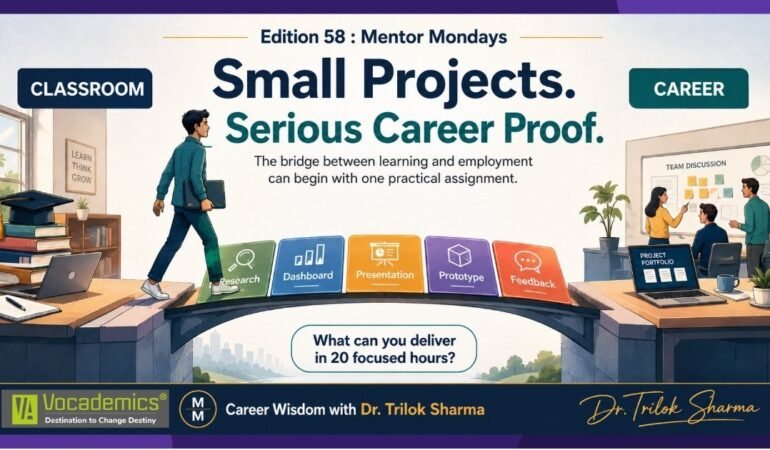
Small Projects – Serious Career Proof!
The bridge between learning and employment can begin with one practical assignment – Dr. Trilok Sharma
If an employer gave you 20 hours and one real problem, what could you deliver?
Last week, we discussed the importance of building evidence before you need it.
But that raises an important question: Where does career evidence come from when you have not yet received your first major opportunity?
Many students believe that experience begins only after they secure a formal internship or full-time job. Until then, they keep collecting courses, certificates and qualifications.
Learning is valuable. But employers eventually want to know:
What have you done with what you have learned?
This is where micro-internships and mini-projects can change the early-career journey.
The Experience Problem
Students often find themselves trapped in a frustrating cycle:
“I need experience to get an opportunity, but I need an opportunity to gain experience.”
Traditional internships remain valuable, but they may involve limited positions, fixed recruitment periods, location restrictions and lengthy selection processes. Students who cannot secure one may feel that their career development has stopped.
It has not.
Experience does not always have to begin with a two-month internship in a large organization. It can begin with a short, carefully defined assignment completed for a startup, small business, NGO, professor, community organization or working professional.
A micro-internship is generally a short-term professional project. On the Parker Dewey platform, for example, these assignments typically involve approximately 10 to 40 hours of work and resemble tasks given to interns or entry-level employees.
The idea is simple:
Give a student a real problem, a clear output, a deadline and professional feedback.
That small experience can become the first bridge between academic knowledge and workplace contribution.
Micro-Internship or Mini-Project?
The terms are related, but they should not be used carelessly.
A micro-internship is usually assigned by an organization or professional. It involves genuine work, a defined deliverable and interaction with a workplace stakeholder. Ideally, it should also be paid.
A mini-project may be initiated by the student, designed by a faculty member or completed as a practical simulation. It may not involve formal employment, but it can still demonstrate competence when it addresses a realistic problem and produces a visible result.
Students should represent both honestly.
Do not describe a self-created assignment as an internship. Instead, present it as an:
- Independent project
- Faculty-guided project
- Client project
- Community project
- Applied academic project
- Professional simulation
Credibility begins with accurate communication.

From Classroom Knowledge to Career Evidence
India’s UGC internship guidelines emphasize the integration of classroom, workshop and laboratory learning with actual workplaces, including businesses, startups, NGOs, research organisations and local enterprises. The guidelines also recognise that graduates frequently struggle because they lack practical skills and experience expected in recruitment.
The solution is not to abandon classroom learning.
The solution is to complete the learning cycle:
Learn → Do → Document → Demonstrate
Learn: Understand a concept, method or tool.
Do: Apply it to a specific problem.
Document: Record your process, decisions and results.
Demonstrate: Explain the work confidently to another person.
A student who has merely studied market research may struggle to explain the subject during an interview.
A student who has surveyed 50 customers, analysed their responses and prepared a three-page recommendation note has a career story.
The difference is not always knowledge.
The difference is application.
What Can a Student Actually Do?
A mini-project does not need to be large or glamorous. It needs to be useful, complete and explainable.
A management student could:
- Conduct a competitor analysis for a local business.
- Prepare a customer-feedback questionnaire.
- Design an employee-onboarding checklist.
- Create a simple sales or expense dashboard.
- Map the customer journey of a small service company.
- Develop a social-media content calendar.
- Document a basic operating procedure.
- Analyse publicly available industry data.
- Prepare a recruitment or training communication kit.
An engineering student could:
- Redesign a workflow.
- Study the causes of a recurring production problem.
- Create a preventive-maintenance checklist.
- Prepare a technical explainer for non-technical users.
- Develop and test a small prototype.
- Conduct a product or process comparison.
- Document safety or quality-improvement suggestions.
A commerce student could:
- Categorize expenses for a small enterprise.
- Create an inventory-control sheet.
- Prepare a basic cash-flow forecast.
- Study pricing patterns.
- Analyze financial ratios from published reports.
- Design a simple invoice or payment-tracking system.
The objective is not to pretend to be an experienced consultant.
The objective is to practice solving a bounded problem professionally.

The Mini-Project Quality Checklist
Before accepting or starting a project, ask six questions:
1. Is there a real problem?
“Learn digital marketing” is not a project.
“Prepare a four-week Instagram content plan for a neighbourhood café” is a project.
2. Is the output clearly defined?
The final output could be a report, presentation, dashboard, process map, prototype, training module, research brief or recommendation note.
3. Is there a deadline?
Open-ended projects are frequently abandoned. A short deadline creates seriousness and momentum.
4. Is someone expecting the result?
Accountability improves quality. The stakeholder may be a business owner, professor, mentor, department head or community leader.
5. Will you receive feedback?
Feedback turns activity into learning.
6. Can you explain what you contributed?
A project becomes career evidence only when you can describe your decisions, challenges, contribution and learning.

Build a Proof-of-Work Audit Card
After completing every project, create a one-page record containing:
Problem: What needed to be solved?
Context: Who was affected and why did it matter?
Deliverable: What exactly did you produce?
Skills Used: Which technical and human skills did you apply?
Tools Used: Which software, research methods or frameworks helped you?
Feedback: What did the stakeholder say?
Improvement: What did you change after receiving feedback?
Result: What became clearer, faster, easier or more useful?
Reflection: What would you do differently next time?
This record can later become a portfolio page, interview answer, LinkedIn post or résumé bullet.
Do not merely write:
“Good knowledge of Excel.”
Write:
“Created a sales dashboard from three months of transaction data, identified the highest-performing product categories and presented the findings to the business owner.”
The second statement gives the employer something to evaluate.

A Seven-Day Mini-Project Sprint
Students who are waiting for experience can begin with a simple seven-day challenge.
Day 1: Select one problem
Choose a problem connected to your preferred career direction.
Day 2: Define the deliverable
Decide exactly what you will submit and to whom.
Days 3–5: Complete the work
Research, analyze, design, test and document your decisions.
Day 6: Request feedback
Ask one knowledgeable person to review the work.
Day 7: Improve and record
Revise the output and prepare your proof-of-work audit card.
Seven days may not make you an expert.
But seven focused days can produce more career evidence than another month of passive intention.

How to Find Micro-Opportunities
Do not begin by asking:
“Can you give me an internship?”
That request places the entire responsibility on the other person.
Instead, make a project-first proposal:
“I am studying marketing and want to develop practical experience in customer research. I can prepare a short competitor and customer-review analysis for your business within ten days. The final deliverable will be a concise presentation with observations and recommendations. May I undertake this as a small learning project and request fifteen minutes of feedback after completion?”
This approach shows preparation, clarity and respect for the professional’s time.
Possible project sources include:
- Local businesses
- Startups
- NGOs and community organizations
- Faculty members
- Alumni
- Professional associations
- Campus departments and student clubs
- Family enterprises
- Research centers
- Independent professionals
Start close to where you are.
Your first practical opportunity may not come from a famous company. It may come from someone who trusts you with one small but meaningful responsibility.
Protect Your Professional Integrity
Micro-opportunities should not become an excuse for organizations to obtain endless unpaid labor.
Before beginning, clarify:
- The scope of work
- Expected hours
- Deadline
- Ownership of the output
- Confidentiality requirements
- Payment or other agreed recognition
- Availability of feedback or a testimonial
NACE has specifically highlighted the equity problems associated with unpaid internships and supports paid internship opportunities.
Students should be open to learning, but they should also learn to recognise boundaries.
Professional experience must build confidence—not exploitation.
The New Career Question
The world of work is changing quickly, and employers are reassessing the skills people will need as technology transforms roles and responsibilities.
In this environment, students cannot depend entirely on qualifications to communicate readiness.
The new career question is becoming:
Can you show me how you think, work, communicate and improve?
Micro-internships and mini-projects help answer that question.
They provide students with more than a line on a résumé. They create:
- A work sample
- A professional conversation
- A feedback experience
- A clearer career preference
- A stronger interview example
- A potential mentor or reference
- Greater confidence in applying knowledge
One small assignment may not transform your career immediately.
But five or six well-chosen projects can transform the way you understand yourself—and the way employers understand your potential.
This Monday’s Career Challenge
Choose one skill that you claim on your résumé.
Now design a small project that proves it.
Do not wait for a perfect internship, a prestigious organization or the end of your degree.
Find one problem.
Produce one useful result.
Ask for one piece of feedback.
Document one career story.
Because your career does not begin when someone finally gives you a job.
It begins when you start using your knowledge to create value.