
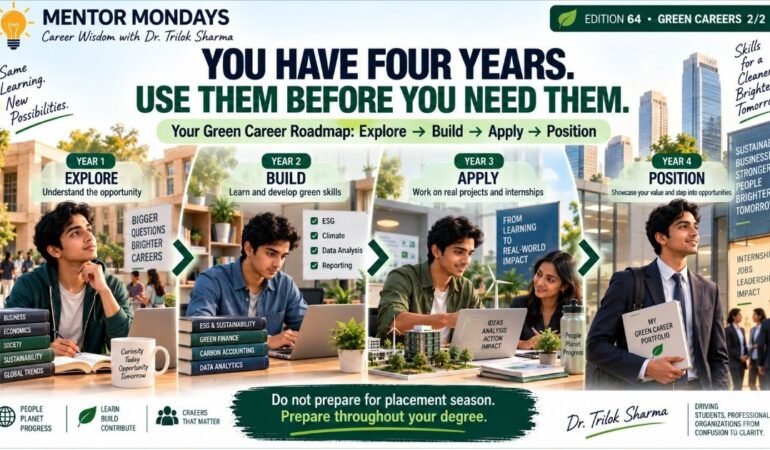
You have four years, use them before you need them
Last Monday, we discussed an important career shift: “Green careers are not limited to people working in forests, solar plants or environmental laboratories.”
- Finance is becoming greener.
- Accounting is becoming greener.
- Investment is becoming greener.
- Supply chains are becoming greener.
- Business reporting is becoming greener.
The question therefore is no longer: “Should I change my degree?”
The better question is: “How can I make my existing degree future-ready?”
If you have just entered a four-year B. Com. (Hons.) or BBA (Hons.) program, you have a valuable career asset that students often underestimate four years of preparation time.

Let us use them deliberately:
- Year 1 Target: Become Green-Aware.
- Year 2 target: Become Green-Skilled.
- Year 3 target: Become Green-Experienced.
- Year 4 target: Become Green-Ready.
YEAR 1 – EXPLORE
Objective: Understand the landscape before choosing a destination.
Do not rush into expensive certifications. First understand the vocabulary. Learn the basics of:
- Climate change
- Sustainability
- SDGs
- ESG
- Circular economy
- Renewable energy
- Carbon emissions
- Sustainable business
Start reading the sustainability reports of companies you already recognize, for example: – Tata, Reliance, Infosys, HDFC Bank, ITC, Mahindra and so on.
Ask simple questions:
- What environmental goals have they declared?
- What are they measuring?
- What are they reducing?
- What are they reporting?
At the same time, strengthen Excel, presentation, research and written communication skills.
These may sound ordinary, but they are not.
A sustainability professional who cannot analyze data or communicate findings will remain limited.
YEAR 2 : BUILD
Now choose one or two areas that genuinely interest you.
Perhaps: ESG & Sustainability, Green Finance, Carbon Accounting, Sustainability Reporting, Climate Risk, Sustainable Supply Chain, Circular Economy.

Start building actual knowledge. There are credible entry points available online.
The IFRS Foundation, for example, currently provides free self-paced learning modules on IFRS S1 and IFRS S2 sustainability disclosure standards, including certificates of completion.
The Greenhouse Gas Protocol offers a free Corporate Standard recorded program as an entry point into organizational greenhouse-gas accounting.
Students interested in reporting can explore GRI learning programs; GRI currently offers a student discount on its Academy courses and certification examination.
Again: do not try to complete everything. Choose direction before certification.
YEAR 3 -APPLY
This is where many students make a mistake. They continue learning. But they never demonstrate that learning. Now start producing evidence.

You could:
- Analyze the sustainability report of one listed company.
- Compare the ESG disclosures of two competing companies.
- Conduct a simple carbon-footprint exercise for a college activity.
- Study the sustainability practices of a local MSME.
- Create an Excel or Power BI sustainability dashboard.
- Prepare a sustainable procurement proposal.
- Study how a company reports Scope 1, Scope 2 and Scope 3 emissions.
- Write a short green-finance investment analysis.
You do not need permission from a large company to begin learning.

Your college, neighborhood, family business, NGO or local enterprise can become your laboratory.
The project need not be big. It needs to be real. Then start documenting your work.
Not: “I am passionate about sustainability.”
Instead: “I analyzed three years of sustainability disclosures of two companies and identified five differences in their reporting.”
That is proof.
YEAR 4 -POSITION
This is the year to connect everything. Now you should be asking:
What roles am I actually preparing for?
Search job platforms using terms such as:
- ESG Analyst
- Sustainability Analyst
- Carbon Analyst Sustainability
- Reporting Green Finance
- Climate Risk
- Responsible Investment
- ESG Research
- Sustainable Procurement
- Impact Analyst
- Sustainability Consulting
Study ten job descriptions. Do not immediately apply:
- First identify which skills employers repeatedly ask for.
- Then compare those requirements with your own profile.
- Complete one serious internship.
- Refine your LinkedIn profile.
- Create a small Green Career Portfolio.
- Tailor your resume.
- Reach out to professionals already working in your chosen area.
If sustainable investing particularly interests you, programs such as the CFA Institute’s Sustainable Investing Certificate are available without formal prerequisites, although investment knowledge is useful.
Specialized programs can come later. The objective in Year 4 is not to become an expert in everything. It is to become: Recognizably employable in something.

Your Four-Year Transformation

Students on a regular three-year graduation program can follow the same framework by combining the third and fourth stages during their final year.
The 30-Day Green Career Starter Challenge
You do not need to wait until next year.

During the next 30 days:
- Week 1: Learn the basic language of sustainability.
- Week 2: Download and read one corporate sustainability report.
- Week 3: Complete one introductory online learning module.
- Week 4: Create one small sustainability analysis and add it to your portfolio.
At the end of thirty days, you will still not be a sustainability professional. But you will have moved from:
“I have heard about green careers.” to “I have started preparing for one.” That difference matters.
One final mentoring thought
Students frequently ask me: “Sir, which career will be best four years from now?”
Nobody can predict that perfectly.
A better strategy is to build capabilities around problems that businesses will still need to solve, for example:
- Climate.
- Energy.
- Resources.
- Waste.
- Risk.
- Reporting.
- Responsible investment.
- Sustainable growth.
Those problems are unlikely to disappear.
So perhaps the smartest career preparation is not to chase tomorrow’s job title.
Prepare yourself to solve tomorrow’s problems.
- Your degree will tell employers what you studied.
- Your skills will tell them what you can do.
- And your portfolio will tell them whether they should believe you.