Every year, thousands of students graduate with degrees.
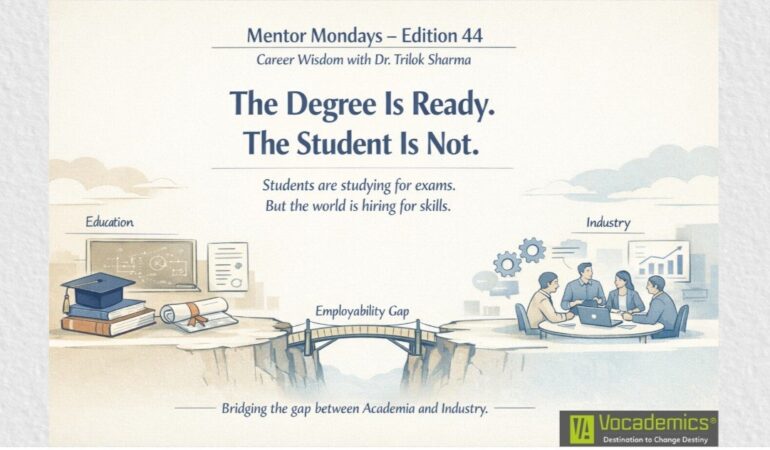
Many of them have good marks, good attendance, and good theoretical knowledge. Yet, when they enter the job market, they struggle. Not because they are not intelligent. But because the degree is ready -and the student is not.
This is not a student problem alone. This is not an institution problem alone. This is not a corporate problem alone.
This is a system problem, and unless academia and industry start working together, this gap will continue to grow.
The Education-Employability Gap
For decades, education followed a very simple model:
Study → Pass Exams → Get Degree → Get Job → Build Career
This model worked when industries were stable, technology changed slowly, and jobs were predictable.
But today the world has changed.
Today companies are not only looking for people who know things. They are looking for people who can do things.
They want people who can:
Solve problems
Communicate clearly
Work in teams
Use technology
Learn quickly
Adapt to change
Take responsibility
Think independently
Unfortunately, many students are still being trained mainly to remember and reproduce, not to understand and apply.
We taught them how to pass exams, but not how to handle work.
Traditional Education vs Modern Workplaces
Traditional education still focuses heavily on:
Syllabus completion
Theory
Written examinations
Marks
Attendance
Degrees
Modern workplaces focus on:
Problem solving
Communication
Teamwork
Technology usage
Decision making
Time management
Adaptability
Continuous learning
Accountability
In simple words:
Education is still testing memory. Industry is testing ability.
This mismatch is the root of the placement problem, the employability problem, and the fresher training problem.
The Placement Problem – Two Sides of the Same Story
When I talk to academic institutions, they say:
Companies are not coming for placements.
When I talk to companies, they say:
Students are not job-ready.
Both are right. And both are incomplete.
Institutions are producing graduates. Companies are looking for professionals.
Institutions are completing curriculum. Companies are looking for capability.
Institutions measure results in marks. Companies measure results in performance.
Between these two systems stands the student – confused, underprepared, and often frustrated.
The Real Question Education Must Ask
The most important question for education leaders today is not:
How many students passed?
What was the university result?
How many toppers did we produce?
The most important question is:
How many students are employable? How many students can solve real problems? How many students can work in real organizations?
Because life does not give question papers. Life gives situations.
Life does not test memory. Life tests judgment.
Life does not reward degrees alone. Life rewards value creation.
Bridging the Gap – Our Commitment
At Vocademics International LLP, we strongly believe that the future of education depends on collaboration between academia and industry, not on working in isolation.
We are committed to working with:
Academic institutions
Corporates
Training organizations
Placement cells
Students
To develop:
Employability skill frameworks
Industry-oriented training programs
Internship and live project models
Career assessment and skill mapping tools
Faculty development programs
Corporate–academia interaction platforms
Placement readiness programs
Communication and professional skills training
Our goal is simple:
Reduce the gap between what students learn and what the industry expects.
We are always open to collaborating with institutions and corporates who are serious about improving student employability,industry readiness, and meaningful placements.
What Academic Institutions Can Do
If institutions want better placements and better career outcomes for their students, they may need to rethink a few things:
Introduce more case studies and real-life business problems.
Make internships compulsory and meaningful, not just certificate-based.
Focus on communication, presentation, and writing skills.
Encourage students to work on live projects with local industries.
Invite industry professionals regularly for interaction.
Evaluate students on projects and problem solving, not only exams.
Start skill labs – Excel, Data, AI tools, Business Communication, Financial Literacy.
Train faculty in industry trends and practical applications.
Build long-term relationships with companies.
Measure success not only by results, but by employability.
Institutions should remember:
Their real product is not the degree. Their real product is the student.
What Corporates Can Do
Corporates also need to become active partners in education.
Instead of only saying “students are not ready,” companies can:
Provide curriculum inputs to institutions.
Offer short industry training modules.
Give live business problems as student projects.
Offer structured internships.
Conduct pre-placement training workshops.
Mentor student groups.
Create apprenticeship models.
Identify talent early instead of only during final placements.
Companies should not see students as finished products, but as potential that can be shaped.
The Future of Education
Education in the coming years will not be defined by:
How many subjects you studied
How many exams you cleared
How many degrees you collected
It will be defined by:
What problems you can solve
How fast you can learn
How well you can communicate
How you work with people
How you adapt to change
How you use technology
How you create value
The future classroom must shift from:
“What to learn” → “How to apply”
From:
Memorizing answers → Asking better questions
Completing syllabus → Building skills
Marks → Capability
Degree → Employability
Final Thought
The biggest risk today is not that students will fail in exams.
The biggest risk is that they may pass exams but fail in employability.
Education must not produce only degree holders. Education must produce thinkers, problem solvers, creators, and responsible professionals.
Because the future will not belong to those who studied the most.
The future will belong to those who can learn, adapt, and apply the fastest.
Every decade reshapes the way we work. But the coming decade may reshape it faster than any period in modern history. Artificial Intelligence is advancing rapidly. Entire industries are being redesigned. New roles are emerging even as traditional ones disappear.
According to global workforce studies, nearly 40% of the skills used in today’s jobs will change by 2030. That means the real question for professionals is no longer: “Which job should I choose?”
The real question is: “Which skills will make me valuable no matter how jobs change?”
Let us explore the answer.
The Future of Work: A Skill Transformation
The world of work is being influenced by several powerful forces:
A. Artificial Intelligence and automation
B. Digital transformation across industries
C. Climate and sustainability transitions
D. Global economic uncertainty
E. Changing demographics and workforce expectations
Together, these forces are redefining what organizations expect from professionals. But here is an interesting insight.
While technology is advancing rapidly, the most valuable skills of the future are becoming deeply human.
1. Creativity.
2. Resilience.
3. Judgment.
4. Empathy.
5. Leadership.
These are qualities that machines cannot easily replicate.
The future professional will not be defined only by technical expertise — but by a powerful combination of technology awareness and human capability.
The Core Skills of 2030
Research from global workforce studies highlights a set of skills that will become increasingly important by 2030.
Let us look at some of the most significant ones.
1. Analytical Thinking
The ability to interpret data, identify patterns, and make sound decisions will remain the most sought-after skill.
In an AI-driven world, the value lies not in data — but in interpretation.
2. Creative Thinking
Automation can process information, but innovation still requires imagination.
Creative thinkers will lead new product ideas, new business models, and new solutions to complex problems.
3. Resilience, Flexibility & Agility
Change will be constant.
The most successful professionals will not necessarily be the most knowledgeable — they will be the most adaptable.
4. Curiosity & Lifelong Learning
The traditional career model was:
Education → Job → Retirement.
The new model is:
Education → Work → Learn → Reinvent → Grow.
Professionals must become continuous learners.
5. Leadership & Social Influence
Organizations need leaders who can guide teams through uncertainty, inspire people, and build trust in complex environments.
Leadership is no longer limited to senior management — it is a career competency.
6. Motivation & Self-Awareness
In the future workplace, emotional intelligence will be as important as technical intelligence.
Understanding your strengths, motivations, and values will help professionals make better career decisions.
7. Technological Literacy
You do not need to be a programmer.
But every professional must understand how digital tools, AI systems, and data-driven technologies influence their work.
Technology literacy will soon become a basic professional requirement.
8. Empathy & Active Listening
As workplaces become more global and virtual, the ability to understand people, manage emotions, and communicate effectively will become invaluable.
Human relationships will remain the foundation of every successful organization.
9. Talent Management & Collaboration
Future workplaces will be highly collaborative.
Professionals must know how to:
• Work across cultures • Lead diverse teams • Develop and mentor talent
10. Systems Thinking
Modern challenges are interconnected.
Systems thinking helps professionals understand how different parts of a problem interact with each other — allowing better decision-making.
Emerging Skills to Watch
Alongside these core skills, several emerging competencies are gaining importance.
AI & Big Data Awareness
Understanding how AI systems function will help professionals collaborate effectively with intelligent technologies.
Cybersecurity & Digital Infrastructure
As the world becomes more digital, protecting data and systems becomes critical.
Sustainability & Environmental Literacy
Organizations are increasingly aligning with global climate goals. Professionals who understand sustainability will have an advantage.
User Experience & Design Thinking
In the digital economy, the success of products and services depends heavily on user experience.
Beyond Reskilling: The Mindset Shift
Many professionals believe the answer lies in reskilling — learning a new tool, a new software, or a new certification.
But the deeper shift is not technical; it is philosophical.
Future careers will reward those who embrace:
a) Curiosity
b) openness to change
c) growth mindset
d) self-reflection
e) lifelong learning
The goal is not simply to collect skills. The goal is to develop the ability to continuously evolve.
The Hybrid Professional
The future belongs to professionals who combine four dimensions of capability:
1. Technology Awareness
Understanding AI, data, and digital tools.
2. Cognitive Strength
Creative thinking, analytical thinking, and problem-solving.
3. Personal Resilience
Adaptability, learning agility, and emotional stability.
4. Human Intelligence
Leadership, empathy, communication, and collaboration.
This combination creates what experts call:
The Hybrid Professional
A person who works comfortably with both machines and people.
The Indian Perspective
India stands at a unique moment in history.
Our country has one of the largest young workforces in the world.
But this demographic advantage will translate into opportunity only if our workforce develops the right capabilities.
Employers across India are increasingly prioritizing:
a) Digital fluency
b) Critical thinking
c) Adaptability
d) Innovation
e) Collaboration
Educational institutions and training ecosystems must therefore focus not just on degrees, but on capabilities.
Action Steps for Future-Ready Professionals
If you want to prepare yourself for the next decade, start with these steps:
1. Become a Lifelong Learner
Make learning a continuous habit.
2. Strengthen Your Thinking Skills
Focus on problem-solving, creativity, and strategic thinking.
3. Build Emotional Intelligence
Empathy, communication, and leadership will differentiate professionals.
4. Understand Technology
Even non-technical professionals must understand how AI and digital tools affect their industries.
5. Develop Adaptability
Do not fear change — learn to navigate it.
Activity: Your Personal Skill Map
Take a moment to reflect. Draw four quadrants on a sheet of paper:
Technology | Thinking | Personal | Human
List your strengths in each area. Then ask yourself: Where are the gaps?
Those gaps represent your next learning journey.
From Dr. Trilok’s Mentor Desk
“In the coming decade, knowledge alone will not secure your career. Technology will change too quickly for that.
What will truly differentiate professionals is their ability to think clearly, learn continuously, adapt courageously, and lead with integrity.
Invest not only in skills — invest in your mindset.”
Closing Thoughts
The future of work is not a battle between humans and machines; it is a collaboration. Technology will automate tasks. But human intelligence will guide purpose.
1. Your creativity.
2. Your empathy.
3. Your judgment.
4. Your leadership.
These will define your value in the workplace of tomorrow. So, do not just prepare for your next job; prepare for the next version of yourself.
“If I ask, I might look greedy.” “If I negotiate, I might lose respect.” “If I push, I might damage the relationship.”
So we stay quiet, and then we feel undervalued.
Negotiation is not confrontation – It is clarification.
It is the courage to say: “Here is the value I bring. Let’s discuss alignment.”
I have seen brilliant students hesitate to negotiate internships. Talented executives avoid discussing compensation. Entrepreneurs underprice their work because they fear appearing “too much.”
But here is the truth:
👉 If you don’t define your value, the market will discount it.
Negotiation is not about winning over someone. It is about creating a win-win with dignity.
🧠 The 4 Principles of Asking Without Fear
1. Prepare, don’t improvise. Confidence comes from data, not emotion.
2. Separate ego from outcome. It’s a discussion — not a war.
3. Anchor with value, not demand. Say: “Based on the responsibilities and impact…” Not: “I deserve more.”
4. Be willing to walk — politely. Silence after a reasonable ask is powerful.
The irony?
The people who negotiate respectfully are often respected more. Because clarity builds trust.
Silence builds assumptions.
This week, reflect:
When did you negotiate — and win? Not just money : Time. Role clarity. Boundaries. Even expectations at home.
Negotiation is not loud, it is intentional.
And remember —
Respect doesn’t mean silence. It means honest dialogue.
If this resonated, share it with someone who needs the courage to ask.
And if you are guiding a student or professional through career decisions, structured clarity makes negotiation easier.
Not during interviews….Not during promotions. But somewhere in between — when a tempting shortcut appears perfectly justified.
The numbers make sense….The logic is convenient….The compromise feels harmless.
And yet, that moment decides far more than the outcome of a deal. It decides the direction of a career.
Ethical careers are often misunderstood as cautious or slow. In reality, they are not about rejecting ambition — they are about refusing to disconnect ambition from values.
Many professionals chase speed early on. A few choose alignment. The difference shows up later.
Why Ethics Isn’t a Soft Skill
Careers rarely derail because of incompetence. They derail when values quietly become optional.
Skills can be replaced. Credentials can be updated. But once trust is diluted, rebuilding it takes far longer than earning it did.
Over time, ethical choices compound into three forms of trust that no resume can list:
Trust of colleagues, who know where you stand
Trust of clients, who rely on consistency, not charisma
Trust of self, which brings clarity at the end of demanding days
This inner alignment is not idealism, it is professional sustainability.
When Applause Fades
Recognition is temporary by design. Markets change. Organizations restructure. Titles move on.
What remains employable — long after applause fades — is character.
Character opens doors when credentials are similar. It repairs bridges when mistakes occur. It steadies professionals during transitions, downturns, and reinvention.
In volatile careers, integrity becomes the most underrated asset.
A Lived Moment from the Field (Anonymized)
A few years ago, I worked closely with a mid-career professional—highly competent, widely trusted, and on the verge of a significant leadership role.
At a critical moment, he was informally encouraged to soften certain disclosures in a report. Nothing illegal… Nothing dramatic… Just enough ambiguity to keep stakeholders comfortable and timelines intact.
Saying yes would have accelerated his ascent. Saying no would quietly slow it down.
He chose clarity over convenience. The immediate consequence was disappointing: the role went to someone else.
What followed, however, was telling.
Within a year, during a period of organizational churn, that same professional was approached—unsolicited—for a far more responsibility-heavy role. The reason cited was not his technical brilliance, but a simple sentence from the leadership table:
“We know where he draws the line. That’s exactly who we want in uncertainty.”
Careers don’t always reward ethical choices immediately. But they remember them precisely when it matters most.
The Ethical Growth Paradox
Careers built on integrity often start slower. They say “no” more often. They wait when others rush.
But over time, they grow stronger — not louder.
The paradox is simple: What feels like restraint in the short term becomes credibility in the long term.
Fast rises without ethical grounding collapse easily…Steady growth anchored in values endures pressure.
A Mentor’s Reflection
Ethical careers are not about perfection, they are about direction.
Every professional faces ethical crossroads. The question is not whether temptation will appear — but whether your values are clear before it does.
The professionals who leave lasting impact are not those who avoided tough choices. They are the ones who chose their values over convenience, repeatedly — even when no one was watching.
Your Turn to Reflect
Before the next opportunity tests you, pause and ask:
What is one ethical line you would never cross for growth?
Write it down. Make it explicit. Protect it.
Clarity about values is not restrictive — it is liberating.
It removes the burden of deciding who you are in moments that demand speed.
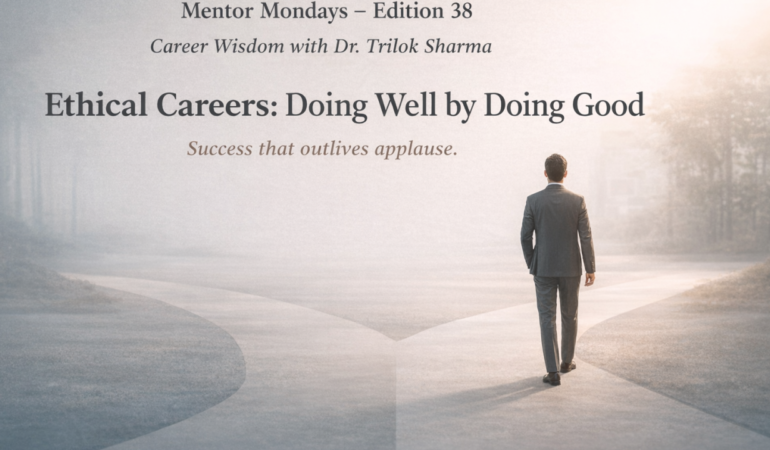
This is Mentor Mondays – Edition 38,part of Career Wisdom with Dr. Trilok Sharma.Join us every Monday for reflections that help you build a career of substance, not just success.
Welcome to this edition of Mentor Mondays, where we explore how modern careers are evolving. Today’s focus is not about women fitting in—but about how they are reframing what success at work truly means.
From Fitting In to Reframing
For decades, women at work were expected to adapt to systems designed without their voices. To fit in. To conform. To adjust.
Today, they are being heard—not for how well they adapt, but for how they reframe. For the perspectives, judgment, and depth they bring to teams, decisions, and leadership.
This is not a small adjustment. It is a fundamental reimagining of workplace excellence.
Beyond “Catching Up”
The real shift isn’t about women catching up. It’s about organizations realizing that careers grow stronger when different strengths coexist.
Progress does not require identical paths or identical styles. It requires respect for diversity in thinking, leading, and contributing.
Different approaches don’t dilute excellence. They define it.
What Women Bring to Work
At work, women bring more than skill.
They bring context, continuity, and conscience.
Context — seeing the bigger picture beyond immediate tasks
Continuity — building systems and relationships that last
Conscience — leading with values, ethics, and responsibility
These are not soft skills. They are strategic advantages.
A Different Kind of Leadership
Not louder leadership— but listening leadership.
Not lone-wolf ambition— but collective progress.
Women are demonstrating that leadership can prioritize understanding over visibility, collaboration over competition, and shared success over solo victories.
Completion, Not Competition
The most successful workplaces I observe don’t celebrate competition among women. They cultivate completion—where experience meets empathy, ambition meets balance, and success is shared, not snatched.
Competition asks, “How do I win?” Completion asks, “How do we all grow?”
That distinction changes cultures.
Why This Matters—for Everyone
When women grow, teams stabilize. Decisions humanize. Work cultures mature.
This isn’t a women’s issue. It’s a workplace wisdom issue.
Mentor’s Note
Progress isn’t about replacing one dominant voice with another. It’s about expanding the conversation.
The most meaningful transformations happen when more voices are heard, more experiences matter, and success is defined broadly—not narrowly.
When we expand the conversation, we don’t reduce anyone’s space. We increase everyone’s potential.
Your Turn
Tag a woman who inspires your career journey.
A mentor. A colleague. A leader. Or a quiet supporter who steadied your path.
Let’s acknowledge the women who helped us grow—and the wisdom we now carry forward.
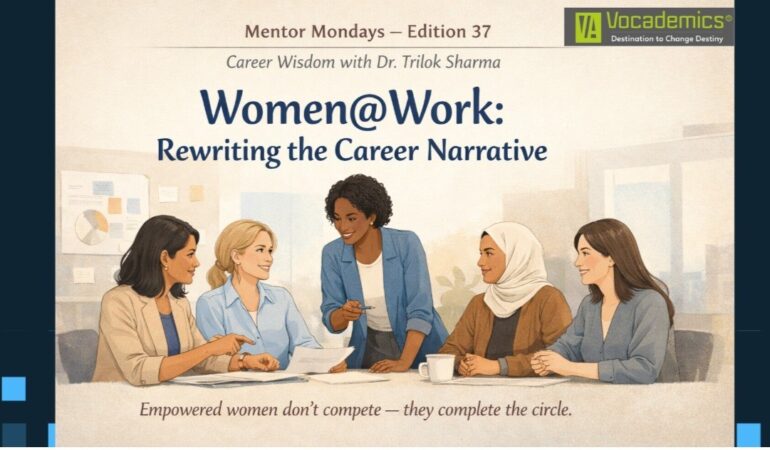
This is Mentor Mondays: Career Wisdom with Dr. Trilok Sharma.Every Monday, we explore careers with clarity, purpose, and perspective.