Stress Isn’t the Enemy: Managing Career Pressure Wisely

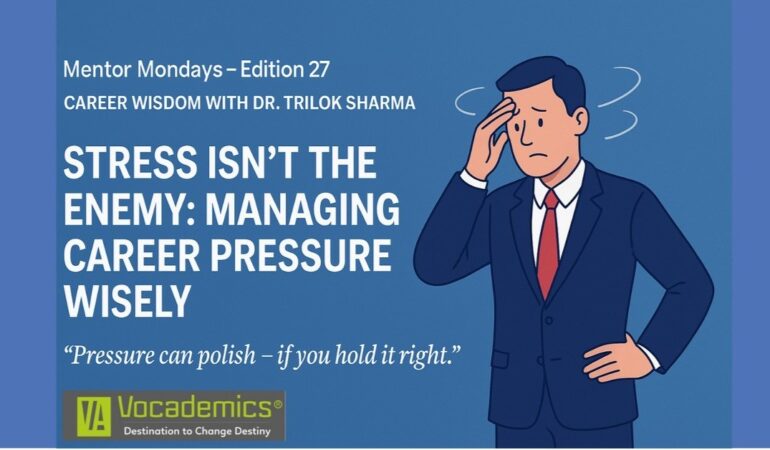
Stress Isn’t the Enemy: Managing Career Pressure Wisely

“Pressure can polish—if you hold it right.”

Article content

Stress is not a villain waiting to ruin your career. Most of the time, it’s just your mind saying: “Boss, something needs attention.” Pressure becomes harmful only when it piles up without direction.

The game is not to fight stress… The game is to manage it, convert it, and let it fuel you.

Article content

Why This Matters?

Every career has pressure: deadlines, competition, expectations, growth targets. But the people who rise are not the ones with zero stress — they’re the ones who know how to channel it.

Top performers don’t avoid pressure. They shape it, like a craftsman shapes metal.

1️⃣ Stress Isn’t One Thing — It’s Three

Understanding your stress is half the victory.

✔ Good Stress (Eustress):

The excitement before a big presentation or interview. It sharpens you.

✔ Tolerable Stress:

Temporary loads that pass — month-end, project launch, festival season.

✔ Toxic Stress:

When pressure becomes chronic, draining, and directionless.

Goal: Keep yourself in the first two zones and avoid the third.

2️⃣ The “Pressure Funnel” Mindset

(Why Some People Break and Some People Shine)**

When stress enters your life, it goes through three filters:

🔹 Perception — “Is this a threat or a challenge?”

Your interpretation changes your biological response.

🔹 Preparation — “Do I have a plan?”

Stress without a plan becomes anxiety.

🔹 Practice — “Have I done this before?”

Repeated exposure builds confidence.

The stronger the filters, the smoother the pressure flows.

3️⃣ The 4-Step Career Stress Playbook

1. Pause → Name the Stress

Your brain calms down when you label the feeling: “I’m overwhelmed because I have three deadlines.”

2. Break It → 90-Minute Sprints

Long hours create exhaustion. Focused, short sprints create progress.

3. Talk It → Don’t Carry Alone

Article content

Speak to a mentor, friend, colleague. Sharing reduces mental load by up to 40% (Harvard study).

4. Restore It → One Personal Ritual

Article content

This is your grounding anchor. A walk. A prayer. Breathing exercise. A 10-minute diary. A cup of chai on the terrace.

Pick one and stick to it.

4️⃣ Red Flags You Should Never Ignore

If these show up, slow down immediately:

  • Your sleep is disturbed
  • You avoid calls/messages
  • You can’t focus for more than 5 minutes
  • Small things irritate you
  • You lose interest in things you love

These are not weakness — they’re indicators that your system needs repair, not judgment.

Closing Thought

Pressure can polish you— but only if you learn to hold it right.

Careers grow not by eliminating stress, but by mastering the art of managing it with clarity and compassion.

Your Turn

Share one stress ritual that keeps you grounded. A small practice of yours might become someone else’s life saver.

Article content

CTA

If you’re exploring your career path, strengths, or next big move, visit Vocademics Career Studio for guidance, assessments, and mentoring: 👉 https://vocademics.edumilestones.com

Read More
The Gen-Z Work Code: What’s Changing in Career Mindsets

The Gen-Z Work Code: What’s Changing in Career Mindsets

It’s not rebellion — it’s redefinition.

Article content

Every generation questions the rules. Gen Z isn’t tearing them down — they’re rewriting them in plain language: meaning, balance, authenticity.

Article content

Why This Matters

For decades, success meant stability, title, and tenure. The new workforce asks instead:

“Does my work matter?” “Can I breathe here?” “Will I grow as a person, not just as an employee?”

This isn’t laziness or entitlement. It’s a value shift born from uncertainty — a pandemic childhood, digital overload, and watching burnout up close. They’re not chasing the ladder anymore. They’re designing their landscape.

Article content

1️⃣ Work Is Identity — But Fluid

A Gen Z professional may design, code, and freelance all at once. Career fluidity isn’t confusion; it’s curiosity in motion.

2️⃣ Values Over Vacancies

👉 42% would quit a job that clashes with their ethics (Deloitte 2024 Gen Z Survey). They don’t separate who they are from what they do — and they expect employers not to either.

3️⃣ Money Matters — But Not at Any Cost

They value fair pay but won’t trade mental health or purpose for it. Having seen burnout’s toll, they’re determined not to repeat it.

4️⃣ Leadership They Can Trust

Command-and-control doesn’t cut it. They follow leaders who listen, share feedback, and show up human. Authenticity is the new authority.

5️⃣ Learning Is the Real Currency

Degrees open doors; skills keep them open. They thrive on feedback, micro-learning, and rapid growth. They expect mentorship — not micromanagement.

Article content

Reflection Prompt

💭 What’s your non-negotiable work value — the one thing no job should ever ask you to compromise? Write it down. Then make sure your next career step honors it.

CTA

🔗 For personalized career insights and self-assessment tools, visit Vocademics Career Portal

Read More
🎉 25 Lessons from 25 Editions: A Career Wisdom Compendium

🎉 25 Lessons from 25 Editions: A Career Wisdom Compendium

A career is rarely built in a day — but often shaped on a Monday.

What began as a simple mentoring idea has now reached its 25th edition. Twenty-five weeks of stories, questions, and quiet reflections that helped thousands of readers think more intentionally about their work and growth.

This one is a pause, a thank-you, and a gift — a compendium of everything we’ve learned together.

💡 Why This Edition Matters

Every edition has carried a single truth: careers grow through clarity and consistency, not chance.

From decoding job descriptions to learning from the Ramayan, from remote work to resilience — each piece explored how to thrive in a world that keeps rewriting the rules of success.

This Silver Jubilee edition gathers those insights into one place — a Career Wisdom Playbook you can revisit whenever you feel stuck, uncertain, or just curious again.

🧭 25 Lessons in Career Wisdom

(Excerpt from the Playbook — you can Access these articles on LinkedIn)

1️⃣ Purpose beats pressure. Don’t just look for a job; look for meaning.

2️⃣ Skills age. Curiosity doesn’t. Keep learning beyond your degree.

3️⃣ Try before you decide. Prototype your career through internships or side projects.

4️⃣ Grit outlasts genius. Keep showing up; mastery hides in repetition.

5️⃣ Feedback is fuel. Seek it with humility, use it with courage.

6️⃣ Fear can be fertilizer. Growth and discomfort are twin siblings.

7️⃣ Networking = helping. Real relationships outlive job titles.

8️⃣ Ethics pay dividends. Reputation compounds faster than returns.

9️⃣ Digital presence is identity. Build it with intention, not impulse.

🔟 Leadership begins before authority. Influence starts with reliability.

(And 15 more inside the Playbook…Download here )

Article content

📘 Download the Career Wisdom Playbook

A concise, beautifully designed 25-lesson guide — created to help students, professionals, and educators revisit the best of Mentor Mondays.

👉 Download your free copy

🔗 For more mentoring tools and assessments: https://vocademics.edumilestones.com

🙏 A Note of Gratitude

To every reader who kept turning up, shared a post, or used an edition in their classroom or office — thank you. You turned a column into a community.

Your engagement, questions, and reflections have shaped Mentor Mondays far more than any algorithm ever could.

💬 Your Turn

Which lesson from the past 25 editions stayed with you?

Comment below or share a short post with your favorite takeaway.

Tag #MentorMondays and @DrTrilokSharma — let’s make this milestone a shared reflection.

✨ “Careers aren’t found. They’re crafted — week by week, choice by choice.”

Read More
🏆 Career Grit: The Art of Long-Term Consistency

🏆 Career Grit: The Art of Long-Term Consistency

Article content
Fast starts fade – Steady finishers WIN!

Talent opens the door; grit keeps it from closing. Most careers don’t fail because people lack skill — they fade because people stop showing up when results don’t come fast enough.

Why This Matters?

In the age of instant wins and viral success, consistency has become underrated. Yet every long-term achiever — from Narayana Murthy to Deepa Malik — built slow, patient momentum that never stalled. Their real secret? They out-persisted everyone else.

Article content
The consistency curve

1️⃣ The Grit Equation

Effort × Time = Mastery Talent might start the race, but effort — run after run — compounds into mastery. 🔹 Research by Angela Duckworth shows that grit predicts success better than IQ or background.

2️⃣ Indian Stories of Staying Power

🧭 Ratan Tata – Waited decades for Tata Motors’ global breakthrough. Never rushed, never compromised.

💄 Falguni Nayar (Nykaa) – Built her empire after 50. Proof that discipline can outlast youth.

🏸 Pullela Gopichand – His academy’s 4 a.m. routines forged champions, not luck.

🌾 Dr. Kamal Kisan (Agri-Tech) – Iterated 17 prototypes before one investor finally said yes.

Article content
The Indian Timeline

3️⃣ The Science of Slow Progress

Neuroscience shows that repetition thickens neural pathways — every consistent act literally rewires your brain for skill. That’s why daily practice feels boring: it’s building invisible strength.

4️⃣ Try This Week

  • Pick one micro-habit tied to your growth — read 5 pages daily, make one professional connection, or write one reflection a day.
  • Track it for 30 days. No breaks, no excuses.
  • Notice how your confidence and clarity shift by week four.
Article content
The Brick-by-Brick Metaphor

5️⃣ Where You See It

🏅 In athletes’ training logs. 📚 In teachers who refresh syllabi every semester. 💡 In founders who pivot quietly while the world scrolls past.

Key Takeaway

🔥 Consistency beats intensity. A single burst inspires; a steady flame sustains.

Article content

CTA

Take your Career Grit Assessment and find out how persistent you really are: 👉 https://vocademics.edumilestones.com

💬 What’s one area of your work where you’re choosing consistency over speed this month? Share your reflections below — someone might just need your example today.

Read More
🧳 Work Without Borders: Remote Careers & Digital Nomads

🧳 Work Without Borders: Remote Careers & Digital Nomads

🌍 Why This Matters

Remote work is no longer a niche perk. It’s becoming a mainstream route to opportunity. From cities like Ahmedabad, Udaipur, Mandsaur, Shajapur, Dhariawad, Jabalpur or Mysore, students and professionals alike can engage with firms in Berlin, Singapore, Toronto or Bengaluru — with the right mindset and tools. What’s changing is less where you sit, and more how you show up.

Article content

🧠 What’s Changing

  • Global hiring doesn’t always ask “Where are you?” any more — it asks “What value do you bring, and can you align with our workflow?”
  • Digital infrastructure — from Zoom to Slack to Notion to shared cloud workspaces — has turned your home into a global office.
  • Hybrid models and remote-first roles are growing: not just junior tasks, but leadership, project oversight and cross-border collaboration too.
  • For students in Tier 2/3 cities this means: your ZIP code is less a barrier; your skillset, network and self-discipline matter more than ever.
Article content

🚀 Where Students (and Early-Career Job-Seekers) Can Start

  1. Choose and master a remote-friendly skill: e.g., UI/UX design, front-end web dev, data analytics, digital marketing, content creation, user research.
  2. Build your online portfolio — GitHub, Behance, LinkedIn Projects or your own website. Make your work visible.
  3. Cultivate habits of asynchronous collaboration: you might not share time-zones — but you will share deliverables, status and clear communication.
  4. Start networking in global forums: remote-job boards, virtual meetups, Slack/Discord groups focused on remote work or digital nomads.
  5. Sharpen your business English (reading, writing, speaking) and professional etiquette. Reliable communication becomes your trust-capital across borders.

🎓 Real-Life Examples

Article content
  • Ms. Aditi Meena: A BCA graduate from Jodhpur who began freelancing while still in college. Within two years she was leading UI/UX projects for a Tokyo-based fintech firm — all while based at home. Her differentiator? Persistence, reliability and transparent communication.
  • Ms. Tiya Sharma: From a remote village in Madhya Pradesh, Tiya followed guidance from Vocademics to craft her profile, made connections with foreign clients, and today handles multiple projects — both within India and internationally — working from home. Her geography didn’t stop her; the system did the lifting.

👔 What About Working Professionals & Leaders?

Article content

Remote opportunities aren’t only for freshers or early-career folks. If you’re already working — or leading — there’s real potential to move into remote-first leadership roles: project leads, remote team managers, global client partners, strategic roles that don’t require you to commute to an office.

  • On platforms like Indeed you’ll find thousands of leadership-and-management roles marked “Remote” in India. Indeed+1
  • Firms like Crossover advertise full-time C-Suite and senior leadership positions open remotely from India. Crossover
  • LinkedIn reports 4,000+ remote leadership job postings in India, including roles in brand management, employee experience, executive coordination. LinkedIn So: this article is useful not just for students and early-jobbers in Tier 2/3 cities, but also for established professionals eyeing remote options, location-flexible leadership or hybrid-remote roles.

🔑 Key Takeaway

  • Work from anywhere isn’t about escape — it’s about access.
  • When geography no longer binds you, learning, income, and network all expand.
  • Your location becomes a platform, not a limitation.

📞 Call to Action

Article content
  • Audit your LinkedIn profile this week. Does it speak to a global/remote audience? Remove local-only cues; highlight remote-friendly skills.
  • Apply to at least one remote-first job or project (it can even be part-time or freelance) and treat it as your “proof-of-concept”.
  • Join a virtual community focused on remote work or digital nomads. Share what you’re learning, ask your questions, build your “remote mindset”.
  • For more information and guidance, book an appointment with Dr. Trilok Sharma at : https://vocademics.edumilestones.com
Read More
Green Careers: Opportunities in Sustainability & Climate Action

Green Careers: Opportunities in Sustainability & Climate Action

Article content

Why This Matters

Climate change is no longer just a topic for policymakers or scientists—it’s shaping the global job market. From ESG reporting desks in corporate towers to solar farms on the outskirts of Indian towns, careers in sustainability are becoming mainstream. If you’re a student or professional looking for relevance in the next decade, green skills may be your sharpest edge

Article content

🌱 Four Growing Pathways

1. ESG (Environmental, Social, Governance) Companies worldwide are under pressure to show their environmental and social responsibility. Careers here include:

  • ESG analysts and reporting managers
  • Compliance officers ensuring regulations are met
  • Sustainability consultants bridging business and impact

2. Renewable Energy India’s renewable sector is booming—solar, wind, hydropower, and the emerging field of green hydrogen. This creates demand for:

  • Energy engineers and technicians
  • Project managers for large-scale plants
  • Policy experts guiding clean energy transitions

3. Waste Management & Circular Economy Waste is no longer just a problem—it’s a resource. Opportunities exist in:

  • Recycling and upcycling industries
  • E-waste management specialists
  • Entrepreneurs reimagining products with circular design (e.g., startups making bricks out of plastic waste)

4. Green Finance Capital is flowing into sustainability. Finance professionals are needed to direct it wisely:

  • Green fund managers and ESG investment analysts
  • Carbon credit traders
  • Risk analysts evaluating climate-related investments
Article content

🛠️ Skills That Give You an Edge

  • Data analytics (for ESG metrics and climate models)
  • Technical know-how (renewable energy, waste tech, sustainable design)
  • Policy literacy (Paris Agreement, India’s Net Zero roadmap, SDGs)
  • Collaboration (ability to work across science, business, and governance)

📊 Infographic Spotlight

Article content

10 Green Careers of the Future

  1. Sustainability Consultant
  2. ESG Analyst
  3. Renewable Energy Engineer
  4. Green Architect / Urban Planner
  5. Waste Management Specialist
  6. Carbon Credit Trader
  7. Climate Scientist
  8. Environmental Lawyer
  9. Green Finance Manager
  10. Circular Economy Entrepreneur

✨ Takeaway

Green careers aren’t niche anymore—they’re becoming the backbone of tomorrow’s economy. Aligning your skills with sustainability is not only an ethical choice but also a practical one. The planet needs solutions, and the market is paying for them.

🔗 Your Next Step

Curious where you might fit in the green economy?

👉 Explore your personalized career path with us at Vocademics : https://vocademics.edumilestones.com

Read More
Digital Presence = Career Presence

Digital Presence = Career Presence

Article content

🌐 The New Résumé

Before recruiters meet you, they Google you. Your digital footprint speaks long before your CV does. In today’s job market, visibility = credibility. Whether you’re a student, a freelancer, or a manager, the way you show up online quietly shapes the opportunities that find you.

💡 Why It Matters

  • Nearly 8 out of 10 employers screen candidates online before deciding whom to interview.
  • Students with active LinkedIn or portfolio pages are twice as likely to be shortlisted.
  • Your online voice tells people how you think—not just what you’ve done.

A résumé lists achievements. Your digital presence tells your story.

🔄 From Passive Scroller → Purposeful Builder

You don’t need to “go viral.” You need to be visible for the right reasons. Every post, project, and comment adds a brushstroke to your professional portrait.

Ask yourself:

“If someone saw only my online profile, would they understand who I am becoming?”

🧭 Three Platforms That Build Your Career

Article content

1️⃣ LinkedIn – Your Professional Story

  • Headline: one clear line that says what you do or aspire to do.
  • About: your brief life philosophy and focus.
  • Posts: share insights, not selfies—less noise, more value.

2️⃣ GitHub / Behance / Portfolio Sites – Your Work in Action For coders, designers, writers, and analysts, these spaces are proof of skill. Let people see your process, not just the polished result.

3️⃣ Personal Website or Linktree – Your Hub Bring all your worlds together—your résumé, projects, and contact links—in one clean space.

Article content

🚫 What Not to Do

❌ Use your career page for random selfies or political rants.

❌ Spam the feed with “Open to Work 🙏” posts without context.

❌ Comment for visibility instead of adding insight.

Your tone online is part of your professional etiquette.

⚡ Quick Wins for a Strong Digital Brand

  • Keep one professional photo across all platforms.
  • Follow 10 industry voices who genuinely teach you something.
  • Share one reflection a week—a project, a challenge, or a small learning.
  • Engage thoughtfully on others’ posts; curiosity beats cleverness.

Consistency > Volume.

✅ Add-on Checklist: Your First 10 LinkedIn Actions

Article content
Your First 10 LinkedIn Actions

1️⃣ Update your headline – be specific and clear.

2️⃣ Add a profile photo + banner that match your field.

3️⃣ Write a human, first-person About section.

4️⃣ List your top three skills.

5️⃣ Add education & projects with brief details.

6️⃣ Request two recommendations from mentors or peers.

7️⃣ Follow five relevant companies in your domain.

8️⃣ Connect with peers and faculty mentors.

9️⃣ Post your first original insight.

🔟 Engage on others’ posts three times a week.

🪞 Closing Thought

“If you don’t tell your story online, someone else—or an algorithm—will.”

Your career presence is built click by click—quietly, consistently. Start shaping it today.

Article content

👉 CTA: Begin your career-building journey with guided assessments and mentoring at vocademics.edumilestones.com

Read More
Why It’s OK to Change Your Mind

Why It’s OK to Change Your Mind

How to navigate and embrace career changes

🌱 Opening Thought

Have you ever felt stuck in a job, wondering if it’s “too late” to change paths? Here’s the truth: career pivots are not signs of failure—they are signs of growth.

In today’s world, where industries evolve rapidly and new opportunities open every year, changing your mind about your career is not only acceptable, it’s often essential.

🔄 Why Career Pivots Are Normal

Article content
Your career is a journey with turns, not a straight line!
  • On average, professionals change jobs 5–7 times in their lifetime.
  • Evolving skills, shifting economies, and personal aspirations make pivots inevitable.
  • The most successful people are not those who never change, but those who adapt with confidence.

⚡ Triggers That Lead to Career Change

  • Burnout or dissatisfaction – wanting more meaning in work.
  • New passions – discovering something that excites you.
  • Industry shifts – automation, AI, or market disruption.
  • Life transitions – relocation, family priorities, health considerations.

🧭 How to Navigate a Career Pivot

Article content
Navigate your pivot with confidence

Think of a pivot as a strategic shift, not a random leap. Here’s a five-step approach:

  1. Reflect – What’s working, what’s not? What energizes you?
  2. Research – Study industries, future skills, and talk to mentors.
  3. Reskill – Use courses, certifications, or side projects to bridge gaps.
  4. Reconnect – Build networks in your new interest area.
  5. Reposition – Update your CV, LinkedIn, and craft your story around transferable skills.

📖 Real Stories, Real Pivots

Article content
Real Life Examples

Career pivots are not theoretical—they’re lived realities.

  • From IT to CSR Leadership: My daughter-in-law is a B.Tech. (Computer Science) graduate who began her career as an IT Engineer with L&T. While the role was prestigious, she soon realized this was not where her heart truly was. Driven by her passion for social impact, she transitioned into the Social Development sector. Today, she is thriving as a CSR and Sustainability Manager with a leading MNC in Dubai. Her journey proves that pivoting is about aligning passion with purpose.
  • My Own 40+ Year Journey: Coming from a small village, I had no roadmap for careers. I began as a school teacher (at the very school I started in the 1980s), then moved into journalism, where I excelled. From there, I transitioned into the corporate world, then into social service and philanthropy, and back again to the corporate sector—where I was honored to be listed in Forbes Middle East as one of the Top 50 Indian CEOs in the Arab World (2014–2016). Today, after four decades, I serve as a coach, trainer, and mentor. Each pivot wasn’t a reset—it was a new chapter in a continuous story of growth.

These examples show that no experience is wasted; every pivot adds depth and dimension to your professional and personal life.

💡 The Mindset Shift

Instead of fearing “starting over,” reframe it as “building on what I already know.” Every role you’ve held—whether in sales, teaching, management, or research—adds layers of transferable skills. 👉 No experience is wasted. Every pivot enriches your growth story.

🌟 Key Takeaways

  • Changing your mind is not quitting—it’s evolving.
  • Your career is a marathon, not a sprint.
  • Flexibility is a superpower in a changing world.
  • Each pivot adds a new dimension to your legacy.

🚀 Final Word

Article content

The next time you feel the urge to pivot, don’t silence it. Listen closely. It might just be your next big leap.

🔗 Call to Action

Thinking about your own career pivot? 👉 Explore your strengths and future-fit opportunities with https://vocademics.edumilestones.com

Read More
Crafting a Career Vision Statement

Crafting a Career Vision Statement

Why a Career Vision Statement Matters

Article content
Difference between Mission & Vision

In today’s fast-paced professional world, it’s easy to get lost in endless notifications, deadlines, and competing priorities. Without a clear sense of direction, our careers can easily turn into a series of disconnected jobs rather than a meaningful journey.

That’s where a career vision statement comes in. Think of it as your personal North Star—a guiding declaration that connects your values, strengths, and aspirations to a future worth striving for.

Unlike a mission statement (focused on the present), a vision statement paints a picture of your desired future. It inspires you, helps filter opportunities, and anchors you during setbacks.

💡 In short: It’s the difference between driving aimlessly and navigating with a clear destination.

The Power of a Clear Vision

Research shows that professionals with a strong sense of purpose report 64% higher fulfillment and are 50% more likely to hold leadership roles (Imperative & LinkedIn).

Why? Because clarity fuels:

  • Direction – guides career choices and transitions.
  • Meaning – connects daily work with deeper purpose.
  • Focus – filters distractions and misaligned opportunities.
  • Resilience – helps you bounce back from failures.

Consider Elon Musk: his vision of sustainable energy and space exploration has kept him pushing through repeated failures. Your vision doesn’t need to be world-changing, but it should be personally compelling enough to energize you through challenges.

Laying the Foundation: Reflection First

Article content
Reflection to Discover Your Vision

Before writing your vision, you need to reflect on three key areas:

  1. Strengths What puts you in “flow” where time flies? What do others seek your help for? When have you felt most competent and alive?
  2. Values What principles do you never compromise on? What causes consistently capture your attention? What kind of culture brings out your best self?
  3. Impact What problems do you feel drawn to solve? How could your talents serve society or your field? What legacy would you like to leave behind?

Patterns in your answers reveal the raw material of your vision.

Crafting Your Career Vision Statement

Once you’ve reflected, use this step-by-step process:

  1. Create the right environment – quiet, focused, and distraction-free.
  2. Visualize your future – imagine your ideal career day 5–10 years ahead. Who are you working with? What problems are you solving? How do you feel?
  3. Write in the present tense – as if you are already living it.
  4. Keep it concise – 1–3 sentences that inspire and guide you daily.
  5. Test for resonance – read it aloud. Does it excite you?
  6. Seek feedback – mentors or trusted peers can help refine it.
  7. Finalize – clarity + authenticity + aspiration.

📌 Formula: “I [action verbs] [specific contribution] for/by [audience or means] to achieve [desired impact].”

Article content
Crafting Your Career Vision Statement

💡 Example: “I create environments that energize communities by cultivating relationships that elevate impact.”

Using Your Vision in Daily Life

A vision statement is not meant to sit in a notebook. It should be a practical decision-making tool.

  • Make it visible – put it on your desk, wallpaper, or diary.
  • Filter opportunities – ask: Does this bring me closer to my vision?
  • Set boundaries – decline roles/projects that don’t align.
  • Course-correct – regularly check if your career path matches your vision.
  • Stay resilient – revisit your vision when setbacks hit—it turns failures into temporary detours.

Real-World Examples

  • Content Creator & Coach: “To touch the lives of as many people as possible, empowering them to achieve personal and career success through coaching and inspiring content.”
  • Corporate Leader: “To become a leader who transforms organizations into inclusive, innovative workplaces while balancing family and personal growth.”
  • Healthcare Researcher: “To revolutionize healthcare by conducting cutting-edge research that improves women’s lives globally.”

Each balances clarity, authenticity, and aspiration—and so should yours.

Common Pitfalls & How to Avoid Them

  • Generic jargon – Write in your own words, not corporate clichés.
  • Perfectionism – A draft vision is better than no vision.
  • Rigid mindset – Your vision can evolve as you grow.
  • Vagueness – “I want to be successful” won’t inspire action.

👉 Tip: Review your vision annually—refine it as your journey unfolds.

From Vision to Roadmap

A vision is your destination; a roadmap is the bridge.

Article content
From Vision to Roadmap

Break it down into milestones:

  • Next 6 months: Take one meaningful action (e.g., course, mentor, project).
  • 1 year: Build 2–3 vision-aligned skills.
  • 3 years: Secure roles/projects that align with your impact.
  • 5–10 years: Live your vision fully.

Also build:

  • A support network (mentors, peers, allies).
  • A skills inventory (identify gaps to close).
  • Reflection routines (monthly or quarterly check-ins).

Your North Star

A career vision is more than professional strategy—it’s an act of self-leadership.

When your work aligns with your values and aspirations, you gain energy, resilience, and fulfillment. Even routine tasks feel purposeful when tied to a larger vision.

As Picasso said:

“The meaning of life is to find your gift. The purpose of life is to give it away.”

✍️ Your Action Step

This week, take 30 minutes to:

  1. Draft your career vision statement (even imperfectly).
  2. Share it with a mentor or friend for feedback.
  3. Align one concrete action with it within 30 days.

Remember: we don’t design our careers by chance—we design them by vision.

🔗 Call to Action

Need structured help in shaping your career vision?

👉 Explore Vocademics International LLP’s Career Vision Workshop – and mention Mentor Mondays to receive 15% off your consultation.

🌐 Learn more: vocademics.edumilestones.com

📣 Share your vision journey in the comments.

What’s your draft vision?

What challenges are you facing?

Let’s build clarity—together.

Read More
How to Tell Your Story in 90 Seconds

How to Tell Your Story in 90 Seconds

Welcome back to Mentor Mondays, your weekly guide to professional growth, skill-building, and career clarity.

Imagine this: You walk into an interview, the panel looks at you, and the first question comes:

“So, tell us about yourself…”

It sounds simple, but in those 90 seconds, you have a rare opportunity to shape the interviewer’s perception. Will you list your degrees? Recite your resume? Or will you tell a story that is clear, confident, and compelling?

This edition is all about crafting that perfect personal pitch. Whether you’re a student entering the job market or a professional transitioning roles, this guide will help you articulate your journey, values, and goals — in just one and a half minutes.

🕐 Why 90 Seconds Matter

Most recruiters form an impression of you within the first few moments. A 90-second pitch:

  • Sets the tone for the rest of the interview
  • Highlights your strengths and uniqueness
  • Demonstrates your clarity of thought and communication
  • Builds rapport and shows confidence

A great pitch can make even average answers shine. A poor one can lose attention before you even begin.

🎨 Structure: The 3-Part Formula

Use this 3-part structure to keep your pitch focused and memorable:

1. The Present

Start with what you are doing now. Mention your current role, field of study, or internship experience.

“I’m currently pursuing my final year in B.Tech with a focus on Artificial Intelligence, and just completed a 6-month internship at Infosys in the NLP division.”

2. The Past

Then talk about relevant experiences that shaped your journey — academics, leadership roles, or volunteer work.

“During my second year, I led a campus hackathon and discovered my passion for problem-solving and mentoring peers.”

3. The Future

Conclude with your goals and what you’re looking for.

“I’m now looking to apply my skills in a dynamic organization that values innovation and learning, especially in the AI and data ethics space.”

🎭 Storytelling Technique: The STARR Framework

Use the STARR method to answer behavioral questions and enrich your career pitch:

  1. Situation – What was the context?
  2. Task – What challenge or goal did you face?
  3. Action – What steps did you take?
  4. Result – What was the outcome?
  5. Reflection – What did you learn?

To truly master behavioral interviews, it’s important to understand how unstructured thoughts often cloud our ability to answer confidently. This is where the STARR Framework becomes essential. The “Behavioral Interview Questions Funnel” sketch illustrates this beautifully—it begins with a broad and often vague prompt like “Tell me about a time when…”, which can easily trigger scattered or unclear memories. Without structure, answers can become lengthy or irrelevant. By applying the STARR method, you organize your response into a clear, logical flow, leading to a confident, outcome-focused delivery that impresses interviewers.

🔹 Example:

“During my second year of college, I realized our robotics club had become inactive and lacked participation. (Situation)

I felt responsible to revive it and set a goal to rebuild its presence on campus. (Task)

I initiated a robotics bootcamp, restructured the team, and onboarded enthusiastic juniors through outreach events. (Action)

As a result, within three months, the club grew to 60+ active members and won two inter-college competitions. (Result)

This experience taught me the value of initiative, leadership, and creating sustainable engagement through collaboration. (Reflection)

📚 Dos and Don’ts

Dos:

  • Keep it conversational
  • Practice it out loud, but don’t memorize it like a script
  • Highlight soft skills (communication, adaptability, teamwork)
  • Add personality (what drives you, what excites you)

Don’ts:

  • Don’t recite your entire resume
  • Don’t use jargon or cliches
  • Don’t oversell or sound rehearsed

🌐 Building Your Future Skills Pyramid

As you sharpen your storytelling and interview techniques, don’t forget to invest in the skills that will shape your career in 2030 and beyond. Our Future Skills Pyramid sketch offers a visual roadmap—starting from Foundational Skills like communication and digital literacy, moving up to Transitive Skills such as adaptability and collaboration, and peaking with Technical & Domain Expertise relevant to your field. Building this layered skillset ensures that you’re not just interview-ready, but also future-ready, equipped to thrive in dynamic, AI-driven work environments.

🌟 From Dr. Trilok’s Desk

“A great introduction is not a trailer of your life story. It’s a window into your mindset.”

When you tell your story with authenticity and purpose, you instantly become memorable.

🎓 Practice Task

Take a moment now to write your 90-second pitch using the 3-part model.

  • What’s your present?
  • What’s your past?
  • What’s your future aspiration?

Read it out loud. Then refine it with STARR examples. Practice until it becomes a part of you, not a performance.

🚀 Ready to Own the Room?

For personalized feedback, interview coaching, or career guidance, visit: www.vocademics.edumilestones.com

See you next Monday with another edition of Mentor Mondays: Career Wisdom with Dr. Trilok Sharma.

Read More