
Speaking, Writing, Listening and Presenting Are No Longer Optional Skills
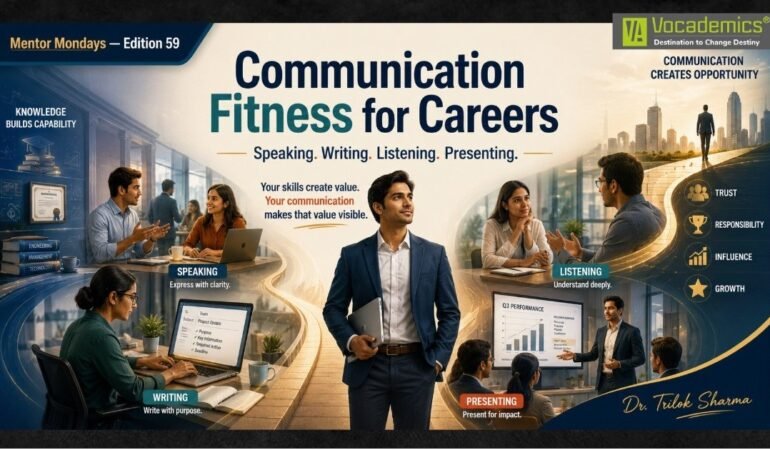
Your skills create value, but your communication makes that value visible. – Dr. Trilok Sharma
A professional may have excellent qualifications, strong technical knowledge and years of experience.
But can that person explain an idea clearly?
Can they write a professional email without creating confusion?
Can they listen carefully enough to understand what has not been directly said?
Can they present their work in a way that earns attention, trust and support?
In today’s workplace, knowledge may help you enter a career. Communication determines how far you travel within it.
Communication is no longer merely a “soft skill.” It is a career survival skill.
Just as physical fitness helps the body perform under pressure, communication fitness helps a professional think, respond and contribute effectively in demanding situations.
You do not become physically fit by exercising once before an important event. In the same way, you cannot become a powerful communicator by attending one workshop just before an interview or presentation.
Communication fitness requires regular practice.

Communication Is How Your Capability Becomes Visible
Many professionals quietly assume: “My work should speak for itself.”
Unfortunately, work does not always speak for itself.
Someone has to explain:
- What was done
- Why it was important
- What problem was solved
- What value was created
- What should happen next
Two people may possess similar knowledge, but the person who communicates more clearly is often trusted with greater responsibility.
This does not mean that style is more important than substance.
It means that substance must be communicated before it can be recognised.
A strong idea that remains trapped inside someone’s mind cannot influence a meeting, guide a team, reassure a customer or support a decision.
Communication is the bridge between your capability and other people’s understanding of that capability.
The Four Muscles of Communication Fitness
A career-ready professional must continuously strengthen four communication muscles:
1. Speaking: Turning Thoughts into Clear Expression
Speaking is not about using impressive vocabulary, copying a foreign accent or dominating every conversation.
Professional speaking means being able to organize your thoughts and express them with clarity, confidence and respect.

You need speaking fitness when you:
- Introduce yourself
- Participate in a meeting
- Explain a technical issue
- Speak with a customer
- Ask for support
- Disagree with a colleague
- Give feedback
- Respond to an unexpected question
Many capable people remain silent because they are waiting to speak perfect English.
But careers do not require perfect sentences every time. They require meaningful participation.
A person who speaks in simple, structured and relevant sentences is often more effective than someone who uses complicated language without clarity.
Before speaking, organize your message around three questions: What is the issue? Why does it matter? What action do I recommend?
Speaking improves when thought becomes structured.
2. Writing: Creating a Professional Record of Your Thinking
Your spoken words may be forgotten. Your written words remain.
Emails, reports, messages, proposals, meeting notes and presentations create a permanent record of your professionalism.
A poorly written email can delay a decision, damage a relationship or create unnecessary work. A clear email can save hours of explanation. Professional writing is not about writing more. It is about making the reader work less.

Before sending any professional message, check whether it answers four questions: Why am I writing? What does the reader need to know? What action is required? By when is it required?
Avoid hiding the purpose of the message beneath long introductions.
Instead of writing: “This is with reference to our previous discussion and the various points discussed during the meeting…”
Write:
“As discussed, please share the revised production schedule by 4:00 p.m. today.”
Clear writing respects the reader’s time.
Your emails and reports silently communicate your discipline, judgment and reliability—even when you are not present.
3. Listening: Understanding Before Responding
Many people listen only long enough to prepare their reply.
That is not listening. That is waiting for a speaking opportunity.
Professional listening requires attention, patience and interpretation.
It means understanding:
- The words being spoken
- The concern behind the words
- The information that may be missing
- The emotional tone of the conversation
- The action expected from you
Listening becomes especially important during conflict, customer complaints, feedback discussions and performance reviews.

When people feel unheard, even a technically correct response may fail. A communication-fit professional does not immediately defend, interrupt or conclude.
They pause and confirm: “Let me make sure I have understood your concern correctly.”
That one sentence can prevent misunderstanding and reduce emotional tension.
Listening is not a passive skill. It is an active form of professional intelligence.
The best communicators are not always the people who speak the most. They are often the people who understand the most.
4. Presenting: Converting Knowledge into Influence
A presentation is not a collection of slides. It is a guided journey from information to understanding and from understanding to action.
Presentation fitness is required far beyond conference halls. You are presenting whenever you:
- Explain an idea to your manager
- Share project progress
- Recommend a solution
- Brief a customer
- Defend a budget
- Propose a change
- Report an achievement
- Teach someone a process
A professional presentation should answer three questions: Where are we now? What does the information mean? What should we do next?

Too many presentations contain data without direction. Charts, numbers and technical details may demonstrate effort, but they do not automatically create understanding.
The presenter must interpret the information. Do not merely say: “Customer complaints increased by 18 per cent.”
Explain: “Customer complaints increased by 18 per cent, mainly because of delayed responses. We recommend assigning one escalation owner for the next 30 days.”
Presenting is the ability to make knowledge usable.
Communication Fitness Is Not the Same as Fluency
People frequently say: “My communication is weak because my English is weak.”
Language proficiency certainly helps, but communication fitness is broader than fluency.
A person may speak grammatically correct English and still communicate poorly.
Another person may use simple language but communicate with remarkable clarity.
Communication fitness depends on:
- Clear thinking
- Logical structure
- Relevant information
- Respectful tone
- Active listening
- Audience awareness
- Confidence to participate
- Ability to invite action
Do not measure your communication only by vocabulary. Measure it by results.
- Did the listener understand?
- Did the reader know what to do?
- Did the meeting move forward?
- Did the presentation support a decision?
- Did the conversation strengthen trust?
That is the real test.

Warning Signs of Poor Communication Fitness
You may need to strengthen your communication fitness when:
- People frequently ask you to explain again
- Your emails generate long clarification chains
- You avoid speaking in meetings
- You know the answer but hesitate to contribute
- Your presentations contain too much text
- You interrupt before others complete their point
- You speak without understanding the audience
- Your messages do not contain a clear action
- You confuse confidence with speaking loudly
- You use technical language that others cannot understand
These are not permanent weaknesses.
They are communication habits—and habits can be improved through practice.
A 15-Minute Daily Communication Workout
You do not need two hours every day to become communication-fit.
Begin with fifteen focused minutes.
Speak for Three Minutes
Select one workplace topic and explain it aloud:
- What I worked on today
- A problem I recently solved
- One improvement my department needs
- A product or service offered by my organization
- A lesson I learned this week
- Record yourself occasionally.
Do not initially judge your accent. Check your clarity, structure and confidence.
Write for Four Minutes
Write one short professional message every day. Practice:
- Requesting information
- Sharing an update
- Reporting a delay
- Confirming a decision
- Thanking a colleague
- Following up on an action
Keep the purpose and expected action clear.
Listen for Four Minutes
Listen to a short professional conversation, interview, meeting extract or presentation. Note:
- How the speaker begins
- How ideas are connected
- Which words create clarity
- How the speaker concludes
Listening to good communication gradually improves your own communication patterns.
Present for Four Minutes
Take one idea and explain it using this structure:
Situation → Meaning → Recommendation
For example: “Our response time has increased from two hours to five hours. This may reduce customer confidence. I recommend introducing a daily pending-query review at 4:00 p.m.”
Small daily practice creates visible professional improvement.
The Communication Fitness Audit
Ask yourself honestly:
1. Can I introduce myself professionally in 60 seconds?
2. Can I explain my work to someone outside my department?
3. Can I write a clear email with a specific action?
4. Can I disagree without sounding disrespectful?
5. Can I listen without interrupting?
6. Can I summarize a discussion accurately?
7. Can I present an idea without reading from slides?
8. Can I answer an unexpected question calmly?
9. Can I adapt my language for a customer, colleague or senior leader?
10. Can I conclude a conversation with clear next steps?
Do not treat this as an examination.
Treat it as a personal development map.
Select one area and practice it consistently for the next 30 days.
Communication Fitness Builds Career Trust
Organizations do not promote people only because they complete assigned tasks.
They promote people who can:
- Coordinate with others
- Explain problems
- influence decisions
- Manage disagreements
- Represent the organization
- Guide team members
- Communicate during uncertainty
- Build confidence among stakeholders
As responsibilities increase, communication becomes even more important.
At entry level, you may be responsible primarily for your own work.
At managerial level, you become responsible for shared understanding.
At leadership level, you become responsible for meaning, direction and confidence.
The higher you move, the more your career depends on your ability to communicate through people—not merely work around them.
Your Degree May Open the Door. Communication Helps You Remain in the Room.
A degree can demonstrate what you studied.
Communication demonstrates whether you can apply, explain and share what you know.
Technical knowledge may make you employable.
Communication fitness makes you dependable, visible and promotable.
Do not wait for an interview, appraisal, presentation or crisis to begin improving.
Build your communication muscles before the moment demands them.
- Speak a little more clearly.
- Write a little more carefully.
- Listen a little more deeply.
- Present a little more purposefully.
Because in the modern workplace, communication is not an additional career skill.
It is how almost every other career skill becomes useful.
This Week’s Mentor Monday Challenge
For the next seven days, complete one communication workout every day:
- Monday: Give a 60-second professional introduction.
- Tuesday: Rewrite one unclear email.
- Wednesday: Listen to someone without interrupting.
- Thursday: Explain a technical idea in simple language.
- Friday: Present one workplace improvement in three minutes.
- Saturday: Ask a colleague for communication feedback.
- Sunday: Record what improved and what needs further practice.
Communication fitness is not built through intention.
It is built through repetition.
Reflection Question
Which communication muscle currently limits your career the most: speaking, writing, listening or presenting?