
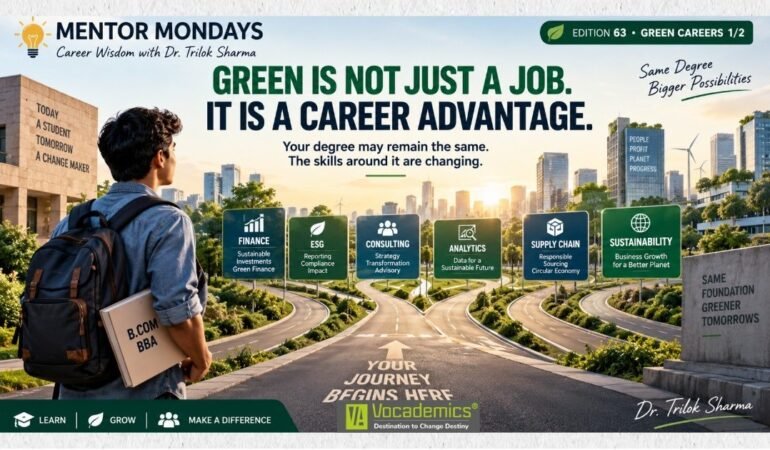
The opportunity today’s graduates should start noticing before everyone else does
Imagine two students, one from B Com (Hons) and another from BBA (Hons); graduating four years from now. Both understand finance. Both know accounting. Both can use Excel.
But one of them also understands ESG, carbon accounting, sustainability reporting, climate risk and green finance.
Who do you think will have more doors open?
That question brings us to an emerging career reality that many undergraduate students are still not discussing seriously enough:
The economy is becoming greener : and jobs are changing with it.

When students hear the words green career, many immediately imagine solar-panel technicians, environmental scientists, wildlife conservationists or renewable-energy engineers.
Those are certainly green careers, but that is only one part of the story.
A growing number of professionals will continue to work in finance, accounting, banking, consulting, supply chain, auditing, risk management and business strategy – but sustainability will become an important part of what they do.
That creates an entirely different opportunity for commerce and management graduates.
What exactly is a Green Career?
A green job is broadly one that helps reduce environmental impact, conserve natural resources or enable the transition towards a more sustainable economy.
Your earlier Green Careers study identifies opportunities across renewable energy, sustainable agriculture, green construction, waste management, CSR, sustainability consulting and environmental policy. But students should understand another important distinction.
There are:
- Green Jobs – jobs whose primary purpose is environmental or sustainability-related.
And then there are:
- Greened Jobs – familiar professions that increasingly require green knowledge and skills.
- An accountant may start measuring emissions.
- A banker may evaluate climate-related financial risk.
- A procurement manager may assess whether suppliers meet sustainability standards.
- An investment analyst may evaluate a company not only by profitability, but also by environmental and governance performance.
- A consultant may help companies reduce energy consumption, waste and carbon emissions.
That is why the green transition is relevant even if you have never studied environmental science.
Why should a Commerce or BBA student care?
Because employers are already beginning to value green skills outside traditional environmental professions.

LinkedIn’s 2025 research found that demand for green talent was growing at about twice the rate of growth in the supply of green skills. It also found that more than half of green hires were already occurring in jobs that could traditionally have existed without green skills. Green-skilled professionals were being hired at a substantially higher rate than the overall workforce.
That is the signal students should notice.
Green skills are slowly becoming business skills.
And the green transition itself is creating employment. The World Economic Forum estimates that climate adaptation could contribute around 5 million additional net jobs globally by 2030, climate mitigation another 3 million, while changes in energy generation, storage and distribution could add around 1 million.
Renewable energy alone already supports an estimated 16.6 million jobs worldwide.
India has its own significant opportunity. Research by the Skill Council for Green Jobs and Sattva Consulting has estimated the potential for as many as 35 million green jobs in India by 2047 across traditional and emerging sectors.
The numbers matter.
But the direction matters even more.
Where could a B Com or BBA graduate fit?
Consider some of these possibilities:
- ESG Analyst : Studies a company’s environmental, social and governance performance.
- Sustainability Analyst : Works with data, initiatives and reporting connected with sustainability goals.
- Green Finance Analyst : Works on financing projects and businesses linked with sustainable development.
- Carbon Accounting Associate : Helps organizations measure greenhouse-gas emissions.
- Climate Risk Analyst : Studies how climate-related risks could affect companies, assets and investments.
- Sustainability Reporting Associate : Supports disclosures under sustainability-reporting frameworks.
- Sustainable Procurement Analyst : Evaluates suppliers not merely on price and quality, but increasingly on environmental performance.
- ESG Assurance/Audit Associate : Helps examine and validate sustainability-related information.
- Impact Analyst : Measures whether investments or projects are actually producing intended social or environmental outcomes.
- Sustainability Consultant : Helps organizations translate sustainability commitments into business practices.

Notice something?
Most of these are not careers that require you to abandon commerce. They require you to add another layer to commerce.
The Green Career Equation
For a young commerce student, I would put it very simply:
Your Degree + Green Knowledge + Digital Skills + Proof of Work = Green Career Readiness
- Your degree gives you the foundation.
- Green knowledge gives you differentiation.
- Digital capability allows you to work with information.
- And projects, internships and practical assignments prove that you can actually apply what you know.
This distinction is important because students sometimes believe that accumulating certificates automatically makes them employable… It does not.

Do not become a collector of certificates. Become a collector of capabilities.
And what about salaries?
There is no single “green salary”.
Compensation varies enormously according to the sector, qualification, role, country and experience.
Your earlier research, for example, reported broad Indian ranges across renewable energy, green buildings and carbon-related occupations, ranging from a few lakh rupees annually in entry-level operational roles to substantially higher packages in specialized carbon and sustainability positions.
- But I would advise students not to choose this direction simply because they have heard that green careers may pay well.
- Choose it because the knowledge could strengthen the profession you already intend to pursue.
Your first question is therefore not…
“Which green job should I apply for?”
You are still in college, So, a much better question is:
“Which green capability can I add to my existing degree during the next four years?”

If you are a first-year B Com (Hons.) or BBA (Hons.) student today, you possess something extraordinarily valuable: TIME.
Four academic years give you enough time to explore, learn, experiment, undertake projects, complete selected courses and gradually build a portfolio.
- You do not have to decide everything today.
- But you should start noticing the direction in which careers are moving.
Because the graduate who starts preparing before a skill becomes fashionable often has an advantage over the graduate who starts preparing after it becomes compulsory.
Mentor’s Monday Question
Before you leave this article, ask yourself:
If sustainability becomes an important part of business over the next decade, what would I like my existing degree to become capable of doing?
Keep your answer, because next Monday, we move from WHY to HOW.
Do not forget to come back and read – Edition 64: Your Four-Year Green Career Roadmap – What to learn, build and prove before you graduate.