“Most professionals plan their work carefully. Very few ever plan the risks hiding inside their career.” — Dr. Trilok Sharma
Let me ask you something honest- When did you last sit quietly and ask yourself — “Is my career actually safe right now?”
Not your job. Not your designation. Not your salary slip. Your career — the long arc of your professional life, your relevance, your readiness, your relationships in the world of work.
Most of us don’t ask that question. Not because we are lazy. But because we are busy. Deadlines, meetings, deliverables, WhatsApp groups, quarterly reviews — life fills up fast. And career reflection gets postponed to someday.
But here is the quiet, uncomfortable truth: careers don’t collapse suddenly. They erode slowly. The risk was always there. We just weren’t watching the map.

Today, let us draw that map together.
What Is a Career Risk Map?
A career risk map is not a scary document. Think of it as a honest mirror — one that shows you not just where you are, but where the cracks are forming beneath the surface.
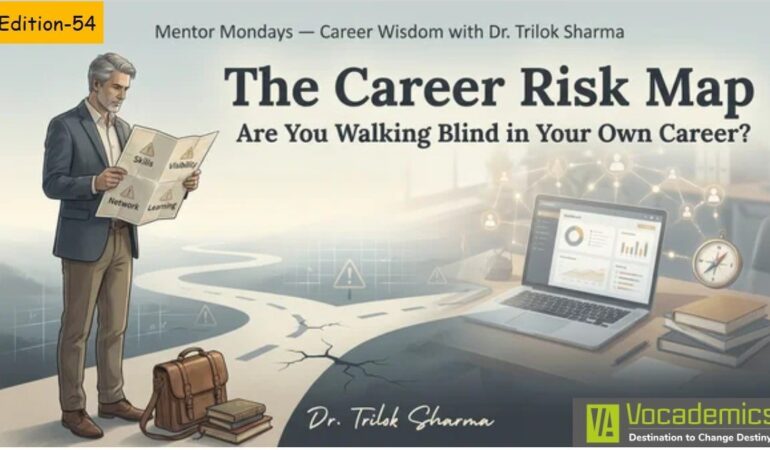
Every professional, regardless of age, industry or seniority, carries at least four invisible risks at any given point in their career journey:
- Outdated Skills
- Weak or Shrinking Network
- Poor Professional Visibility
- No Real Learning Plan
These are not dramatic failures. They are quiet gaps. And in today’s world — where AI is reshaping roles, industries are reorganizing and talent expectations are changing fast — these gaps are becoming career liabilities faster than ever before.

Let us look at each one honestly :-
Risk 1 — The Outdated Skills Trap
Imagine a doctor who stopped reading medical journals in 2015. Or a finance professional who has never touched a data analytics tool. Or a manager who still leads teams the way it was done in 2005.
Skills have an expiry date now. Not a long one.
This is not about chasing every new technology. It is about asking a simple question every six months: “Is what I know still relevant to what the world needs?”
The professionals who are quietly losing ground are not incompetent people. They are people who stopped updating. They assumed that experience alone would carry them forward. It used to. It does not, as reliably, anymore.
Mentor’s Checkpoint: List your top five professional skills. Now ask — which of these would still be valued three years from now? Which ones have already started losing weight?
Risk 2 — The Shrinking Network Problem
A network is not a LinkedIn connection count. A network is the number of people who would genuinely respond if you reached out today — people who know your work, trust your character and would recommend you without hesitation.

Many professionals build relationships when they need something and go quiet in between. That is not a network. That is a contact list with transactional memories.
The real career risk is this: when you actually need your network, it is too thin, too old or too cold.
In the AI age, human relationships are becoming more valuable, not less. Machines can match resumes to job descriptions. They cannot replace the phone call that a trusted colleague makes on your behalf. They cannot replicate the warmth of a mentor who speaks your name in a room you are not in.
Mentor’s Checkpoint: How many meaningful professional conversations did you have last month — not for any transaction, just to connect, learn or give? If the answer is “very few,” your network is slowly drying up.
Risk 3 — The Invisible Professional
Here is a pattern I have seen across many careers: a genuinely capable person, doing honest, quality work — and yet slowly becoming professionally invisible.
They do not write. They do not speak. They do not share what they know. They attend conferences but never raise a hand. They have opinions but rarely voice them in the right rooms.
In an era of information abundance, invisibility is a career risk. Not because you must become loud or performative — please, not that — but because the world needs to know that you exist, that you think and that you contribute.
Quiet Ambition — which we explored in our earlier edition — is about doing great work without drama. But quiet does not mean absent. There is a difference between dignity and disappearance.

Your visibility is your professional oxygen. Breathe in a room. Leave a thought. Publish a reflection. Speak at a team meeting. Mentor someone younger. Be findable when opportunity comes knocking.
Mentor’s Checkpoint: If someone Googled your name or looked at your LinkedIn today, what would they find? Would it reflect who you truly are as a professional — your thinking, your values, your expertise? Or is there a gap between your real self and your digital presence?
Risk 4 — No Learning Plan
This is perhaps the most common and the most quietly dangerous risk of all.
Ask a professional, “What are you learning right now?” and many will pause awkwardly. Some will mention a course they started six months ago and never finished. Others will say they are “picking things up on the job.” A few — a very few — will describe an actual, intentional learning habit.

A learning plan does not have to be a grand document. It can be as simple as:
- One book every six weeks
- One new skill explored every quarter
- One conversation with a domain expert every month
- One hour per week invested in deliberate reflection
But it has to be intentional. The world is not waiting for you to catch up. AI tools are being built and deployed faster than most training programmes can keep pace with. The only real defence is a professional who has made learning a permanent lifestyle — not an occasional event.
Mentor’s Checkpoint: Do you have a personal learning plan for the next 12 months? Not your company’s training calendar. Yours. If not, that is the most important career task you could begin this week.
Drawing Your Own Career Risk Map
Here is a simple framework I call the SVNL Check — four questions, one honest conversation with yourself.
Risk Area
The Question to Ask Yourself
S — Skills : Are my current skills future-relevant, or am I coasting on yesterday’s expertise?
V — Visibility : Does the professional world know I exist, think and contribute?
N — Network : Do I have relationships built on genuine trust, not just convenience?
L — Learning : Is there an active, intentional learning plan in my life right now?
Score yourself honestly — not to feel bad, but to feel ready. Every gap you name today is a gap you can close tomorrow.
A Word on Fear — and Why This Is Not That
I want to say this clearly.
The Career Risk Map is not about fear. It is not about panic. It is not about abandoning what you are doing and running towards the next shiny certification.
It is about clarity with courage.
The most resilient professionals I have met — across industries, across geographies, across decades — were not the ones who were never at risk. They were the ones who knew where their risks were and did something steady and intentional about them.
A ship’s captain does not fear the sea. But he always checks the map.
This Week’s Reflection Question
“If you were to honestly draw your Career Risk Map today — which of the four areas would show the biggest gap? And what is one small thing you could do this week to begin addressing it?”
Sit with that question. Write your answer somewhere. And then do the one small thing.
That is how meaningful careers are built — not in dramatic leaps, but in honest, steady, intentional steps.