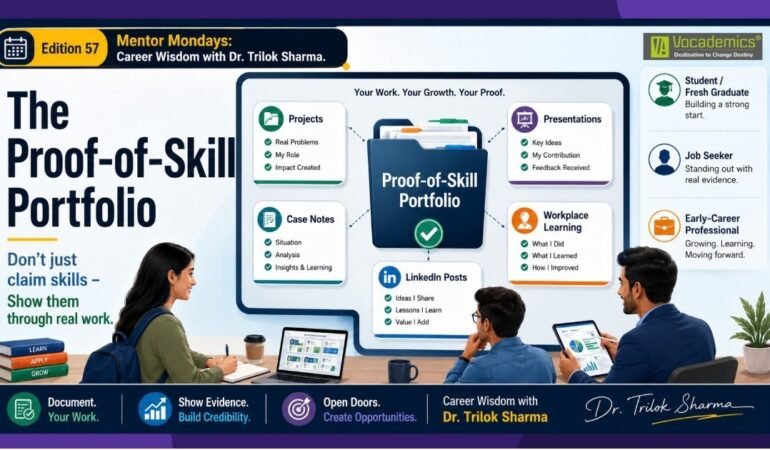
Don’t Just Claim Skills – Show Them.
There comes a point in every career journey when qualifications alone stop answering the most important question.
For a student, that question may be: “How do I stand out before my first job?”
For a fresh graduate, it may be: “How do I prove that I am ready for the workplace?”
For a job seeker, it may be: “How do I show capability beyond my resume?”
For an early-career professional, it may be: “How do I demonstrate growth, learning and future readiness?”
And for someone planning a career shift, the question becomes even sharper: “How do I convince others that I can move into a new role, new function or new industry?”
The answer is increasingly clear : You need more than a resume. You need more than certificates. You need more than claims. You need a Proof-of-Skill Portfolio.

A resume tells people what you have studied or where you have worked. A portfolio shows what you have actually created, analyzed, solved, presented, improved and learned.
In a competitive career environment, skills become powerful only when they become visible.
The Problem: Many People Have Skills, But Very Little or NO Proof
Most students and young professionals are not short of ability.
They attend courses. They complete assignments. They participate in projects. They do internships. They attend workshops. They learn tools. They make presentations. They solve workplace problems. They take part in events. They write, speak, design, organize, analyze and coordinate.
But after all this, one problem remains : The evidence is scattered.
A project stays in an old folder. A presentation is forgotten after delivery. An internship becomes only a certificate. A workplace learning remains only a memory. A LinkedIn post is never written. A case analysis is never documented. A problem solved at work is never converted into a learning note.
As a result, when an opportunity comes, many capable people are unable to show the depth of their capability.
They say: “I have communication skills.” “I am good at analysis.” “I can work in teams.” “I have leadership qualities.” “I am interested in marketing.” “I want to move into HR.” “I have learned digital tools.” “I handled responsibilities during internship.”
These statements may be true, but in career conversations, truth becomes stronger when it is supported by evidence. That is where a Proof-of-Skill Portfolio makes a difference.
What Is a Proof-of-Skill Portfolio?
A Proof-of-Skill Portfolio is a simple, organized collection of real work that demonstrates your capabilities.

It is not only for designers, writers or creative professionals. It is useful for management students, engineers, commerce graduates, HR professionals, marketing aspirants, analysts, consultants, trainers, entrepreneurs, job seekers and anyone who wants to show professional readiness.
It may include: Projects Case notes Presentations Internship reflections Workplace learning notes Research summaries Client or customer insights Problem-solving examples LinkedIn learning posts Certificates with short reflections Before-after examples of improvement Feedback received and acted upon
The purpose is simple: When someone asks, “What can you do?” your portfolio should help answer that question with confidence.
A good portfolio does not need to be complicated. It does not need expensive design. It does not need a personal website in the beginning. It does not need perfect achievements. It needs structure, honesty and visible evidence.
Why This Matters Now
The world of work is moving from qualification-based confidence to evidence-based confidence.
Degrees still matter. Marks still matter. Certifications still help…But employers, clients, mentors and collaborators increasingly want to see how you think, how you apply learning, how you communicate, how you solve problems and how seriously you take your own growth.
- For students, a portfolio builds employability before placement season.
- For fresh graduates, it adds weight to a limited resume.
- For job seekers, it helps create differentiation in a crowded market.
- For early-career professionals, it shows growth beyond the job title.
- For career switchers, it creates a bridge between past experience and future direction.
The portfolio is not a substitute for competence. It is a way of making competence visible.
Five Sections Every Proof-of-Skill Portfolio Should Have
You can begin with a simple digital folder. Name it: My Proof-of-Skill Portfolio

Inside it, create five sections.
1. Project Evidence
Every project should leave behind a proof file. Whether it is an academic project, a workplace assignment, a consulting note, a research task, a team activity or a self-initiated experiment, document it properly.
For each project, capture: Project title Problem or objective, Your role, Method used, Key findings, Outcome or recommendation, Skill demonstrated, One learning from the process.
- For example, a student may document a market research project on consumer behavior.
- A fresh graduate may document a process improvement idea from an internship.
- An early-career professional may document how they helped streamline reporting, improve coordination or analyze customer feedback.
Even a small project becomes powerful when it is presented as evidence of thinking and action.
2. Case Notes
A case note shows how you think. It is especially useful for students, management learners, consultants, analysts, HR professionals and anyone preparing for interviews or career transitions.
A good case note does not need to be long. One page is enough.
You can structure it around five questions: 1. What was the situation? 2. What was the core problem? 3. What options were available? 4. What decision or recommendation would I make? 5. What did I learn from this case?
Case notes demonstrate judgement. They show whether you can move beyond information and reach insight. This is important because careers are not built only on knowledge. They are built on the quality of decisions we are able to make with that knowledge.
3. Presentation Records
Many people prepare presentations, deliver them once and then forget them. That is a missed opportunity. Every meaningful presentation should become part of your portfolio.
Save the final deck. Write a short note about the purpose. Mention your contribution. Capture the audience or context. Record the feedback received. Add one point you would improve next time.
This section is useful for almost everyone.
- A student can include class or project presentations.
- A fresh graduate can include internship review presentations.
- A professional can include internal presentations, client decks, training material or review documents.
- A job seeker can include a self-created presentation on an industry, company or function of interest.
Presentation records show communication, structure, confidence and preparation. They also show that you can convert thinking into a shareable format.
4. Internship and Workplace Learning Diary
An internship is not just a certificate. A job is not just a designation. Both are learning environments. The real value comes from observation, participation, feedback and reflection. During an internship or early professional role, maintain a weekly learning diary.
Write short notes on: What did I observe? What task was given to me? What problem did I understand? What skill did I use? What feedback did I receive? What did I learn about workplace behavior? What would I do differently next time?
This habit can change the quality of your career conversations. Instead of saying, “I did an internship in marketing,” you can say: “During my internship, I observed how customer objections were handled. I prepared a short note on five recurring objections and suggested response points for the sales team.”
Instead of saying, “I worked in operations,” you can say: “I noticed delays in daily coordination and created a simple tracking format that helped the team follow pending tasks more clearly.”
That is the difference between experience and evidence.
5. LinkedIn Learning Posts
LinkedIn is not only a place for job updates and achievements. It can also become your public learning journal. Once a week, write a short post about something you learned, observed, analyzed or reflected upon.
It could come from: A project, A book, An internship, A workplace incident, A guest lecture, A case discussion, A client interaction, A training program, A failed attempt, A professional conversation, A problem you solved.
Keep it simple. What happened? What did you learn? Why does it matter? How can others apply it?
You do not need to sound like an expert. In fact, early in your journey, it is better to sound like a sincere learner. Over time, these posts become a visible record of your thinking, growth and professional seriousness.
This is how people move from being invisible to being discoverable.

Before and After: The Difference a Portfolio Makes
Without a portfolio, a candidate says: “I am interested in HR.”
With a portfolio, the same person can show: A short note on employee engagement, A case reflection on workplace conflict, An internship diary on recruitment coordination, A presentation on performance appraisal, A LinkedIn post on feedback culture.
Without a portfolio, a marketing aspirant says: “I understand branding.”
With a portfolio, the person can show: A competitor analysis, A campaign review, A customer persona sheet, A social media content calendar, A reflection on consumer behaviour.
Without a portfolio, an early-career professional says: “I am ready for a bigger role.”
With a portfolio, the person can show: Projects handled, Problems solved, Improvements suggested, Feedback received, Skills developed, Learning documented.
The difference is not only in ability. The difference is in visibility.
How to Start This Week
Do not wait for a perfect portfolio. Start with one folder. Then add one proof every week.
- One project note.
- One case reflection.
- One presentation record.
- One internship learning.
- One workplace insight.
- One LinkedIn post.
- One problem-solving example.
- One feedback note. One before-after improvement.
In three months, you will have evidence. In six months, you will have a story. In one year, you will have a professional identity.
The habit is more important than the format. The consistency is more important than the design. The reflection is more important than the decoration.
A Simple Portfolio Audit
Ask yourself these five questions:
- Can I show three projects that demonstrate my skills?
- Can I show two examples of how I analyze problems?
- Can I show one presentation that reflects my communication ability?
- Can I show what I learned from my internship or job role?
- Can my LinkedIn profile reflect my learning journey, not just my qualifications?
If the answer is NO, there is no need to feel discouraged. It simply means your next career task is clear. Start documenting.

In the modern career world, potential must be supported by proof.
Your resume may open the first conversation. Your portfolio can deepen it. Your degree may show where you studied. Your portfolio can show how you think. Your certificate may show that you attended. Your portfolio can show what you understood, applied and improved.
Skills become powerful when they are visible through work. So do not only prepare for interviews.
Prepare evidence, because the future will favour those who can not only say, “I can do this,” but also show, “Here is how I have already begun.”
Proof builds confidence.
Proof builds credibility.