
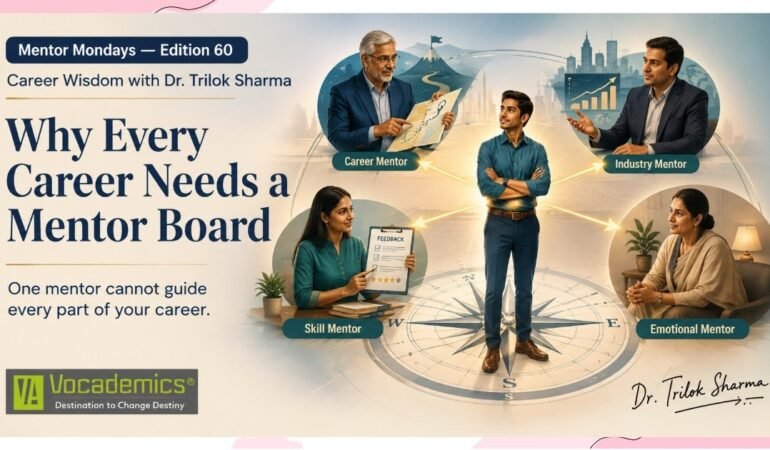
One mentor cannot guide every part of your career
For many years, we have been encouraged to “find a mentor.” The advice is valuable—but incomplete.
It creates the impression that somewhere there is one experienced person who will understand our ambitions, improve our skills, guide our career decisions, introduce us to opportunities, support us emotionally and tell us what to do whenever we feel confused.
That person rarely exists.

Even the most experienced mentor cannot understand every industry, solve every workplace problem, develop every skill or remain available at every important turning point in our career.
Instead of searching endlessly for one perfect mentor, we may need to build something more practical:
A Mentor Board
A Mentor Board is a small circle of people who guide different dimensions of your professional journey.
Just as an organization does not depend upon one director for every decision, your career should not depend upon one person for every kind of guidance. – Dr. Trilok Sharma

Different career questions require different forms of wisdom.
The person who helps you decide whether to change your career may not be the best person to improve your presentation skills.
The person who understands your industry may not fully understand your emotional struggles.
The senior professional who can open doors for you may not have enough time to help you reflect deeply on your choices.
This is why a strong career needs not one mentor, but a thoughtful circle of guidance.
The Four Seats on Your Mentor Board
Your Mentor Board does not have to be large. Four kinds of mentors can provide a strong foundation.
1. The Career Mentor
A career mentor helps you look at the larger direction of your professional life.
This person may help you think through questions such as:
- Am I moving towards the right kind of work?
- Should I continue in this role or explore something new?
- What capabilities must I build for the next stage?
- Am I making this decision from clarity, fear or frustration?
- What could be the long-term consequence of my present choice?
A career mentor does not decide your future for you.
A good career mentor helps you examine your situation more honestly, understand your options and take responsibility for your decisions.
2. The Skill Mentor
A skill mentor helps you become better at a specific capability.
It may be communication, leadership, technical expertise, writing, negotiation, data analysis, teaching, sales or any other skill relevant to your career.
A skill mentor may observe your work, identify gaps, recommend practice and give you direct feedback.
This relationship is often practical and focused.
You are not asking:
“What should I do with my life?”
You are asking:
“How can I perform this part of my work better?”
Career growth requires both direction and competence. A career mentor helps you choose the road; a skill mentor helps you become capable of travelling it.
3. The Industry Mentor
Every profession has realities that cannot be understood fully through textbooks, courses or online information.
An industry mentor helps you understand how a particular sector actually works.
This person may guide you on:
- Emerging opportunities
- Industry expectations
- Unwritten professional norms
- Important networks
- Changing roles
- Future skills
- Common career mistakes
- The difference between an attractive opportunity and a sustainable one
Students especially need this form of guidance.
A course may tell you what a profession is supposed to be. An industry mentor can explain what that profession feels like in practice.
For experienced professionals, an industry mentor can provide perspective about changes that may not yet be visible from inside one organization.
4. The Emotional Mentor
Careers are not built only through qualifications and opportunities.
They are also shaped by rejection, uncertainty, comparison, pressure, disappointment and self-doubt.
At such times, you may not need another strategy. You may need perspective.
An emotional mentor is someone with whom you can speak honestly without feeling judged.
This person may help you regain balance when:
- An interview does not go well
- A promotion is delayed
- A project fails
- You begin doubting your abilities
- Workplace relationships become difficult
- You feel exhausted or directionless
- Everyone appears to be moving ahead except you
An emotional mentor does not encourage dependency. The right person helps you process the experience, separate facts from emotions and return to the situation with greater stability.
Your Mentor Board May Already Exist
Building a Mentor Board does not always mean approaching four famous or highly influential people.
Some of these mentors may already be present in your life.
Your career mentor may be a former manager.
Your skill mentor may be a colleague who performs one task exceptionally well.
Your industry mentor may be an alumnus, client or senior professional.
Your emotional mentor may be a teacher, trusted friend, family elder or experienced colleague.
Mentoring does not always begin with a formal statement:
“Will you become my mentor?”
Sometimes it begins with a thoughtful question, a meaningful conversation and the willingness to act on what you learn.
Your mentors may not even know that you consider them part of your Mentor Board.
What matters is not the title you give the relationship. What matters is the quality of the guidance, the trust between you and the seriousness with which you use it.

A Mentor Board Is Not a Contact List
It is easy to confuse networking with mentoring.
A network may give you access to people.
A Mentor Board gives you access to perspective.
Collecting phone numbers, sending connection requests or meeting influential people does not automatically create mentoring relationships.
Mentoring develops when you:
- Approach people with specific questions
- Respect their experience and time
- Listen without becoming defensive
- Apply relevant guidance
- Return with progress rather than repeated confusion
- Keep them updated about meaningful developments
- Express gratitude without using excessive flattery
The strength of your Mentor Board depends less on the status of its members and more on the quality of your engagement with them.

Do Not Ask Every Mentor the Same Question
- One of the reasons people remain confused is that they seek guidance from the wrong source. They ask family members about industries the family has never experienced.
- They ask technical experts to resolve emotional dilemmas.
- They ask friends to validate major career decisions.
- They ask successful people to provide answers without sharing enough context.
Before seeking guidance, ask yourself:
- What kind of help do I actually need?
- Do I need information?
- Do I need feedback?
- Do I need emotional support?
- Do I need an independent perspective?
- Do I need career counselling?
- Do I need someone to challenge my assumptions?
Clarity about the support you need will help you approach the right person with the right question.
Conduct Your Mentor Board Audit
Take a few minutes and complete this simple reflection.
- Career Direction : Who helps me think about my long-term career decisions?
- Skill Development : Who gives me honest and useful feedback on my capabilities?
- Industry Understanding : Who helps me understand the realities and future of my profession?
- Emotional Perspective : Who can help me remain balanced during uncertainty, rejection or pressure?

Now ask yourself:
- Which position on my Mentor Board is currently empty?
- Am I depending too heavily on one person?
- Am I receiving guidance only from people who think like me?
- When was the last time I updated or thanked someone who guided me?
- Have I acted upon the guidance I received?
An empty seat on your Mentor Board does not mean that you are failing – It simply reveals where you may need to build a meaningful relationship.
Mentors Do Not Remove Every Confusion
A mentor is not expected to provide instant certainty.
- Some questions need time.
- Some decisions involve risk.
- Some career transitions require experimentation.
The role of a mentor is not always to give you the answer.
Sometimes, the most valuable contribution of a mentor is to help you see:
- The question you have been avoiding
- The assumption you have never challenged
- The strength you have underestimated
- The pattern you have repeatedly ignored
- The option you have not considered
- The consequence you are unwilling to acknowledge
Good mentoring does not make you dependent on another person’s wisdom; It gradually develops your own judgement.
Begin with One Meaningful Conversation
You do not need to build your entire Mentor Board immediately. Begin with one gap.
- Identify the area in which you currently need the greatest clarity.
- Then identify one person who may be able to guide you.
- Approach that person respectfully. Explain your situation briefly.
- Ask a specific question. Listen carefully.
- Reflect upon the guidance. Take action.
One meaningful conversation may not solve your entire career – But it can help you see your next step more clearly. And sometimes, the next clear step is all that a person needs.
This Monday’s Reflection
Do not ask only: “Do I have a mentor?”
Ask: “Do I have the right circle of guidance for the career I am trying to build?”
Your career does not need one all-knowing mentor. It needs a thoughtful circle of people who help you see what you may not see alone.
And when such a circle is not yet available, a structured mentoring conversation can become the first step towards building it.

Seeking Greater Clarity?
If you are navigating an important career decision, professional transition, workplace challenge or leadership dilemma, you may explore a confidential one-on-one mentoring conversation with Dr. Trilok Sharma, available online or offline through Vocademics International LLP.
Explore mentoring and appointment options: https://vocademicsinternational.com
Vocademics International LLP : Driving Students, Professional & Organizations From Confusion to Clarity