
By Dr. Trilok Sharma
There are some figures in Indian spiritual tradition who do not remain confined to temples, scriptures or festivals. They quietly enter our homes, our fears, our struggles, our childhood memories, our moments of crisis, and our search for courage.
Hanuman Ji is one of them.
For millions of people, Hanuman Ji is not a distant divine figure. He is close. He is immediate. He is approachable.
When fear comes, we remember him.
When courage is needed, we invoke him.
When the mind becomes restless, we chant his name.
When life feels heavy, we turn to Hanuman Chalisa.
But there is one question we rarely ask deeply:
Can Hanuman Ji be more than a source of strength in crisis? Can he also be a complete guide for living?
My answer is yes.
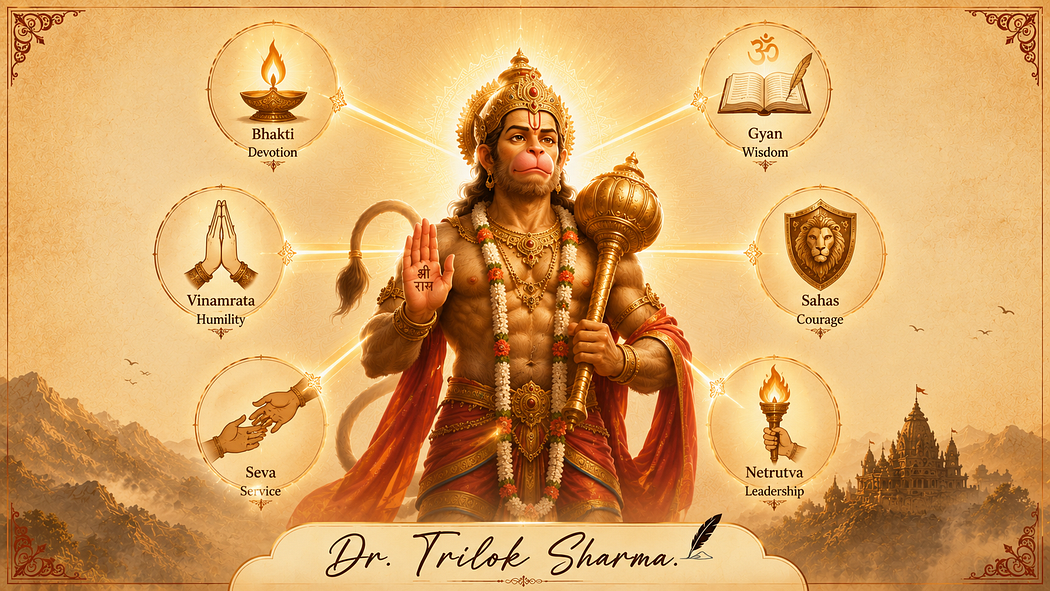
Hanuman Ji is not only Sankatmochan. He is also a life model.
He teaches us how to use strength without ego, knowledge without arrogance, speed without restlessness, courage without cruelty, and devotion without passivity.
This is what I call The Hanuman Way of Life.
Hanuman Ji: Not Only Worship, But Wisdom
Most of us know Hanuman Ji through some deeply personal doorway.
For some, it is Hanuman Chalisa.
For some, it is Tuesday or Saturday worship.
For some, it is the image of sindoor, gada and folded hands.
For some, it is the childhood story of a divine child reaching for the Sun.
For some, it is the protective feeling of Sankatmochan.
All these are beautiful.
But Hanuman Ji is not only to be worshipped. He is also to be understood, reflected upon and practiced.
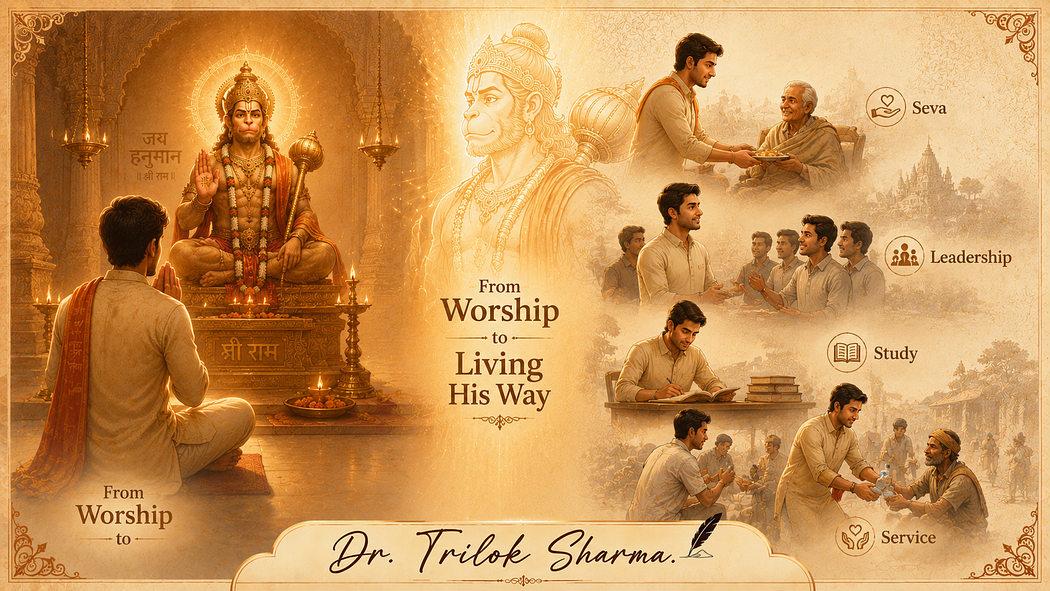
His life offers answers to very modern questions:
How should I use my talent?
How should I respond to crisis?
How should I communicate with someone in pain?
How should I lead without becoming egoistic?
How should I act fast without becoming careless?
How should I remain humble after achievement?
How should I balance devotion and action?
In this sense, Hanuman Ji is a living example of Indian Knowledge Systems.
Indian Knowledge Systems Are Not Museum Wisdom
Sometimes we reduce Indian Knowledge Systems to ancient texts, cultural pride or academic discussion.
But true wisdom is not meant to be locked in a museum. It is meant to be lived.
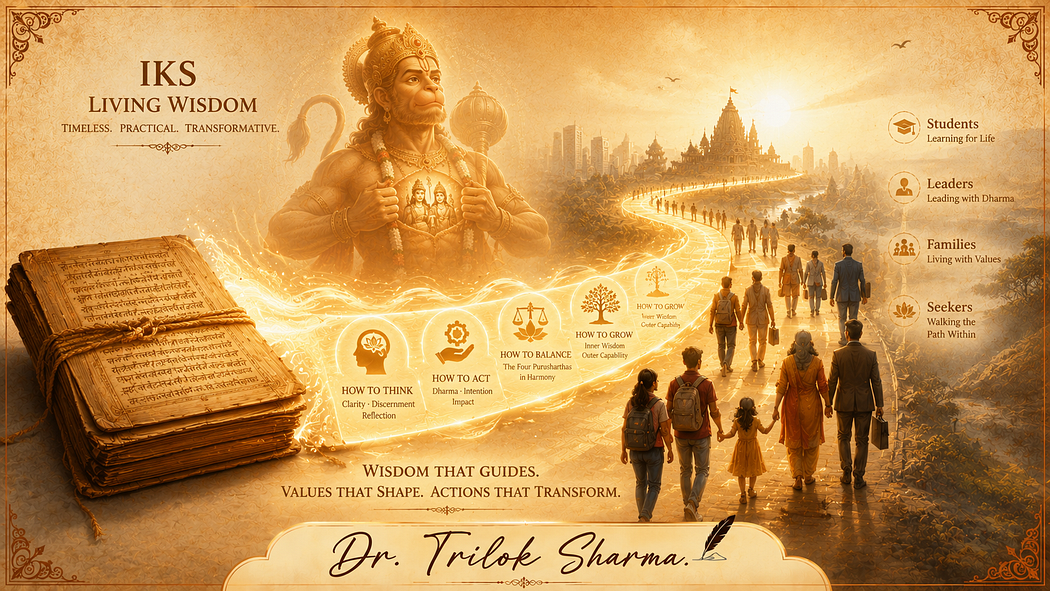
Indian wisdom helps us deal with the practical realities of life — duty, desire, wealth, relationships, power, speech, ego, suffering, courage and liberation.
It asks us not only to know more, but to become better.
Hanuman Ji represents this living wisdom in a very beautiful way.
He is full of knowledge, but deeply humble.
He is full of strength, but completely devoted.
He is a great communicator, but never manipulative.
He is a warrior, but not violent by temperament.
He is a servant, yet he becomes one of the greatest leaders of action.
That is why Hanuman Ji is relevant for everyone — students, teachers, parents, professionals, entrepreneurs, public leaders and spiritual seekers.
The Balance of Life: Dharma, Arth, Kam and Moksh
Indian thought gives us a balanced model of human life through four Purusharthas:
Dharma, Arth, Kam and Moksh.
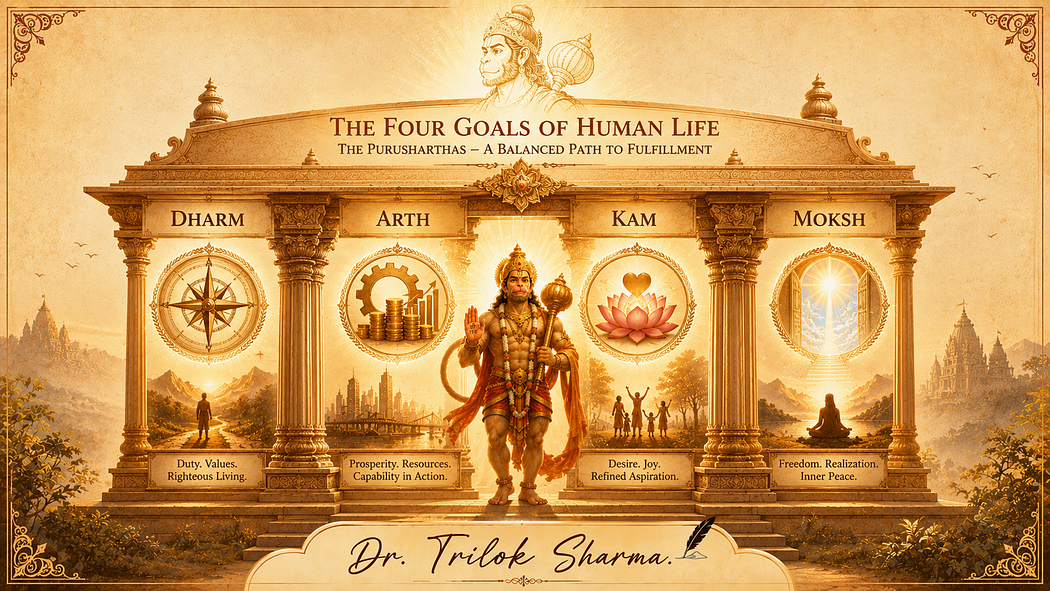
Dharma is right alignment.
Arth is resources, prosperity and capability.
Kam is desire, joy, aspiration and emotional fulfilment.
Moksh is inner freedom.
This framework is very important because it does not reject life. It does not say that wealth is bad, desire is bad or worldly action is bad.
It says: live fully, but live with direction.
The difficulty begins when life becomes imbalanced.
In today’s world, we often see Arth without Dharma. There is ambition, but sometimes no ethical centre.
We see Kam without discipline. There is desire, but no direction.
We see information without wisdom. People know many things, but remain confused in conduct.
We see networking without real connection. We are connected to many, but understood by few.
We see success without peace. People achieve a lot, yet remain restless within.
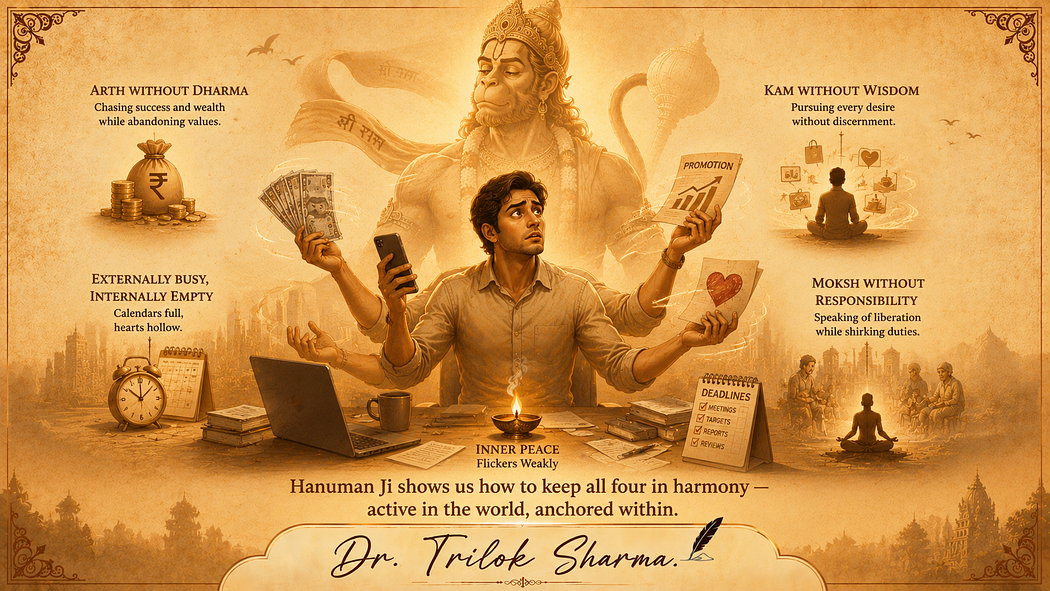
Hanuman Ji offers a beautiful harmony of all four Purusharthas.
He acts powerfully in the world, yet remains surrendered within.
He has strength, but not ego.
He has desire, but it is refined into Ram Karya.
He has resources, but uses them for service.
He has action, but remains inwardly free.
That is why I often say:
Hanuman Ji is the harmony of power and purity.
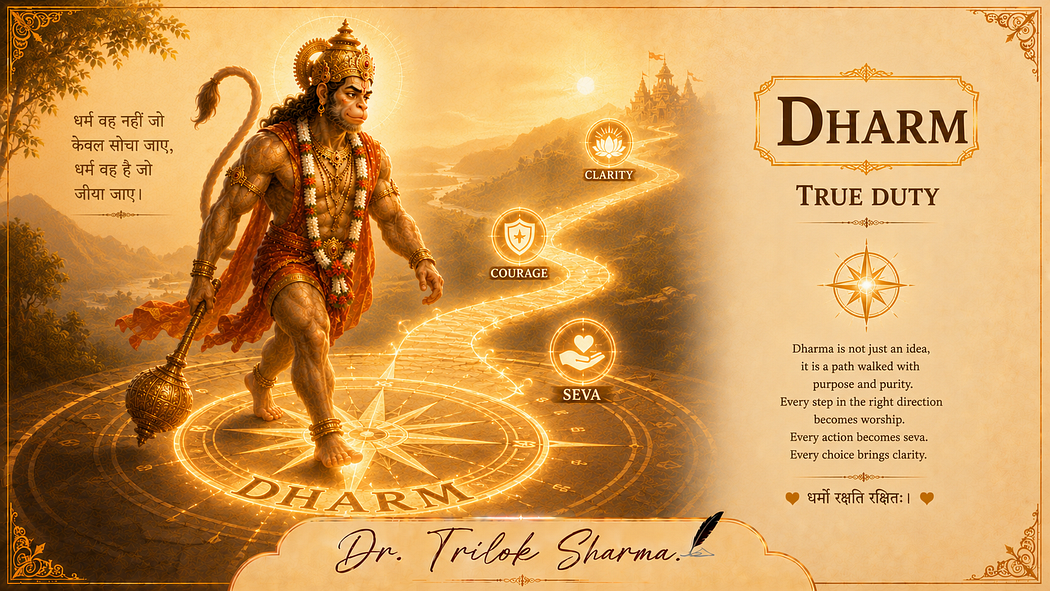
Dharma: The Courage to Do What Is Right
Dharma is often misunderstood as ritual or religion. But in daily life, Dharma means right action in the right spirit.
Hanuman Ji does not follow Dharma mechanically. He responds according to the situation.
When he meets Sita Mata in Ashok Vatika, he is gentle, respectful and compassionate.
When he stands in Ravan’s court, he is fearless and firm.
When he returns to Shri Ram, he is humble, surrendered and precise in his reporting.
This is a powerful lesson.
Dharma is not one fixed tone. Dharma is the right response at the right time.
A parent, teacher, leader or professional must understand this. Sometimes love requires softness. Sometimes love requires firmness. Sometimes truth must be spoken gently. Sometimes truth must be spoken with courage.
The practical question is:
When convenience and conscience stand on opposite sides, which one do I choose?
Arth: What Are My Resources Serving?
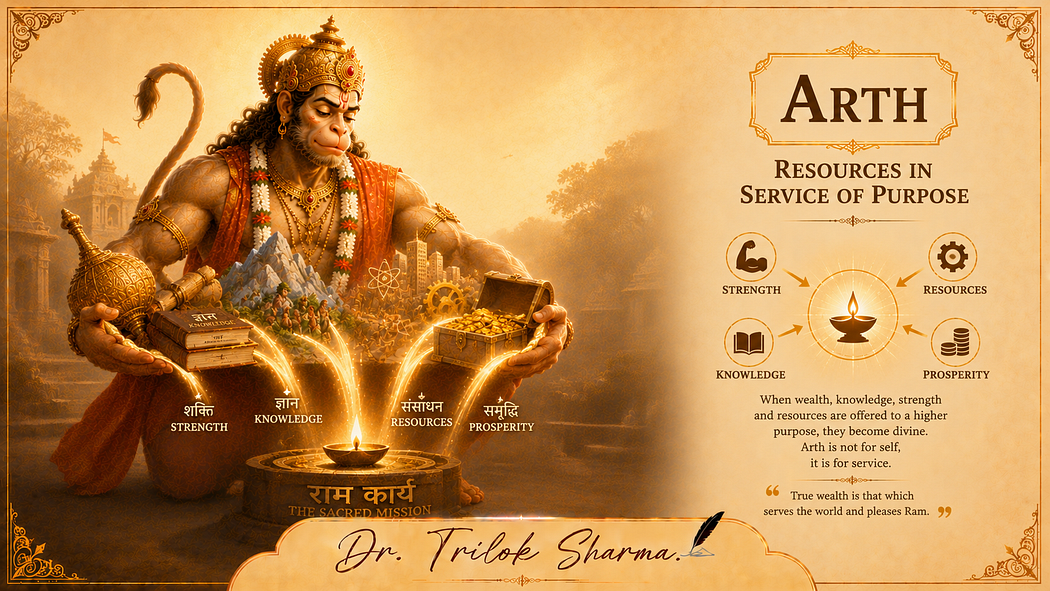
Arth is not only money.
Arth includes all resources — time, talent, knowledge, skills, network, health, position, influence and opportunity.
Hanuman Ji has extraordinary resources. He has strength, intelligence, speed, courage and communication skill.
But he does not use them for personal fame.
He connects Sugriv with Shri Ram.
He carries hope to Sita Mata.
He understands Vibhishan’s sincerity.
He motivates the Vanar Sena.
He brings Sanjeevani for Lakshman.
He dedicates everything to Ram Karya.
This is a great question for today’s professional world:
Is my capability serving only my growth, or is it serving a larger purpose?
A person may be talented, but talent without direction can become ego.
A person may be powerful, but power without purity can become dangerous.
Hanuman Ji shows us that resources become sacred when they serve a noble purpose.
Kam: Desire Needs Direction
The word Kam is often understood in a narrow sense. But in the broader Purushartha framework, Kam includes desire, joy, beauty, aspiration, relationship and creativity.
Desire itself is not the problem. Desire without discipline is the problem.
Hanuman Ji has tremendous energy. He is dynamic, swift, passionate and fully involved.

But his energy is not scattered.
His desire is refined into dedication.
He does not seem to say, “I want my name to become great.”
He seems to say, “I want Ram Karya to be completed.”
This is a life-changing shift.
When desire is only self-centred, it creates restlessness.
When desire becomes dedication, it creates purpose.
Moksh: Freedom While Living
Many people think of Moksh only as something after death. But there is also a practical beginning of Moksh in everyday life.
It begins as inner freedom.
Freedom from ego.
Freedom from comparison.
Freedom from insecurity.
Freedom from anger.
Freedom from the hunger for constant validation.
Freedom from the need to claim credit.
Hanuman Ji performs impossible tasks, yet remains free from ownership.
He crosses the ocean.
He finds Sita Mata.
He shakes Lanka.
He brings Sanjeevani.
He saves Lakshman.
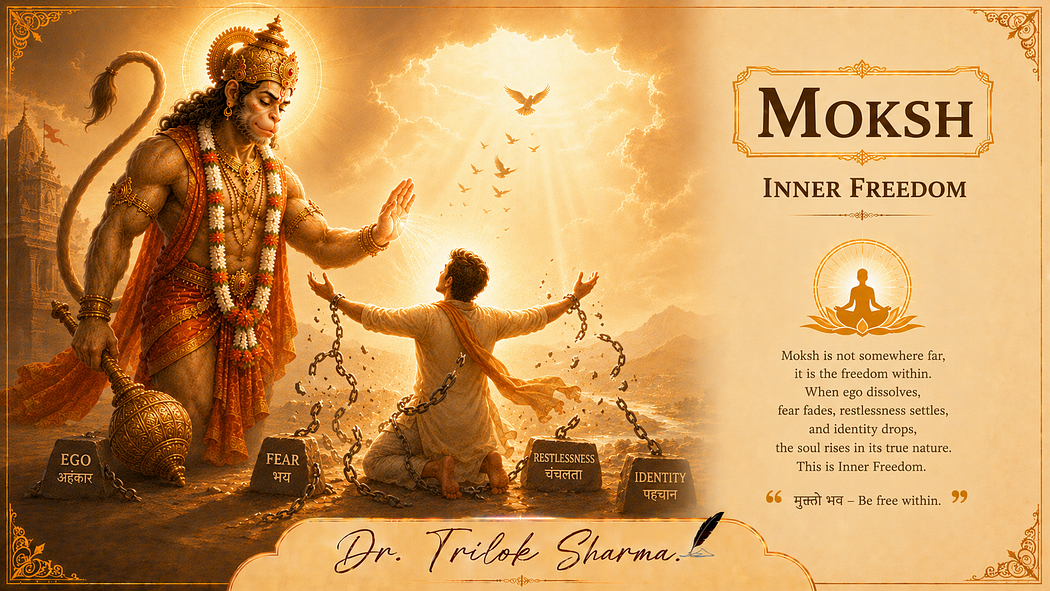
But after every achievement, the credit goes to Shri Ram.
In today’s world, where even small achievements are immediately converted into public display, Hanuman Ji reminds us:
Do the work. Give your best. But do not become the owner of the work.
That is inner freedom.
Sundarkand: The Chapter of Action
Sundarkand is not only beautiful poetry. It is a manual of courage, action, intelligence, devotion and crisis management.

One of the most powerful lines associated with Hanuman Ji’s spirit is:
राम काजु कीन्हें बिनु मोहि कहाँ बिसराम।
Until Ram’s work is done, where is rest for me?
This does not mean rest is bad. Rest is necessary. But comfort becomes dangerous when it interrupts purpose.
When Mainak Parvat offers rest, Hanuman Ji respects him but does not stop. He remains focused.
In modern life, many people do not fail because of lack of talent. They fail because comfort quietly becomes their cage.
Hanuman Ji teaches respectful discipline. Accept blessings, remain humble, but keep moving toward purpose.
Jambavant: The Mentor Who Awakens Strength
The episode of Jambavant is one of the finest lessons in mentoring.
Hanuman Ji has strength, but he has forgotten it. Jambavant reminds him.
This is not ordinary motivation. This is awakening.
A true mentor does not create your strength. He helps you recognize it.
A true mentor does not dominate your mind. He clears the fog around it.
A true mentor does not say, “Become like me.” He says, “Meet the best within yourself.”

Today, many young people suffer not because they lack ability, but because they have forgotten their ability.
They need a Jambavant.
And in someone else’s life, we may also become that Jambavant.
Before commanding someone, try reminding them. You may awaken a Hanuman in them.
Surasa: Strategy Is Greater Than Ego
The Surasa episode is a brilliant lesson in intelligence.
Surasa opens her mouth wide and challenges Hanuman Ji. He first expands his form. As she expands further, he becomes extremely small, enters her mouth and comes out, fulfilling the condition without wasting the mission.
This is not escape. This is strategy.

In life, not every challenge must be handled through force.
In conflict, negotiation, leadership and relationships, ego often says, “Prove yourself.”
Wisdom says, “Complete the mission.”
Sometimes, becoming small at the right moment is the highest form of intelligence.
Sita Mata: Communication Begins with Sensitivity
When Hanuman Ji reaches Ashok Vatika, he does not rush into delivering a message mechanically.
He first understands Sita Mata’s state of mind.
She is in pain. She is surrounded by fear and despair. She does not need a speech. She needs hope.
Hanuman Ji builds trust. He speaks with sensitivity. He presents Shri Ram’s mudrika as a symbol of assurance.
This is one of the greatest communication lessons.
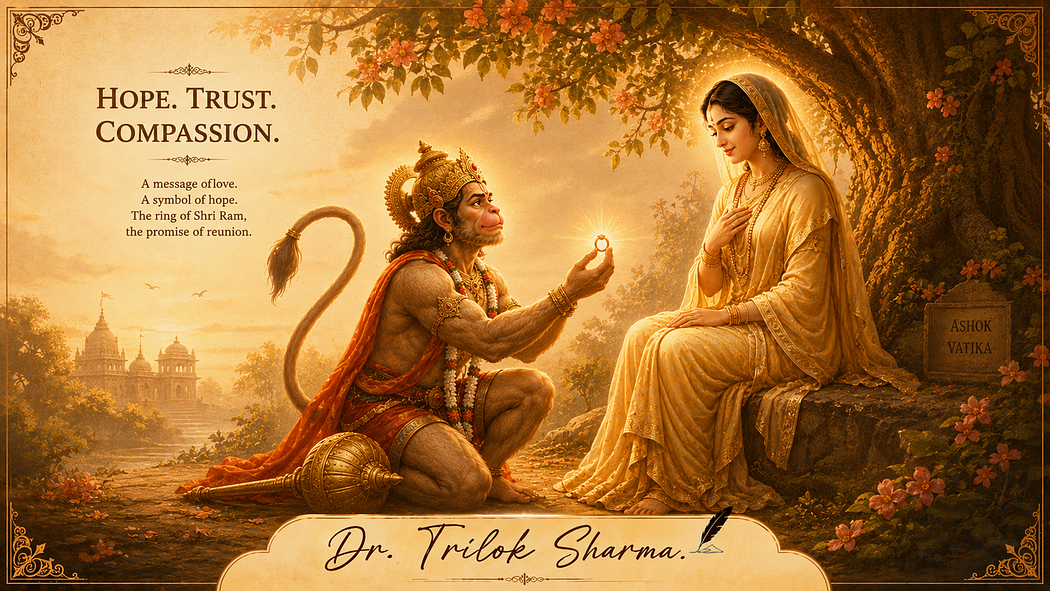
Communication is not only about what I want to say. It is also about what the other person is ready to receive.
For leaders, teachers, counsellors and parents, this is invaluable.
When a person is emotionally broken, do not begin with advice. Begin with presence.
Logic can wait. Trust must come first.
Lanka Dahan: Moral Courage, Not Ego
Lanka Dahan is often seen only as an act of destruction. But it is much deeper.
It is not personal anger. It is a strategic moral response in the context of Dharma.
The same Hanuman Ji who becomes सूक्ष्म before Sita Mata becomes विकट before the system of Adharma.
This is not contradiction. This is maturity.

Life requires adaptability.
Before pain, be gentle.
Before arrogance, be fearless.
Before truth, be humble.
Before injustice, be firm.
This is emotional intelligence with moral courage.
Sanjeevani: Action Under Uncertainty
The Sanjeevani episode gives a practical lesson in crisis leadership.
The situation is urgent. Lakshman’s life is at stake. The correct herb must be brought quickly. Hanuman Ji reaches the mountain but cannot identify the exact herb.

What does he do?
He brings the whole mountain.
This is not confusion. This is decisive action under uncertainty.
In modern organizations, many people suffer from analysis paralysis. They keep waiting for perfect information until the right moment passes.
Hanuman Ji teaches us:
When time is limited, intent is pure, and action is necessary, take the best possible decisive step.
In crisis, speed with sincerity may save what delay with perfection cannot.
The HANUMAN Life Framework
To make these lessons easy to remember, I use the word HANUMAN as a life framework.
This is not a scriptural formula. It is a teaching tool, a स्मरण-सूत्र.
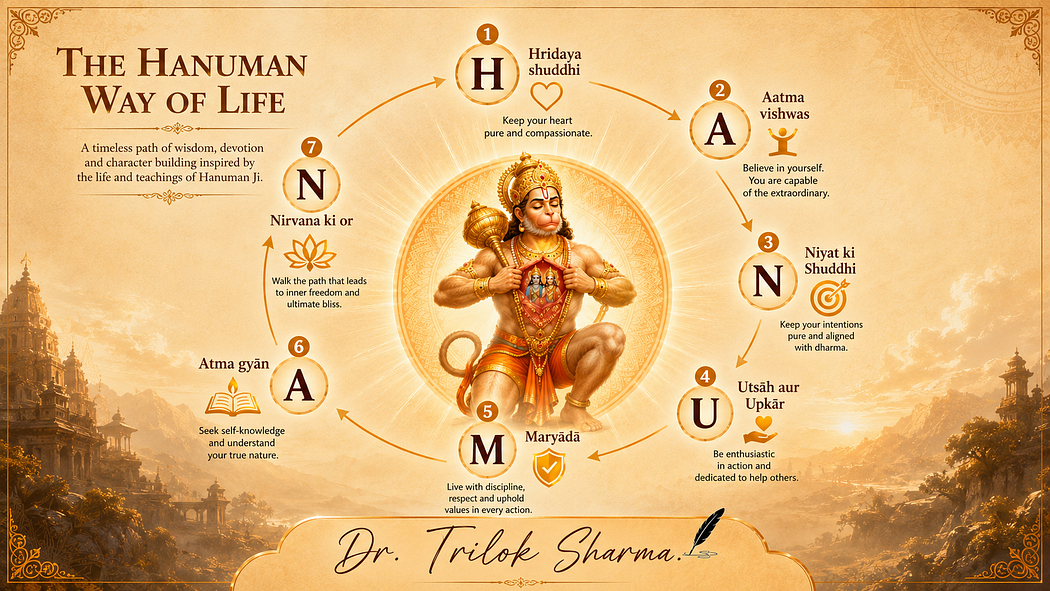
H — Hridaya Shuddhi and Humility
A clean heart is the foundation of right action.
Without purity of heart, intelligence may become manipulation. Power may become domination. Success may become arrogance.
Hanuman Ji is Mahabir, but his strength remains humble.
The test for us is simple:
Is my action coming from ego or seva?
A — Aatma Vishwas and Alliance Building
Hanuman Ji has immense confidence. But his confidence is not ego-driven. It is rooted in Ram-smaran, mission clarity and inner alignment.
He is also a builder of alliances. He connects Sugriv with Shri Ram. He understands Vibhishan. He works with the Vanar Sena.
Confidence and collaboration must go together.
Confidence without relationship becomes arrogance.
Relationship without confidence becomes dependency.
N — Niyat Ki Shuddhi
Intention changes the meaning of action.
Advice can be care, or it can be control.
Leadership can be upliftment, or it can be domination.
Charity can be compassion, or it can be image-building.
Hanuman Ji’s intention is always pure — Ram Karya.
When intention is clear, energy becomes focused.
U — Utsah and Upkar
Hanuman Ji is full of Utsah — energy, enthusiasm and action.
But his energy is not restless. It is useful.
That is the difference.
Modern people are very busy. But are we useful?
Can my energy reduce someone’s burden?
Can my presence give courage?
Can my words bring hope?
Can my work serve more than myself?
When Utsah meets Upkar, energy becomes sacred.
M — Maryada and Mind Control
True strength is not only the ability to act. It is also the ability to restrain oneself.
Hanuman Ji can do many things, but he respects Maryada.
He could have tried to bring Sita Mata back immediately, but he does not cross the boundary of Shri Ram’s command.
This is self-regulation.
Modern life often mistakes impulsiveness for freedom. But true freedom is the ability to govern oneself.
A — Abhyas and Atma Gyan
Hanuman Ji’s forgotten strength is awakened through reminder. This gives us a deep psychological insight.
Many of our strengths are sleeping within us.
Abhyas awakens them.
Daily remembrance, reflection, discipline, seva, study and self-observation slowly build inner power.
Atma Gyan begins with simple questions:
What drives me — fear, ego, greed or service?
What weakens me?
What gives me courage?
What is my real purpose?
N — Naam Bhakti and Nirvan Ki Or
Naam is not mechanical repetition. Naam is inner alignment.
When we take the name of Hanuman Ji, we invoke courage, purity, protection, devotion and strength.
Nirvan does not mean running away from life. It means becoming free from bondage while living life.
Hanuman Ji teaches that bhakti and action are not opposites.
True bhakti purifies action.
Purified action deepens bhakti.
Why Hanuman Ji Matters Today
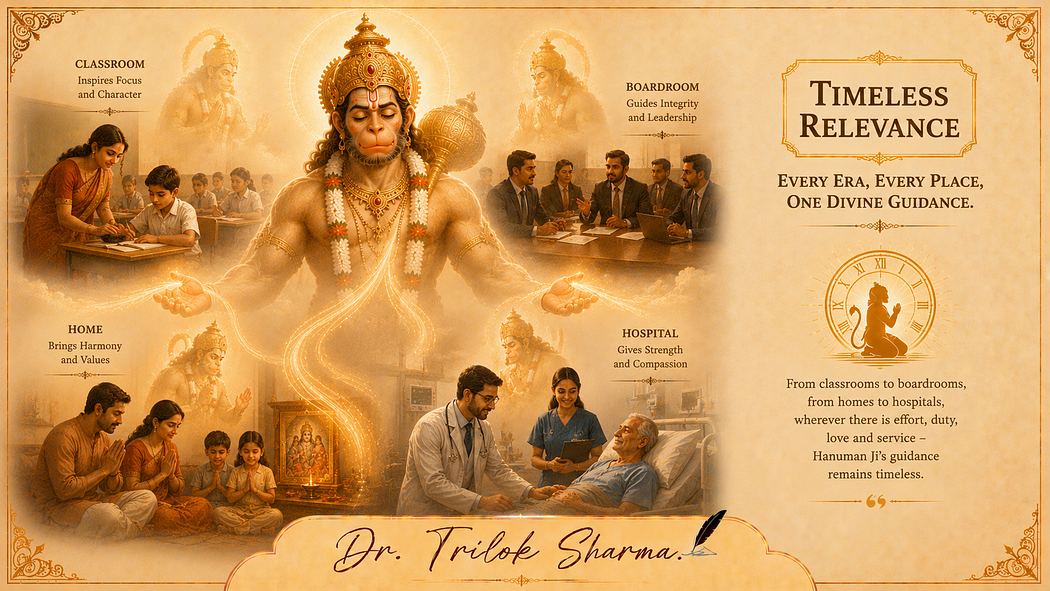
Hanuman Chalisa says:
चारों युग परताप तुम्हारा।
For me, this is not only praise. It is a statement of living presence.
Hanuman Ji IS. He is not merely a figure of the past.
Human challenges repeat in every age — fear, confusion, ego, desire, injustice, loneliness and insecurity.
That is why Hanuman Ji remains relevant.
Today’s world needs his model more than ever.
We are living with too much speed and too little stillness.
Too much information and too little wisdom.
Too much visibility and too little inner confidence.
Too much expression and too little listening.
Too much ambition and too little surrender.
Hanuman Ji gives an integrated path.
Be strong, but not arrogant.
Be intelligent, but not manipulative.
Be active, but not restless.
Be brave, but not cruel.
Be humble, but not weak.
Be devoted, but not passive.
If Hanuman Ji Were Our Mentor Today
If Hanuman Ji were our mentor today, perhaps he would not begin by asking about our degrees, job titles or achievements.

He may ask:
What is your intention?
Where is your energy going?
Are you using your strength for service or comparison?
Is your confidence coming from ego or inner alignment?
Can you speak truth with courage?
Can you remain humble after success?
Can you act without claiming ownership?
These are not only spiritual questions. These are leadership questions. Career questions. Parenting questions. Life questions.
The Final Message
Hanuman Ji is not only to be remembered in sankat. Hanuman Ji is to be practiced in jeevan.
When the heart becomes pure, intention becomes clear, energy becomes useful, speech becomes sensitive, action becomes disciplined, and success becomes an offering — the Hanuman Way begins.

His name gives strength.
His way gives direction.
Bhakti begins with naam, but becomes complete in acharan.
Strength becomes sacred only when it bows to seva.
And perhaps the real Hanuman Chalisa begins when the words become conduct.
Jai Shri Ram. Jai Hanuman.