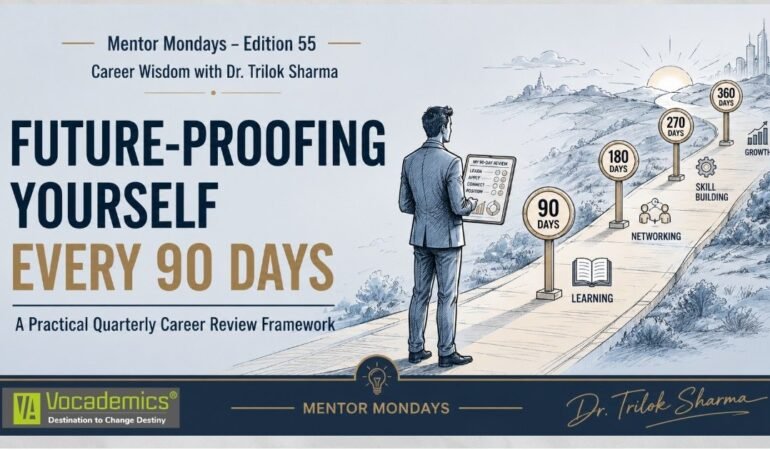
Future-Proofing Yourself Every 90 Days

A Quarterly Career Review Framework for Staying Relevant

Your future is not protected by what you achieved yesterday. It is protected by what you choose to learn, build, and become today.- Dr. Trilok Sharma

Most professionals conduct a performance review once a year.

Unfortunately, the world no longer changes once a year.

Technology evolves every few months. Industries transform rapidly. New skills emerge. Old skills lose relevance. Business models shift. Customer expectations change.

Yet many professionals continue to operate with an outdated assumption:

“If I keep working hard, my career will automatically move forward.”

Hard work remains important.

But today, hard work without periodic reinvention can quietly lead to stagnation.

The professionals who thrive in the coming decade will not necessarily be the most intelligent, the most experienced, or even the most qualified.

They will be the ones who consistently adapt.

That is why I encourage professionals to adopt a simple habit:

Conduct a personal career review every 90 days.

Not every year.

Every quarter.

Because career growth is no longer an annual event. It is a continuous process.

Article content

Why Every 90 Days?

Think about how much can change in three months.

A new technology enters your industry.

A competitor launches a disruptive product.

A new leadership team arrives.

Customer expectations shift.

A skill that was considered advanced six months ago becomes a basic expectation.

Three months is long enough to make meaningful progress.

At the same time, it is short enough to correct mistakes before they become expensive.

Organizations conduct quarterly business reviews because markets move quickly.

Professionals should do the same for their careers.

If companies need quarterly reviews to remain competitive, individuals need them to remain employable.

The Biggest Career Risk Today

Many people believe their biggest career risk is losing a job.

I disagree.

The biggest risk is becoming professionally outdated without realizing it.

Career decline rarely happens suddenly.

It usually happens quietly.

One year without learning.

A few years without meaningful networking.

Several years relying on old expertise.

Gradually, the market moves forward while the individual stays where they are.

Experience remains valuable.

But experience without evolution eventually becomes history.

The question is not:

“How many years of experience do I have?”

The more important question is:

“How relevant is my experience today?”

Article content

The 90-Day Career Review Framework

Every quarter, review yourself in four areas:

Learn

Apply

Connect

Position

These four dimensions create a practical system for long-term career relevance.

1. LEARN

What Have You Learned During the Last 90 Days?

Learning is no longer a phase of life.

It is a permanent professional responsibility.

Article content

Ask yourself:

  • What new skill have I learned?
  • What industry trend do I understand better today?
  • What book, course, certification, podcast, workshop, or project expanded my thinking?
  • What knowledge will make me more valuable in the next three years?

Many professionals proudly discuss what they learned ten years ago.

Future-ready professionals can explain what they learned during the last ten weeks.

Continuous learning is no longer a competitive advantage.

It is becoming a survival skill.

2. APPLY

What Have You Actually Used?

Learning creates potential.

Application creates value.

Many people consume endless content but never convert knowledge into capability.

Ask yourself:

  • Which new skill have I applied?
  • What process have I improved?
  • What problem have I solved differently?
  • What measurable result was created because I learned something new?

Reading about leadership does not develop leadership.

Leading people does.

Studying communication does not improve communication.

Practicing communication does.

The market rewards demonstrated capability, not accumulated information.

3. CONNECT

Who Knows You and Trusts You?

Career opportunities often arrive through relationships before they appear through job portals.

Networking is frequently misunderstood.

It is not about collecting contacts.

It is about building credibility and trust.

Article content

Every 90 days ask:

  • Which professional relationships have I strengthened?
  • Which former colleagues have I reconnected with?
  • Which industry conversations have I participated in?
  • Who have I helped without expecting immediate returns?

Relationships compound over time just like investments.

Many career opportunities emerge not because someone was searching for a job, but because someone remembered them when an opportunity appeared.

Your network is not merely a list of contacts.

It is your professional ecosystem.

4. POSITION

Can Others Clearly See Your Growth?

One of the most common career mistakes is invisible excellence.

Many professionals do excellent work.

Very few communicate it effectively.

Ask yourself:

  • Have I updated my LinkedIn profile recently?
  • Have I shared meaningful insights?
  • Have I documented my achievements?
  • Can someone easily understand my expertise?

Visibility is not self-promotion.

Visibility is clarity.

If people cannot understand your value, they cannot recommend you, hire you, promote you, or collaborate with you.

The objective is not to become famous.

The objective is to become discoverable.

The Quarterly Career Scorecard

At the end of every 90 days, rate yourself from 1 to 10.

Area

Score

Learning ___ /10

Application ___ /10

Networking ___ /10

Positioning ___ /10

Total Score: ___ /40

Track your score every quarter.

Do not compare yourself with others.

Compare yourself with the person you were 90 days ago.

Small improvements repeated consistently create extraordinary results over time.

A Simple Rule for the Next Decade

If every 90 days you:

✔ Learn one meaningful thing

✔ Apply one new capability

✔ Strengthen a few professional relationships

✔ Improve your professional visibility

You will remain ahead of most professionals.

Not because you are working harder.

But because you are evolving faster.

Article content

Final Reflection

The future cannot be predicted perfectly.

But it can be prepared for consistently.

Career security no longer comes from a designation.

It no longer comes from a degree earned years ago.

It no longer comes from staying in the same organization for decades.

Career security now comes from adaptability.

And adaptability is built through small, regular upgrades.

So before the next quarter begins, ask yourself one simple question:

“If my industry changes tomorrow, how prepared am I today?”

Then schedule a meeting with the most important person responsible for your career -“Yourself”

Because the most successful professionals are not those who resist change.

They are the ones who review, learn, adapt, and grow—every 90 days.

Read More
The Career Risk Map: Are You Walking Blind in Your Own Career?

The Career Risk Map: Are You Walking Blind in Your Own Career?

“Most professionals plan their work carefully. Very few ever plan the risks hiding inside their career.” — Dr. Trilok Sharma

Let me ask you something honest- When did you last sit quietly and ask yourself — “Is my career actually safe right now?”

Not your job. Not your designation. Not your salary slip. Your career — the long arc of your professional life, your relevance, your readiness, your relationships in the world of work.

Most of us don’t ask that question. Not because we are lazy. But because we are busy. Deadlines, meetings, deliverables, WhatsApp groups, quarterly reviews — life fills up fast. And career reflection gets postponed to someday.

But here is the quiet, uncomfortable truth: careers don’t collapse suddenly. They erode slowly. The risk was always there. We just weren’t watching the map.

Article content

Today, let us draw that map together.

What Is a Career Risk Map?

A career risk map is not a scary document. Think of it as a honest mirror — one that shows you not just where you are, but where the cracks are forming beneath the surface.

Every professional, regardless of age, industry or seniority, carries at least four invisible risks at any given point in their career journey:

  1. Outdated Skills
  2. Weak or Shrinking Network
  3. Poor Professional Visibility
  4. No Real Learning Plan

These are not dramatic failures. They are quiet gaps. And in today’s world — where AI is reshaping roles, industries are reorganizing and talent expectations are changing fast — these gaps are becoming career liabilities faster than ever before.

Article content

Let us look at each one honestly :-

Risk 1 — The Outdated Skills Trap

Imagine a doctor who stopped reading medical journals in 2015. Or a finance professional who has never touched a data analytics tool. Or a manager who still leads teams the way it was done in 2005.

Skills have an expiry date now. Not a long one.

This is not about chasing every new technology. It is about asking a simple question every six months: “Is what I know still relevant to what the world needs?”

The professionals who are quietly losing ground are not incompetent people. They are people who stopped updating. They assumed that experience alone would carry them forward. It used to. It does not, as reliably, anymore.

Mentor’s Checkpoint: List your top five professional skills. Now ask — which of these would still be valued three years from now? Which ones have already started losing weight?

Risk 2 — The Shrinking Network Problem

A network is not a LinkedIn connection count. A network is the number of people who would genuinely respond if you reached out today — people who know your work, trust your character and would recommend you without hesitation.

Article content

Many professionals build relationships when they need something and go quiet in between. That is not a network. That is a contact list with transactional memories.

The real career risk is this: when you actually need your network, it is too thin, too old or too cold.

In the AI age, human relationships are becoming more valuable, not less. Machines can match resumes to job descriptions. They cannot replace the phone call that a trusted colleague makes on your behalf. They cannot replicate the warmth of a mentor who speaks your name in a room you are not in.

Mentor’s Checkpoint: How many meaningful professional conversations did you have last month — not for any transaction, just to connect, learn or give? If the answer is “very few,” your network is slowly drying up.

Risk 3 — The Invisible Professional

Here is a pattern I have seen across many careers: a genuinely capable person, doing honest, quality work — and yet slowly becoming professionally invisible.

They do not write. They do not speak. They do not share what they know. They attend conferences but never raise a hand. They have opinions but rarely voice them in the right rooms.

In an era of information abundance, invisibility is a career risk. Not because you must become loud or performative — please, not that — but because the world needs to know that you exist, that you think and that you contribute.

Quiet Ambition — which we explored in our earlier edition — is about doing great work without drama. But quiet does not mean absent. There is a difference between dignity and disappearance.

Article content

Your visibility is your professional oxygen. Breathe in a room. Leave a thought. Publish a reflection. Speak at a team meeting. Mentor someone younger. Be findable when opportunity comes knocking.

Mentor’s Checkpoint: If someone Googled your name or looked at your LinkedIn today, what would they find? Would it reflect who you truly are as a professional — your thinking, your values, your expertise? Or is there a gap between your real self and your digital presence?

Risk 4 — No Learning Plan

This is perhaps the most common and the most quietly dangerous risk of all.

Ask a professional, “What are you learning right now?” and many will pause awkwardly. Some will mention a course they started six months ago and never finished. Others will say they are “picking things up on the job.” A few — a very few — will describe an actual, intentional learning habit.

Article content

A learning plan does not have to be a grand document. It can be as simple as:

  • One book every six weeks
  • One new skill explored every quarter
  • One conversation with a domain expert every month
  • One hour per week invested in deliberate reflection

But it has to be intentional. The world is not waiting for you to catch up. AI tools are being built and deployed faster than most training programmes can keep pace with. The only real defence is a professional who has made learning a permanent lifestyle — not an occasional event.

Mentor’s Checkpoint: Do you have a personal learning plan for the next 12 months? Not your company’s training calendar. Yours. If not, that is the most important career task you could begin this week.

Drawing Your Own Career Risk Map

Here is a simple framework I call the SVNL Check — four questions, one honest conversation with yourself.

Risk Area

The Question to Ask Yourself

S — Skills : Are my current skills future-relevant, or am I coasting on yesterday’s expertise?

V — Visibility : Does the professional world know I exist, think and contribute?

N — Network : Do I have relationships built on genuine trust, not just convenience?

L — Learning : Is there an active, intentional learning plan in my life right now?

Score yourself honestly — not to feel bad, but to feel ready. Every gap you name today is a gap you can close tomorrow.

A Word on Fear — and Why This Is Not That

I want to say this clearly.

The Career Risk Map is not about fear. It is not about panic. It is not about abandoning what you are doing and running towards the next shiny certification.

It is about clarity with courage.

The most resilient professionals I have met — across industries, across geographies, across decades — were not the ones who were never at risk. They were the ones who knew where their risks were and did something steady and intentional about them.

A ship’s captain does not fear the sea. But he always checks the map.

This Week’s Reflection Question

“If you were to honestly draw your Career Risk Map today — which of the four areas would show the biggest gap? And what is one small thing you could do this week to begin addressing it?”

Sit with that question. Write your answer somewhere. And then do the one small thing.

That is how meaningful careers are built — not in dramatic leaps, but in honest, steady, intentional steps.

Read More
Human Judgment in a Machine-Driven World

Human Judgment in a Machine-Driven World

Why Decision-Making, Ethics and Context Will Remain Human Strengths

Article content

We are entering a world where machines can write, calculate, analyze, predict, summarize and even advise.

  • AI can prepare reports.
  • AI can compare resumes.
  • AI can draft emails.
  • AI can analyze data.
  • AI can suggest decisions.

But here is the important question: Can AI take responsibility for the decision?

The answer is no.

And that is why human judgment will remain one of the most important professional skills in the AI age. AI may become faster than us. AI may become more informed than us. AI may process more data than us. But AI does not carry human responsibility. It does not understand consequences in the way a parent, teacher, doctor, manager, judge, entrepreneur, mentor or leader understands them.

A machine can suggest – A human must decide.

AI Can Process, Humans Must Interpret.

In professional life, decisions are rarely based only on data.

  • A hiring decision is not only about qualifications. It is also about potential, attitude, team fit and growth possibility.
  • A promotion decision is not only about performance numbers. It is also about consistency, responsibility, trust and leadership readiness.
  • A business decision is not only about profit. It is also about timing, reputation, risk, ethics and people.
  • A career decision is not only about salary. It is also about meaning, family, health, learning, stability and long-term growth.

This is where human judgment becomes important.

  • AI can give options, but humans understand situations.
  • AI can give patterns, but humans understand pain.
  • AI can give probability, but humans understand priority.
  • AI can give answers, but humans must ask: “Is this right?” “Is this fair?” “Is this practical?” “Is this humane?” “Is this suitable for this person, this family, this company, this society?”

That final layer of understanding is judgment.

Article content

The Danger of Outsourcing Thinking

One of the biggest risks of AI is not that machines will think too much. The bigger risk is that humans may start thinking too little.

When AI gives a polished answer, we may feel satisfied too quickly. When AI gives a confident recommendation, we may stop questioning. When AI gives a smart-looking report, we may forget to check ground reality.

This is dangerous, because:

  • A well-written answer is not always a wise answer.
  • A fast answer is not always a fair answer.
  • A data-based answer is not always a complete answer.
  • A machine-generated answer is not automatically a responsible answer.

In the AI age, professionals must develop a new habit: Do not outsource your judgment.

Use AI. Consult AI. Learn from AI. Take help from AI. But do not surrender your thinking.

Article content

Three Human Strengths AI Cannot Replace Easily

1. Context

AI can analyze what is given to it. But human beings understand the hidden background.

We know the tone of a meeting. We understand family pressure. We sense fear behind silence. We recognize when someone is technically correct but emotionally broken. We understand local realities, cultural meanings and personal histories.

Context is not always written in the file.

Sometimes context lives in memory, relationship, observation and experience.

That is why teachers, counsellors, mentors, managers and leaders cannot depend only on AI output. They must bring lived understanding.

2. Ethics

AI can tell us what is possible, but humans must decide what is right.

Just because something can be done does not mean it should be done.

Article content
  • Can AI screen candidates? Yes. But can it be biased? Also yes.
  • Can AI generate marketing content? Yes. But can it mislead people? Also yes.
  • Can AI track employee productivity? Yes. But can it damage trust? Also yes.
  • Can AI create academic content? Yes. But can it weaken originality? Also yes.

Ethics is the courage to ask uncomfortable questions.

Is this fair? Is this transparent? Is this respectful? Is this harming someone silently? Is this legal but still morally questionable?

Machines do not feel moral discomfort…Humans must.

3. Decision Responsibility

A decision is not complete when it is selected.

A decision is complete when someone owns its consequences.

  • If a student chooses a career wrongly, a family suffers.
  • If a company hires wrongly, a team suffers.
  • If a hospital system recommends wrongly, a patient suffers.
  • If a leader cuts jobs blindly, households suffer.
  • If a government policy ignores ground reality, citizens suffer.

Responsibility is not a button. It is a moral burden. And that burden must remain on human.

The New Professional Skill: AI-Assisted Judgment

The future professional should not reject AI. That would be foolish.

But the future professional should not blindly obey AI either. That would be dangerous.

The real skill is AI-assisted judgment.

It means:

  • using AI to gather information
  • using AI to generate options
  • using AI to compare possibilities
  • using AI to challenge assumptions
  • using AI to prepare drafts
  • but using human wisdom to make the final decision

This is the balance we need.

  • AI as assistant. Human as accountable decision-maker.
  • AI as support. Human as conscience.
  • AI as speed. Human as direction.
Article content

A Simple Human Judgment Checklist

Before accepting an AI-generated answer, ask these seven questions:

  1. Is this factually correct?
  2. Is the context complete?
  3. Is this ethical?
  4. Is it fair to all affected people?
  5. Is it practical in real life?
  6. What could go wrong if I follow this?
  7. Am I ready to take responsibility for this decision?

This checklist may look simple.

But in uncertain times, simple questions often protect us from big mistakes.

A Mentor’s Note

Dear students, professionals, teachers, managers and leaders,

AI will become part of your work. There is no point denying it.

But please remember:

Your career value will not come only from using AI tools.

It will come from your ability to think clearly, judge wisely and act responsibly.

Machines may become intelligent. But professionals must remain wise.

Machines may become fast. But leaders must remain fair.

Machines may become powerful. But humans must remain accountable.

In the coming years, the most respected professionals will not be those who blindly follow technology.

They will be those who use technology with maturity.

They will know when to ask AI. They will know when to question AI. They will know when to reject AI. And most importantly, they will know when to stand by a decision.

Because in a machine-driven world, human judgment will not become outdated.

It will become priceless.

AI can suggest. Human conscience must decide.

Need career clarity in the age of AI? Explore structured guidance, career counselling and future-readiness support at: https://vocademics.edumilestones.com


Read More
Prompting Is the New Professional Skill

Prompting Is the New Professional Skill

How AI Communication, Questioning and Clarity Are Becoming Career Skills

A few years ago, when we heard the word “prompt”, most of us thought of a school question paper. Today, “prompt” has entered offices, classrooms, boardrooms, consulting rooms, design studios, HR departments, marketing teams, legal desks, research cells, and even family discussions.

But let me say this very clearly: Prompting is not typing a question into ChatGPT. Prompting is the skill of thinking clearly before asking.

Article content

And this is why prompting is becoming a new professional skill.

In the age of AI, the quality of your answer will often depend on the quality of your question. This is not new wisdom. Good teachers, mentors, counsellors, researchers and leaders have always known this.

A confused question rarely produces a clear answer. AI has simply made this truth visible.

The New Career Divide

In the coming years, the real divide may not be only between those who know AI and those who do not. The deeper divide may be between:

  1. people who give vague instructions
  2. and people who can define problems clearly
  3. people who ask random questions
  4. and people who ask structured questions
  5. people who copy AI output blindly
  6. and people who guide, review, correct and improve it
  7. people who use AI as a shortcut
  8. and people who use AI as a thinking partner

AI is powerful, but it is not a mind reader. It responds to clarity. It improves with context. It performs better when the human user knows what he or she wants. In simple words:

AI does not replace thinking. It exposes the absence of thinking.

Article content

Why Prompting Is More Than a Technical Skill

Many people wrongly believe that prompting is a technical skill meant only for coders, engineers or AI specialists. No. Prompting is also a communication skill. It is a thinking skill. It is a questioning skill. It is a professional clarity skill.

A good prompt requires you to know five things:

  1. What exactly do I want?
  2. Why do I want it?
  3. Who is the audience?
  4. What context should the AI know?
  5. What output format will be useful?

This is not machine language. This is professional maturity.

For example, instead of asking: “Write a resume.”

A better professional prompt would be:

“Create a concise resume summary for a mid-level sales professional with 8 years of B2B experience, strong distributor management skills, and a target role in FMCG regional sales. Keep the tone confident but not exaggerated.”

See the difference?

The first prompt is a request. The second prompt is direction.

And direction is a leadership skill.

The Professional Who Knows How to Ask Will Move Faster

In every workplace, there are people who work hard but remain stuck because they cannot define the problem clearly.

They say: “Something is not working.” “My team is not responding.” “My career is not moving.” “My resume is not strong.” “My interview is not going well.” “My business idea is not clear.”

AI can help in all these situations, but only when the person learns to convert confusion into a clear question. A good prompt is not only about getting an answer from AI. It is about organizing your own mind.

That is why prompting can become a career accelerator.

A student who can ask better questions can learn faster. A manager who can frame better prompts can prepare better reports. A consultant who can brief AI properly can save research time. A teacher who can prompt well can design better learning material. A job seeker who can use AI wisely can improve resumes, interview answers and career planning. An entrepreneur who can question AI properly can test business ideas before spending money.

Article content

Prompting is not magic, but it can reduce confusion, save time, improve thinking and increase professional productivity. And in uncertain times, that matters.

Bad Prompting Creates Bad Confidence

Article content

There is one danger also- AI gives polished answers even when the question is weak, this creates false confidence.

A person may receive a well-written answer and assume it is correct, complete and suitable. But AI may miss context, misunderstand tone, generalize the issue, or give an answer that looks impressive but is not practical. So the future professional must learn not only prompting, but also reviewing.

The new skill is not:

“Ask AI and use the answer.”

The new skill is:

“Ask clearly, check carefully, improve thoughtfully, and apply wisely.”

This is where human judgment remains powerful. AI can generate, but humans must evaluate.

AI can suggest, but humans must decide.

AI can draft, but humans must own the final responsibility.

The Five-Part Prompting Habit

Professionals do not need complicated formulas to begin. They can start with a simple five-part habit.

1. Give the Role

Tell AI what role it should play. Example: “Act as a career mentor…” “Act as an HR interviewer…” “Act as a business consultant…” “Act as a communication coach…”

2. Give the Context

Explain the situation briefly.

Who are you? What is the problem? What is the audience? What is the background?

Without context, AI gives generic advice. With context, AI becomes more useful.

3. Give the Task

Say exactly what you want.

Do you want a draft, summary, comparison, checklist, plan, table, email, caption, speech, framework or analysis?

Clarity saves time.

4. Give the Tone

Mention the emotional and professional tone.

Formal. Warm. Simple. Persuasive. Academic. Conversational. Motivational. Crisp. Empathetic.

Tone is not decoration. Tone decides connection.

5. Give the Format

Ask for the output in the form you need.

Bullet points. Table. LinkedIn post. Email draft. 30-day plan. Interview answer. One-page note. Presentation outline.

A useful answer is not only correct, it must also be usable.

Prompting and Career Future-Proofing

Article content

In the AI age, every professional must become a better communicator.

Not only with people. But also with intelligent tools.

This does not mean we should become dependent on AI. It means we should learn to work with AI intelligently.

The future will need professionals who can:

  1. define problems clearly
  2. ask sharp questions
  3. give proper context
  4. verify information
  5. improve drafts
  6. connect AI output with human reality
  7. communicate with judgment
  8. protect ethics, originality and responsibility

This is why prompting is not a small trick, it is a career skill.

It teaches us to think before asking. It teaches us to clarify before acting. It teaches us to review before accepting. It teaches us to communicate with purpose.

A Mentor’s Note

Dear young professionals, students, teachers, managers and career seekers, do not fear AI, but do not worship it blindly either.

Treat it as a powerful assistant, not as your replacement. Your future value will not come from typing faster. It will come from thinking deeper.

AI may give you information. But you must bring wisdom.

AI may give you options. But you must bring judgment.

AI may help you write. But you must know what is worth saying.

So, start learning prompting today.

Not as a fashionable AI word. But as a discipline of clarity.

Because in the future workplace, the person who knows how to ask will often know how to lead. And sometimes, the best career skill is not having all the answers, it is learning how to ask the right question.

Prompting is not just an AI skill. It is the new language of professional clarity.

Need career clarity in the age of AI? Explore structured guidance, career counselling and future-readiness support at: https://vocademics.edumilestones.com

Read More
The AI-Proof Career Mindset

The AI-Proof Career Mindset

How to Stay Valuable in a Changing World

A few years ago, career advice was simple.

Get a good degree. Find a stable job. Work hard. Grow slowly.

That world has not completely disappeared, but it has certainly changed.

Today, students are asking different questions.

Will AI take my job? Which skills will remain useful? Is my degree enough? Should I learn coding, data, AI tools, communication, or all of them? What should I do today so that I do not become irrelevant tomorrow?

These questions are real. And we should not dismiss them casually.

The world of work is changing very fast. According to the World Economic Forum’s Future of Jobs Report 2025, skills like AI and big data, analytical thinking, creative thinking, resilience, flexibility, agility and technological literacy are expected to become increasingly important. The same report also highlights that human-centric skills like leadership, curiosity, lifelong learning, systems thinking and self-awareness will remain highly relevant.

So the future is not only about AI.

It is about the kind of human being who can work intelligently with AI.

That is why the real question is not:

“Will AI replace me?”

The better question is:

“Am I becoming the kind of person AI cannot easily replace?”

AI Is Not the Enemy. Carelessness Is.

Article content

Many people are making two opposite mistakes.

Some are afraid of AI and want to avoid it completely.

Some are overexcited and believe AI will do everything for them.

Both are dangerous.

If you ignore AI, you may become outdated. If you blindly depend on AI, you may become shallow.

The right approach is simple:

Use AI as a tool. Do not surrender your thinking to it.

AI can draft. But you must decide.

AI can generate options. But you must judge.

AI can give information. But you must understand context.

AI can create speed. But you must bring wisdom.

That is the AI-proof mindset.

The New Career Reality

In the earlier world, knowledge itself created advantage.

Today, knowledge is available everywhere.

The real advantage is in:

  • asking better questions
  • interpreting information correctly
  • solving real problems
  • communicating with clarity
  • learning continuously
  • staying emotionally steady
  • taking ethical decisions

AI can support these abilities, but it cannot replace the full human depth behind them.

A recent World Economic Forum report on human advantage also points out that many employers still see gaps in creativity, problem-solving, curiosity, lifelong learning, resilience and flexibility in the workforce.

This means one thing very clearly:

The future will reward those who combine technology with maturity.

Not technology alone. Not maturity alone. Both together.

Article content

The AI-Proof Career Mindset: 7 Shifts

1. From Degree Mindset to Learning Mindset

A degree may open the first door. But learning keeps the doors open.

In the AI era, education cannot end with college. It must continue through courses, reading, projects, internships, tools, mentors and real-world exposure.

The most dangerous sentence in any career is:

“I already know enough.”

No, my young friends. You don’t. None of us do.

The future belongs to lifelong learners.

2. From Job Security to Skill Security

Earlier, people searched for a secure job.

Today, the wiser goal is to build secure skills.

A job can be affected by recession, automation, restructuring or business slowdown.

But strong skills travel with you.

Communication travels. Problem-solving travels. Leadership travels. Digital literacy travels. Emotional maturity travels. Ethical judgment travels.

Your company may change. Your designation may change. Your industry may change.

But your capability remains your real insurance.

Article content

3. From Information Collection to Judgment Building

AI can give information in seconds.

But information is not wisdom.

Wisdom means knowing:

What is relevant? What is reliable? What is ethical? What is practical? What is suitable for this situation?

The future will not reward people who simply collect information.

It will reward people who can judge information.

In simple words:

AI can give you answers. Your career will depend on the quality of your questions and decisions.

4. From Tool Usage to Tool Mastery

Many students proudly say, “I use AI.”

Good.

But the real question is:

How do you use it?

Do you use it to copy? Or do you use it to think better?

Do you use it to avoid effort? Or do you use it to improve effort?

Do you use it to create shortcuts? Or do you use it to create better quality?

There is a difference between using AI and becoming an AI-assisted professional.

An AI-assisted professional knows how to prompt, verify, edit, apply and take responsibility.

Remember:

AI can assist your work. It cannot own your accountability.

5. From Competition with Machines to Collaboration with Machines

A calculator did not destroy mathematics. It changed how we used mathematics.

Similarly, AI will not destroy all careers. It will change how careers are performed.

The wise professional will not fight the machine unnecessarily.

The wise professional will learn to work with the machine intelligently.

For example:

A teacher can use AI to prepare examples, but classroom warmth remains human. A manager can use AI to analyse data, but team trust remains human. A lawyer can use AI to research cases, but judgment remains human. A doctor can use AI to detect patterns, but empathy remains human. A writer can use AI to brainstorm, but lived experience remains human.

The future belongs to human + AI, not human versus AI.

6. From Fast Output to Deep Thinking

AI has made output faster.

But speed can become a trap.

Like, Fast food is not always a Good Food. Fast content is not always good Content. Fast Answers are not always Wise answers. Fast Decisions are not always Correct decisions.

In careers, speed matters. But depth matters more.

Article content

If everyone can produce something quickly using AI, then the real difference will be created by:

  • depth of thinking
  • originality of insight
  • quality of judgment
  • emotional intelligence
  • ethical responsibility

Do not become only a fast worker.

Become a thoughtful worker.

7. From Fear to Preparedness

Fear says: “AI will take my job.”

Preparedness says: “I will learn how to remain useful.”

Fear freezes you. Preparedness moves you.

Fear complains. Preparedness upgrades.
Fear compares. Preparedness acts.

The AI-proof career mindset is not about panic. It is about disciplined preparation.

A Simple AI-Proof Career Formula

Use this simple formula:

AI Skill + Human Skill + Domain Skill = Future Career Strength

You need all three.

AI Skill means knowing how to use modern tools intelligently. Human Skill means communication, empathy, leadership, creativity and ethics. Domain Skill means deep knowledge of your chosen field.

If you have only AI skill, you may become a tool operator.

If you have only human skill, you may remain warm but not future-ready.

If you have only domain skill, you may become outdated.

But when all three come together, you become powerful.

What Students Should Do Now

Start with these five actions:

1. Learn one AI tool properly

Do not just experiment randomly. Learn how to use it for research, writing, analysis, presentation or productivity.

2. Build one real project

A project proves more than a certificate. Create something visible.

3. Improve communication

Write better. Speak better. Listen better. Present better.

4. Read beyond your syllabus

The syllabus may prepare you for exams. Reading prepares you for life.

5. Find mentors

A mentor can help you see what Google and AI may not show – your direction.

What Working Professionals Should Do Now

For professionals, the challenge is slightly different.

You may already have experience. But experience alone is not enough if it is not updated.

Ask yourself:

What part of my job can AI improve? What part of my job can AI replace? What human value do I bring that AI cannot? What new skill should I learn in the next 90 days? How visible is my expertise in the market?

Do not wait for your company to train you.

Your career is your responsibility.

Article content

The Mentor’s View

The AI era does not ask us to become less human.

It asks us to become more consciously human.

More curious. More ethical. More adaptive. More creative. More emotionally balanced. More willing to learn.

The tragedy will not be that machines became intelligent.

The tragedy will be if humans stopped improving themselves.

So let us not fear AI.

Let us fear laziness. Let us fear mental stagnation. Let us fear shallow learning. Let us fear the habit of copying without thinking.

Because AI will not replace everyone.

But it will expose those who stopped learning.

Final Reflection

The future will not belong to the most frightened person.

It will not belong only to the most technical person.

It will belong to the person who can combine:

Technology with Judgment, Speed with Depth, Knowledge with Wisdom, and Ambition with Adaptability.

That is the AI-proof career mindset.

And that is where the next chapter of career wisdom begins.

Reflection Question for Readers

What is one skill you are consciously building to stay relevant in the AI era?

I would love to read your thoughts.

CTA

At Vocademics International LLP, we help students and professionals discover their strengths, understand career fitment and prepare for future-ready opportunities through mentoring, career counselling and practical guidance.

Mentor Mondays continues – with clarity, purpose and learning.

Read More
Success Does Not Always Need a Stage

Success Does Not Always Need a Stage

There was a time when ambition meant being visibly busy, loudly successful, constantly available, and always proving something to someone.

Big titles. Bigger announcements. Bigger achievements. Bigger pressure.

But slowly, a different kind of ambition is emerging.

It does not always post. It does not always perform. It does not always compete.

It grows quietly.

It learns deeply. It works patiently. It builds character before visibility.

This is the Quiet Ambition Movement.

And perhaps, it is exactly what today’s young professionals need.

When Success Stops Shouting

For many years, success has been treated like a public performance.

We were taught to show progress, announce achievements, display busyness, celebrate promotions, share milestones, and somehow prove to the world that we are “moving ahead.”

Nothing is wrong with celebrating success.

But somewhere, many people started confusing visibility with growth.

Article content

They started asking:

“Am I looking successful?” instead of “Am I becoming capable?”

“Are people noticing me?” instead of “Am I improving silently?”

“Am I ahead of others?” instead of “Am I becoming better than my previous self?”

This is where the problem begins.

Because real growth is often invisible.

A student preparing quietly for months. A young professional improving one skill every week. A founder building systems before making announcements. A teacher upgrading knowledge without publicity. A leader developing patience instead of chasing applause.

These people may not always look glamorous.

But they are building something deeper.

They are building silent mastery.

The Noise Around Success

Today’s world has made success very loud.

Every achievement becomes a post. Every certificate becomes a badge. Every small milestone becomes a public update.

Again, sharing is not wrong.

But when every step needs validation, ambition becomes dependent on applause.

And applause is dangerous.

Because applause can become addictive.

A person may start working not for learning, but for likes. Not for excellence, but for attention. Not for contribution, but for comparison.

This is why many bright young people feel tired, anxious, and confused.

They are not only building careers. They are also managing impressions.

That is exhausting.

Career is already a journey. Why make it a reality show also?

What Is Quiet Ambition?

Quiet ambition is not lack of ambition.

It is ambition with depth.

It is the decision to grow without unnecessary noise. It is the ability to work hard without constant display. It is the maturity to choose mastery over performance.

Article content

Quiet ambition says:

“I do not need to be seen every day. But I must improve every day.”

It is not passive. It is not lazy. It is not timid.

In fact, quiet ambition requires more strength than loud ambition.

Because loud ambition gets instant attention.

Quiet ambition demands patience.

Loud ambition seeks quick recognition.

Quiet ambition builds long-term credibility.

Loud ambition asks, “Who is watching me?”

Quiet ambition asks, “What am I becoming?”

Silent Mastery Takes Time

Every meaningful career is built in silence before it is recognized in public.

A good speaker spends years listening, reading, failing, and improving. A good leader spends years understanding people. A good teacher spends years refining clarity. A good professional spends years sharpening judgment.

The world sees the final performance.

But it rarely sees the silent preparation.

That is why we must respect hidden work.

The hours no one praises. The mistakes no one sees. The discipline no one applauds. The self-correction no one notices.

This is where mastery is born.

Not on stage. Not in announcements. Not in applause.

Mastery is usually born quietly.

The Career Lesson for Young Professionals

If you are a student or young professional, do not measure your growth only by how visible you are.

Ask yourself:

Am I learning something meaningful? Am I becoming more disciplined? Am I improving my communication? Am I developing emotional maturity? Am I becoming dependable? Am I building skills that will last? Am I becoming useful to people around me?

These questions may not look glamorous.

But they build strong careers.

A career does not become strong because everyone is watching.

It becomes strong because your foundation is strong.

And foundations are always built underground.

Nobody claps for the foundation.

But the entire building stands because of it.

The Danger of Performative Ambition

One of the biggest traps today is performative ambition.

This means looking ambitious without actually growing.

Article content

It may look like:

Being busy but not productive. Attending many events but not learning deeply. Collecting certificates but not developing competence. Posting thoughts but not practicing them. Networking widely but not building trust. Chasing titles but ignoring temperament.

Performative ambition creates image.

Quiet ambition creates substance.

And in the long run, substance always wins.

Because the professional world may be impressed by visibility once.

But it trusts consistency repeatedly.

Success Is Becoming Personal Again

A beautiful shift is happening.

Many people are now redefining success.

For some, success means peace. For some, it means meaningful work. For some, it means financial independence without losing health. For some, it means being respected, not merely recognized. For some, it means having time for family. For some, it means becoming excellent in one chosen field.

This is a healthy shift.

Because success cannot have one fixed definition for everyone.

A loud world may tell you what success should look like.

But a mature person must ask:

“What does success mean to me now?”

Not five years ago. Not according to society. Not according to social media. Not according to someone else’s journey.

Now.

Because our definition of success must also grow with us.

Quiet Ambition Is Not Withdrawal

Article content

Let us be clear.

Quiet ambition does not mean hiding your talent.

It does not mean avoiding opportunities.

It does not mean refusing recognition.

It simply means you do not build your entire identity around external noise.

You can be visible and still be grounded.

You can promote your work and still remain humble.

You can celebrate success and still continue learning.

You can accept appreciation and still stay hungry for improvement.

Quiet ambition is not silence out of fear.

It is silence with focus.

It is the calm confidence of a person who knows that real work does not need daily drama.

The New Career Formula

Maybe the new career formula is not:

More visibility = More success

Maybe it is:

Clarity + Consistency + Competence + Character = Enduring Success

Visibility may open doors.

But competence keeps you inside the room.

Networking may create introductions.

But character creates trust.

Talent may attract attention.

But discipline creates legacy.

And this is why silent mastery endures.

A Gentle Reminder

You do not have to announce every move.

You do not have to compare every milestone.

You do not have to prove your worth every week.

You can grow quietly.

You can build patiently.

You can learn deeply.

You can become excellent without becoming noisy.

Because loud success may impress people for a while.

But silent mastery earns respect for a lifetime.

CTA

So let me ask you:

What does success mean to you now?

Article content

Not what society told you. Not what social media shows you. Not what others are chasing.

What does success mean to you – at this stage of your life?

Share your thoughts in the comments. Your answer may help someone else redefine their journey too.

Read More

Why Hanuman Ji Is More Relevant Today Than Ever?

By Dr. Trilok Sharma

There are some figures in Indian spiritual tradition who do not remain confined to temples, scriptures or festivals. They quietly enter our homes, our fears, our struggles, our childhood memories, our moments of crisis, and our search for courage.

Hanuman Ji is one of them.

For millions of people, Hanuman Ji is not a distant divine figure. He is close. He is immediate. He is approachable.

When fear comes, we remember him.
When courage is needed, we invoke him.
When the mind becomes restless, we chant his name.
When life feels heavy, we turn to Hanuman Chalisa.

But there is one question we rarely ask deeply:

Can Hanuman Ji be more than a source of strength in crisis? Can he also be a complete guide for living?

My answer is yes.

Hanuman Ji is not only Sankatmochan. He is also a life model.

He teaches us how to use strength without ego, knowledge without arrogance, speed without restlessness, courage without cruelty, and devotion without passivity.

This is what I call The Hanuman Way of Life.

Hanuman Ji: Not Only Worship, But Wisdom

Most of us know Hanuman Ji through some deeply personal doorway.

For some, it is Hanuman Chalisa.
For some, it is Tuesday or Saturday worship.
For some, it is the image of sindoor, gada and folded hands.
For some, it is the childhood story of a divine child reaching for the Sun.
For some, it is the protective feeling of Sankatmochan.

All these are beautiful.

But Hanuman Ji is not only to be worshipped. He is also to be understood, reflected upon and practiced.

His life offers answers to very modern questions:

How should I use my talent?
How should I respond to crisis?
How should I communicate with someone in pain?
How should I lead without becoming egoistic?
How should I act fast without becoming careless?
How should I remain humble after achievement?
How should I balance devotion and action?

In this sense, Hanuman Ji is a living example of Indian Knowledge Systems.

Indian Knowledge Systems Are Not Museum Wisdom

Sometimes we reduce Indian Knowledge Systems to ancient texts, cultural pride or academic discussion.

But true wisdom is not meant to be locked in a museum. It is meant to be lived.

Indian wisdom helps us deal with the practical realities of life — duty, desire, wealth, relationships, power, speech, ego, suffering, courage and liberation.

It asks us not only to know more, but to become better.

Hanuman Ji represents this living wisdom in a very beautiful way.

He is full of knowledge, but deeply humble.
He is full of strength, but completely devoted.
He is a great communicator, but never manipulative.
He is a warrior, but not violent by temperament.
He is a servant, yet he becomes one of the greatest leaders of action.

That is why Hanuman Ji is relevant for everyone — students, teachers, parents, professionals, entrepreneurs, public leaders and spiritual seekers.

The Balance of Life: Dharma, Arth, Kam and Moksh

Indian thought gives us a balanced model of human life through four Purusharthas:

Dharma, Arth, Kam and Moksh.

Dharma is right alignment.
Arth is resources, prosperity and capability.
Kam is desire, joy, aspiration and emotional fulfilment.
Moksh is inner freedom.

This framework is very important because it does not reject life. It does not say that wealth is bad, desire is bad or worldly action is bad.

It says: live fully, but live with direction.

The difficulty begins when life becomes imbalanced.

In today’s world, we often see Arth without Dharma. There is ambition, but sometimes no ethical centre.

We see Kam without discipline. There is desire, but no direction.

We see information without wisdom. People know many things, but remain confused in conduct.

We see networking without real connection. We are connected to many, but understood by few.

We see success without peace. People achieve a lot, yet remain restless within.

Hanuman Ji offers a beautiful harmony of all four Purusharthas.

He acts powerfully in the world, yet remains surrendered within.

He has strength, but not ego.
He has desire, but it is refined into Ram Karya.
He has resources, but uses them for service.
He has action, but remains inwardly free.

That is why I often say:

Hanuman Ji is the harmony of power and purity.

Dharma: The Courage to Do What Is Right

Dharma is often misunderstood as ritual or religion. But in daily life, Dharma means right action in the right spirit.

Hanuman Ji does not follow Dharma mechanically. He responds according to the situation.

When he meets Sita Mata in Ashok Vatika, he is gentle, respectful and compassionate.

When he stands in Ravan’s court, he is fearless and firm.

When he returns to Shri Ram, he is humble, surrendered and precise in his reporting.

This is a powerful lesson.

Dharma is not one fixed tone. Dharma is the right response at the right time.

A parent, teacher, leader or professional must understand this. Sometimes love requires softness. Sometimes love requires firmness. Sometimes truth must be spoken gently. Sometimes truth must be spoken with courage.

The practical question is:

When convenience and conscience stand on opposite sides, which one do I choose?

Arth: What Are My Resources Serving?

Arth is not only money.

Arth includes all resources — time, talent, knowledge, skills, network, health, position, influence and opportunity.

Hanuman Ji has extraordinary resources. He has strength, intelligence, speed, courage and communication skill.

But he does not use them for personal fame.

He connects Sugriv with Shri Ram.
He carries hope to Sita Mata.
He understands Vibhishan’s sincerity.
He motivates the Vanar Sena.
He brings Sanjeevani for Lakshman.
He dedicates everything to Ram Karya.

This is a great question for today’s professional world:

Is my capability serving only my growth, or is it serving a larger purpose?

A person may be talented, but talent without direction can become ego.

A person may be powerful, but power without purity can become dangerous.

Hanuman Ji shows us that resources become sacred when they serve a noble purpose.

Kam: Desire Needs Direction

The word Kam is often understood in a narrow sense. But in the broader Purushartha framework, Kam includes desire, joy, beauty, aspiration, relationship and creativity.

Desire itself is not the problem. Desire without discipline is the problem.

Hanuman Ji has tremendous energy. He is dynamic, swift, passionate and fully involved.

But his energy is not scattered.

His desire is refined into dedication.

He does not seem to say, “I want my name to become great.”
He seems to say, “I want Ram Karya to be completed.”

This is a life-changing shift.

When desire is only self-centred, it creates restlessness.
When desire becomes dedication, it creates purpose.

Moksh: Freedom While Living

Many people think of Moksh only as something after death. But there is also a practical beginning of Moksh in everyday life.

It begins as inner freedom.

Freedom from ego.
Freedom from comparison.
Freedom from insecurity.
Freedom from anger.
Freedom from the hunger for constant validation.
Freedom from the need to claim credit.

Hanuman Ji performs impossible tasks, yet remains free from ownership.

He crosses the ocean.
He finds Sita Mata.
He shakes Lanka.
He brings Sanjeevani.
He saves Lakshman.

But after every achievement, the credit goes to Shri Ram.

In today’s world, where even small achievements are immediately converted into public display, Hanuman Ji reminds us:

Do the work. Give your best. But do not become the owner of the work.

That is inner freedom.

Sundarkand: The Chapter of Action

Sundarkand is not only beautiful poetry. It is a manual of courage, action, intelligence, devotion and crisis management.

One of the most powerful lines associated with Hanuman Ji’s spirit is:

राम काजु कीन्हें बिनु मोहि कहाँ बिसराम।

Until Ram’s work is done, where is rest for me?

This does not mean rest is bad. Rest is necessary. But comfort becomes dangerous when it interrupts purpose.

When Mainak Parvat offers rest, Hanuman Ji respects him but does not stop. He remains focused.

In modern life, many people do not fail because of lack of talent. They fail because comfort quietly becomes their cage.

Hanuman Ji teaches respectful discipline. Accept blessings, remain humble, but keep moving toward purpose.

Jambavant: The Mentor Who Awakens Strength

The episode of Jambavant is one of the finest lessons in mentoring.

Hanuman Ji has strength, but he has forgotten it. Jambavant reminds him.

This is not ordinary motivation. This is awakening.

A true mentor does not create your strength. He helps you recognize it.

A true mentor does not dominate your mind. He clears the fog around it.

A true mentor does not say, “Become like me.” He says, “Meet the best within yourself.”

Today, many young people suffer not because they lack ability, but because they have forgotten their ability.

They need a Jambavant.

And in someone else’s life, we may also become that Jambavant.

Before commanding someone, try reminding them. You may awaken a Hanuman in them.

Surasa: Strategy Is Greater Than Ego

The Surasa episode is a brilliant lesson in intelligence.

Surasa opens her mouth wide and challenges Hanuman Ji. He first expands his form. As she expands further, he becomes extremely small, enters her mouth and comes out, fulfilling the condition without wasting the mission.

This is not escape. This is strategy.

In life, not every challenge must be handled through force.

In conflict, negotiation, leadership and relationships, ego often says, “Prove yourself.”

Wisdom says, “Complete the mission.”

Sometimes, becoming small at the right moment is the highest form of intelligence.

Sita Mata: Communication Begins with Sensitivity

When Hanuman Ji reaches Ashok Vatika, he does not rush into delivering a message mechanically.

He first understands Sita Mata’s state of mind.

She is in pain. She is surrounded by fear and despair. She does not need a speech. She needs hope.

Hanuman Ji builds trust. He speaks with sensitivity. He presents Shri Ram’s mudrika as a symbol of assurance.

This is one of the greatest communication lessons.

Communication is not only about what I want to say. It is also about what the other person is ready to receive.

For leaders, teachers, counsellors and parents, this is invaluable.

When a person is emotionally broken, do not begin with advice. Begin with presence.

Logic can wait. Trust must come first.

Lanka Dahan: Moral Courage, Not Ego

Lanka Dahan is often seen only as an act of destruction. But it is much deeper.

It is not personal anger. It is a strategic moral response in the context of Dharma.

The same Hanuman Ji who becomes सूक्ष्म before Sita Mata becomes विकट before the system of Adharma.

This is not contradiction. This is maturity.

Life requires adaptability.

Before pain, be gentle.
Before arrogance, be fearless.
Before truth, be humble.
Before injustice, be firm.

This is emotional intelligence with moral courage.

Sanjeevani: Action Under Uncertainty

The Sanjeevani episode gives a practical lesson in crisis leadership.

The situation is urgent. Lakshman’s life is at stake. The correct herb must be brought quickly. Hanuman Ji reaches the mountain but cannot identify the exact herb.

What does he do?

He brings the whole mountain.

This is not confusion. This is decisive action under uncertainty.

In modern organizations, many people suffer from analysis paralysis. They keep waiting for perfect information until the right moment passes.

Hanuman Ji teaches us:

When time is limited, intent is pure, and action is necessary, take the best possible decisive step.

In crisis, speed with sincerity may save what delay with perfection cannot.

The HANUMAN Life Framework

To make these lessons easy to remember, I use the word HANUMAN as a life framework.

This is not a scriptural formula. It is a teaching tool, a स्मरण-सूत्र.

H — Hridaya Shuddhi and Humility

A clean heart is the foundation of right action.

Without purity of heart, intelligence may become manipulation. Power may become domination. Success may become arrogance.

Hanuman Ji is Mahabir, but his strength remains humble.

The test for us is simple:

Is my action coming from ego or seva?

A — Aatma Vishwas and Alliance Building

Hanuman Ji has immense confidence. But his confidence is not ego-driven. It is rooted in Ram-smaran, mission clarity and inner alignment.

He is also a builder of alliances. He connects Sugriv with Shri Ram. He understands Vibhishan. He works with the Vanar Sena.

Confidence and collaboration must go together.

Confidence without relationship becomes arrogance.
Relationship without confidence becomes dependency.

N — Niyat Ki Shuddhi

Intention changes the meaning of action.

Advice can be care, or it can be control.
Leadership can be upliftment, or it can be domination.
Charity can be compassion, or it can be image-building.

Hanuman Ji’s intention is always pure — Ram Karya.

When intention is clear, energy becomes focused.

U — Utsah and Upkar

Hanuman Ji is full of Utsah — energy, enthusiasm and action.

But his energy is not restless. It is useful.

That is the difference.

Modern people are very busy. But are we useful?

Can my energy reduce someone’s burden?
Can my presence give courage?
Can my words bring hope?
Can my work serve more than myself?

When Utsah meets Upkar, energy becomes sacred.

M — Maryada and Mind Control

True strength is not only the ability to act. It is also the ability to restrain oneself.

Hanuman Ji can do many things, but he respects Maryada.

He could have tried to bring Sita Mata back immediately, but he does not cross the boundary of Shri Ram’s command.

This is self-regulation.

Modern life often mistakes impulsiveness for freedom. But true freedom is the ability to govern oneself.

A — Abhyas and Atma Gyan

Hanuman Ji’s forgotten strength is awakened through reminder. This gives us a deep psychological insight.

Many of our strengths are sleeping within us.

Abhyas awakens them.

Daily remembrance, reflection, discipline, seva, study and self-observation slowly build inner power.

Atma Gyan begins with simple questions:

What drives me — fear, ego, greed or service?
What weakens me?
What gives me courage?
What is my real purpose?

N — Naam Bhakti and Nirvan Ki Or

Naam is not mechanical repetition. Naam is inner alignment.

When we take the name of Hanuman Ji, we invoke courage, purity, protection, devotion and strength.

Nirvan does not mean running away from life. It means becoming free from bondage while living life.

Hanuman Ji teaches that bhakti and action are not opposites.

True bhakti purifies action.
Purified action deepens bhakti.

Why Hanuman Ji Matters Today

Hanuman Chalisa says:

चारों युग परताप तुम्हारा।

For me, this is not only praise. It is a statement of living presence.

Hanuman Ji IS. He is not merely a figure of the past.

Human challenges repeat in every age — fear, confusion, ego, desire, injustice, loneliness and insecurity.

That is why Hanuman Ji remains relevant.

Today’s world needs his model more than ever.

We are living with too much speed and too little stillness.
Too much information and too little wisdom.
Too much visibility and too little inner confidence.
Too much expression and too little listening.
Too much ambition and too little surrender.

Hanuman Ji gives an integrated path.

Be strong, but not arrogant.
Be intelligent, but not manipulative.
Be active, but not restless.
Be brave, but not cruel.
Be humble, but not weak.
Be devoted, but not passive.

If Hanuman Ji Were Our Mentor Today

If Hanuman Ji were our mentor today, perhaps he would not begin by asking about our degrees, job titles or achievements.

He may ask:

What is your intention?
Where is your energy going?
Are you using your strength for service or comparison?
Is your confidence coming from ego or inner alignment?
Can you speak truth with courage?
Can you remain humble after success?
Can you act without claiming ownership?

These are not only spiritual questions. These are leadership questions. Career questions. Parenting questions. Life questions.

The Final Message

Hanuman Ji is not only to be remembered in sankat. Hanuman Ji is to be practiced in jeevan.

When the heart becomes pure, intention becomes clear, energy becomes useful, speech becomes sensitive, action becomes disciplined, and success becomes an offering — the Hanuman Way begins.

His name gives strength.
His way gives direction.

Bhakti begins with naam, but becomes complete in acharan.

Strength becomes sacred only when it bows to seva.

And perhaps the real Hanuman Chalisa begins when the words become conduct.

Jai Shri Ram. Jai Hanuman.

Read More
Career Kindness: Why Helping Others Helps You

Career Kindness: Why Helping Others Helps You

“Mentorship compounds faster than money.”

In the financial world, we are taught the magic of compound interest. You invest a little, leave it alone, and let time build it into a fortune.

Article content

But there is an even more powerful asset class that most professionals leave completely off their balance sheets: Career Kindness.

When you invest your time, knowledge, and empathy into helping someone else climb the ladder, you aren’t “giving away” your value. You are initiating a cycle of professional compounding that will pay dividends for the rest of your career.

Here is why lifting others is the ultimate career accelerator for you.

Article content

1. The Mirror Effect: Teaching is the Best Way to Learn

The moment you try to explain a complex industry concept, a leadership strategy, or a technical skill to a mentee, you are forced to crystallize your own thinking.

  • The Benefit: Mentorship acts as a mirror. It highlights the gaps in your own knowledge and solidifies your expertise. You don’t truly master a skill until you can teach it to someone else.

2. Upward Loyalty Outlasts Job Titles

People rarely remember the details of a project you worked on together, but they never forget how you made them feel when they were struggling.

Article content
  • The Benefit: When you help junior colleagues, interns, or peers without expecting an immediate return, you build authentic, long-term loyalty. Years down the road, those same individuals will be hiring managers, founders, and industry leaders. The goodwill you plant today becomes the network that supports you tomorrow.

3. Staying Dialed into the Future

As we progress in our careers, it is easy to become disconnected from the ground floor. We lose touch with new tools, shifting cultural perspectives, and fresh industry trends.

  • The Benefit: Mentorship is a two-way street (often called reverse mentoring). Engaging with those who are just starting out keeps your perspective fresh, your ideas modern, and your mindset adaptable.

The ROI of Generosity

True career kindness isn’t about transactional networking—it’s about transformational relationships.

Article content

The next time you are tempted to say you are “too busy” to grab that virtual coffee, review a resume, or offer feedback, remember that your legacy is defined by the people you help build, not just the projects you complete.

Invest in others. The returns are infinite.

Join the Conversation 💬

Let’s start compounding some gratitude today.

Tag your very first mentor or a memorable mentee in the comments below and let them know the impact they made on your journey!

Read More
Hybrid Leadership: Leading When Teams Are Everywhere

Hybrid Leadership: Leading When Teams Are Everywhere

Technology made remote work possible. Leadership will decide whether it works.

Today, your team may be in different cities…different time zones…sometimes even different mindsets.

And here’s the uncomfortable truth:

👉 Distance doesn’t break teams. 👉 Disconnection does.

Article content

The New Leadership Challenge

Earlier, leadership was visible. You could walk the floor, read faces, sense energy.

Now?

You lead through screens, through silence, through delayed replies.

And slowly… something dangerous happens.

Not conflict, Not resistance. 👉 Emotional drift.

People don’t leave the company, they disconnect first.

So What Actually Works?

Hybrid leadership is not about managing work. It is about managing human connection without physical presence.

Let’s simplify this.

Article content

1. Replace “Check-ins” with Real Conversations

Most leaders ask: “Kaam kaisa chal raha hai?”

Few ask: “Tum kaise ho?”

That one shift changes everything.

👉 Productivity follows emotional safety.

2. Overcommunicate Clarity, Not Control

Remote teams don’t need more supervision, they need more clarity.

✔ What is expected ✔ By when ✔ Why it matters

When clarity is high, control becomes unnecessary.

3. Create Rituals, Not Just Meetings

Meetings feel transactional, rituals feel human.

Examples:

  • Weekly “No Agenda” 15-min connect
  • Monthly team story-sharing
  • Celebrating small wins (even on chat)

👉 Rituals build culture. 👉 Meetings only exchange information.

Article content

4. Make Visibility Intentional

In office, visibility was automatic, in hybrid, it must be designed.

Encourage:

✔ Sharing progress ✔ Appreciating publicly ✔ Recognizing effort (not just results)

If people feel unseen, they slowly become unengaged.

Article content

5. Lead Energy, Not Just Tasks

Hybrid teams don’t burn out because of workload, they burn out because of:

  • Isolation
  • Lack of recognition
  • Continuous digital fatigue

As a leader, ask yourself daily: 👉 “What energy am I creating in my team?”

Because energy travels even through screens.

The Real Shift

Hybrid leadership is not a logistical shift, it is a psychological shift from:

❌ Managing presence To ✔ Building connection

❌ Monitoring activity To ✔ Creating trust

A Thought to Reflect

Article content

Next time you lead a meeting, pause for a second and ask: 👉 “Am I running a meeting or building a team?”

Because in hybrid work : 👉 Cameras can be ON,  But people can still feel OFF

Remember : Physical distance is a reality but emotional distance is a choice.

CTA

If you are a leader, manager, or educator navigating hybrid teams, start with one simple step this week:

👉 Have one conversation that is not about work. You will see the difference.

Read More
After Class 12… This Is Not a Decision. It’s a Beginning.

After Class 12… This Is Not a Decision. It’s a Beginning.

Article content

There is a moment after Class 12 results… where everything becomes quiet—and suddenly very loud inside.

For years, life was simple: Study → Exams → Marks → Next Class

Now, for the first time, life asks a different question: 👉 “What next?”

And that’s where confusion begins.

Let me tell you something very clearly:

👉 You are not confused. You are transitioning.

This is not pressure. This is your life asking you to think.

🔶 Your Career Is Not a Choice. It Is a Journey.

Article content

Most students believe they are standing at a “decision point.” You are not.

👉 You are standing at the starting point of a long journey.

And the biggest mistake at this stage is: Choosing a direction… without knowing yourself.

🔶 Self-Discovery Is Your Superpower

Before you choose a course… Before you choose a college… Before you listen to 10 opinions…

Pause and ask:

👉 “Who am I becoming?”

Because:

👉 Right career = Right understanding of self

🔷 Step 1: Understand Your “Zone”

Article content

Your zone is not what others suggest.

It is where: ✔ You feel naturally comfortable ✔ You enjoy the process ✔ You lose track of time

Your interests are clues.

They are the things you: • Love talking about • Keep exploring online • Want to learn more about • Would do… even without money

🔷 Step 2: Ask Yourself Honestly

Take a notebook. Sit quietly. No distractions.

Write your answers:

  1. What subject do I enjoy the most?
  2. What am I naturally good at?
  3. What activities make me feel happy and productive?
  4. What do I enjoy watching/reading regularly?
  5. What kind of life do I imagine 10 years from now?

Don’t rush this.

👉 These answers are more important than any entrance exam.

🔷 Step 3: Understand Your Strengths

Many students underestimate this part.

Let’s simplify:

👉 Your strengths are things you: • Learn quickly • Do well with less effort • Get appreciated for • Feel confident doing

They can be: ✔ Academic (Math, Science, Theory) ✔ Creative (Design, Writing, Art) ✔ People Skills (Communication, Helping, Leading)

Article content

🔷 Step 4: Find Your Direction Formula

Here is the simplest formula I give to students:

👉 Your Strengths + Your Passion = Long-Term Success

When your work matches both…

You don’t just survive. You grow.

🔷 Step 5: Validate Your Zone (Practical Tips)

Don’t rely only on self-thinking.

Do this:

✔ Ask your teachers and friends: “What do you think I am naturally good at?”

✔ Reflect on projects you genuinely enjoyed

✔ Observe which careers attract your attention naturally

👉 Patterns will start appearing.

🔶 The Real Question You Must Answer

Before choosing any course, ask yourself:

👉 “What am I good at—and what do I enjoy doing?”

Most students skip this step.

They choose: • What is popular • What is “safe” • What others are doing

And later… they struggle.

Article content

🔶 Common Questions I Hear Every Year

As a career mentor, I don’t give direct answers.

Instead, I guide students to think better.

These are the questions they come with:

• Should I choose Engineering, Medicine, or something else? • Can I succeed without a traditional degree? • What if I am not sure what I want? • Are there options beyond the usual paths? • Can I explore opportunities abroad?

👉 These are not questions to be answered quickly. 👉 These are questions to be understood deeply.

🔷 Final Thought

Class 12 is a milestone.

But it is not your destination.

👉 It is your first real step into designing your life.

So don’t choose what looks good on paper.

Choose what: ✔ Fits your strengths ✔ Excites your curiosity ✔ Aligns with your future vision

Because…

👉 Self-discovery is not a luxury. It is a necessity.

🔶 CTA – Clarity Over Confusion

If you or your child is at this stage…

Don’t guess. Don’t rush.

👉 Get structured clarity.

Explore career paths for free: 🌐 https://vocademics.edumilestones.com

You can also take a scientific psychometric assessment and a guided counselling session to make informed decisions.

At Vocademics, we don’t just advise.

👉 We help you discover clarity within yourself.

Read More