A Practical Green Career Roadmap for Commerce & Management Students

A Practical Green Career Roadmap for Commerce & Management Students

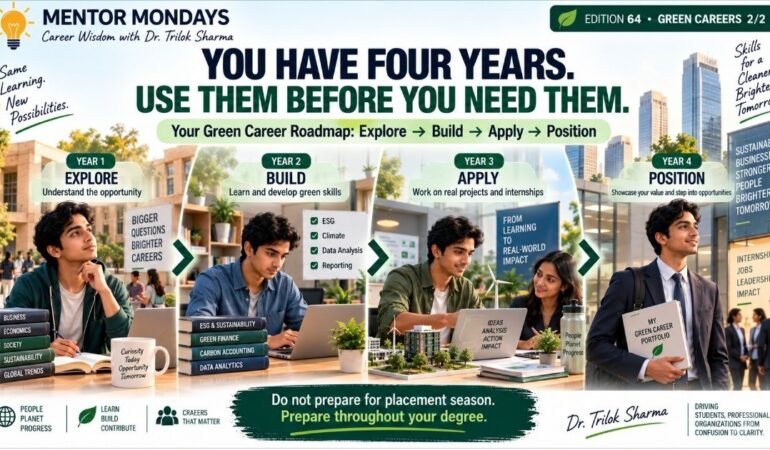
You have four years, use them before you need them

Last Monday, we discussed an important career shift: “Green careers are not limited to people working in forests, solar plants or environmental laboratories.”

  • Finance is becoming greener.
  • Accounting is becoming greener.
  • Investment is becoming greener.
  • Supply chains are becoming greener.
  • Business reporting is becoming greener.

The question therefore is no longer: “Should I change my degree?”

The better question is: “How can I make my existing degree future-ready?”

If you have just entered a four-year B. Com. (Hons.) or BBA (Hons.) program, you have a valuable career asset that students often underestimate four years of preparation time.

Article content

Let us use them deliberately:

  1. Year 1 Target: Become Green-Aware.
  2. Year 2 target: Become Green-Skilled.
  3. Year 3 target: Become Green-Experienced.
  4. Year 4 target: Become Green-Ready.

YEAR 1 – EXPLORE

Objective: Understand the landscape before choosing a destination.

Do not rush into expensive certifications. First understand the vocabulary. Learn the basics of:

  1. Climate change
  2. Sustainability
  3. SDGs
  4. ESG
  5. Circular economy
  6. Renewable energy
  7. Carbon emissions
  8. Sustainable business

Start reading the sustainability reports of companies you already recognize, for example: – Tata, Reliance, Infosys, HDFC Bank, ITC, Mahindra and so on.

Ask simple questions:

  • What environmental goals have they declared?
  • What are they measuring?
  • What are they reducing?
  • What are they reporting?

At the same time, strengthen Excel, presentation, research and written communication skills.

These may sound ordinary, but they are not.

A sustainability professional who cannot analyze data or communicate findings will remain limited.

YEAR 2 : BUILD

Now choose one or two areas that genuinely interest you.

Perhaps: ESG & Sustainability, Green Finance, Carbon Accounting, Sustainability Reporting, Climate Risk, Sustainable Supply Chain, Circular Economy.

Article content

Start building actual knowledge. There are credible entry points available online.

The IFRS Foundation, for example, currently provides free self-paced learning modules on IFRS S1 and IFRS S2 sustainability disclosure standards, including certificates of completion.

The Greenhouse Gas Protocol offers a free Corporate Standard recorded program as an entry point into organizational greenhouse-gas accounting.

Students interested in reporting can explore GRI learning programs; GRI currently offers a student discount on its Academy courses and certification examination.

Again: do not try to complete everything. Choose direction before certification.

YEAR 3 -APPLY

This is where many students make a mistake. They continue learning. But they never demonstrate that learning. Now start producing evidence.

Article content

You could:

  • Analyze the sustainability report of one listed company.
  • Compare the ESG disclosures of two competing companies.
  • Conduct a simple carbon-footprint exercise for a college activity.
  • Study the sustainability practices of a local MSME.
  • Create an Excel or Power BI sustainability dashboard.
  • Prepare a sustainable procurement proposal.
  • Study how a company reports Scope 1, Scope 2 and Scope 3 emissions.
  • Write a short green-finance investment analysis.

You do not need permission from a large company to begin learning.

Article content

Your college, neighborhood, family business, NGO or local enterprise can become your laboratory.

The project need not be big. It needs to be real. Then start documenting your work.

Not: “I am passionate about sustainability.”

Instead: “I analyzed three years of sustainability disclosures of two companies and identified five differences in their reporting.”

That is proof.

YEAR 4 -POSITION

This is the year to connect everything. Now you should be asking:

What roles am I actually preparing for?

Search job platforms using terms such as:

  • ESG Analyst
  • Sustainability Analyst
  • Carbon Analyst Sustainability
  • Reporting Green Finance
  • Climate Risk
  • Responsible Investment
  • ESG Research
  • Sustainable Procurement
  • Impact Analyst
  • Sustainability Consulting

Study ten job descriptions. Do not immediately apply:

  • First identify which skills employers repeatedly ask for.
  • Then compare those requirements with your own profile.
  • Complete one serious internship.
  • Refine your LinkedIn profile.
  • Create a small Green Career Portfolio.
  • Tailor your resume.
  • Reach out to professionals already working in your chosen area.

If sustainable investing particularly interests you, programs such as the CFA Institute’s Sustainable Investing Certificate are available without formal prerequisites, although investment knowledge is useful.

Specialized programs can come later. The objective in Year 4 is not to become an expert in everything. It is to become: Recognizably employable in something.

Article content

Your Four-Year Transformation

Article content

Students on a regular three-year graduation program can follow the same framework by combining the third and fourth stages during their final year.

The 30-Day Green Career Starter Challenge

You do not need to wait until next year.

Article content

During the next 30 days:

  • Week 1: Learn the basic language of sustainability.
  • Week 2: Download and read one corporate sustainability report.
  • Week 3: Complete one introductory online learning module.
  • Week 4: Create one small sustainability analysis and add it to your portfolio.

At the end of thirty days, you will still not be a sustainability professional. But you will have moved from:

“I have heard about green careers.” to “I have started preparing for one.” That difference matters.

One final mentoring thought

Students frequently ask me: “Sir, which career will be best four years from now?”

Nobody can predict that perfectly.

A better strategy is to build capabilities around problems that businesses will still need to solve, for example:

  • Climate.
  • Energy.
  • Resources.
  • Waste.
  • Risk.
  • Reporting.
  • Responsible investment.
  • Sustainable growth.

Those problems are unlikely to disappear.

So perhaps the smartest career preparation is not to chase tomorrow’s job title.

Prepare yourself to solve tomorrow’s problems.

  • Your degree will tell employers what you studied.
  • Your skills will tell them what you can do.
  • And your portfolio will tell them whether they should believe you.
Read More
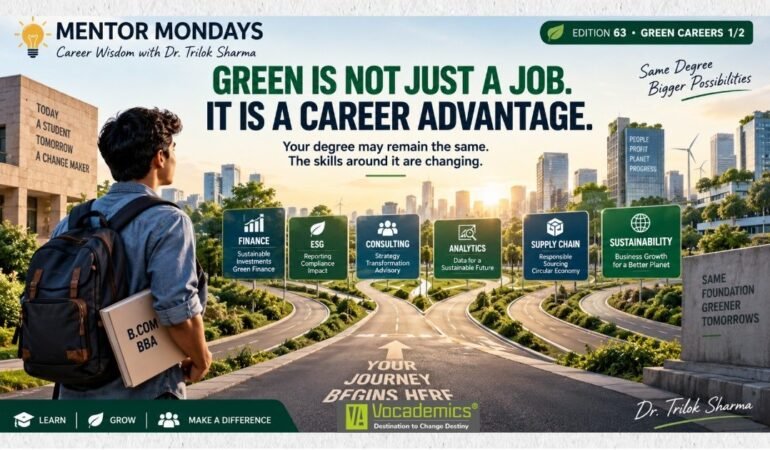
GREEN IS NOT JUST A JOB-IT IS A CAREER ADVANTAGE!

GREEN IS NOT JUST A JOB-IT IS A CAREER ADVANTAGE!

The opportunity today’s graduates should start noticing before everyone else does

Imagine two students, one from B Com (Hons) and another from BBA (Hons);  graduating four years from now. Both understand finance. Both know accounting. Both can use Excel.

But one of them also understands ESG, carbon accounting, sustainability reporting, climate risk and green finance.

Who do you think will have more doors open?

That question brings us to an emerging career reality that many undergraduate students are still not discussing seriously enough:

The economy is becoming greener : and jobs are changing with it.

Article content

When students hear the words green career, many immediately imagine solar-panel technicians, environmental scientists, wildlife conservationists or renewable-energy engineers.

Those are certainly green careers, but that is only one part of the story.

A growing number of professionals will continue to work in finance, accounting, banking, consulting, supply chain, auditing, risk management and business strategy – but sustainability will become an important part of what they do.

That creates an entirely different opportunity for commerce and management graduates.

What exactly is a Green Career?

A green job is broadly one that helps reduce environmental impact, conserve natural resources or enable the transition towards a more sustainable economy.

Your earlier Green Careers study identifies opportunities across renewable energy, sustainable agriculture, green construction, waste management, CSR, sustainability consulting and environmental policy. But students should understand another important distinction.

There are:

  • Green Jobs – jobs whose primary purpose is environmental or sustainability-related.

And then there are:

  • Greened Jobs – familiar professions that increasingly require green knowledge and skills.
  1. An accountant may start measuring emissions.
  2. A banker may evaluate climate-related financial risk.
  3. A procurement manager may assess whether suppliers meet sustainability standards.
  4. An investment analyst may evaluate a company not only by profitability, but also by environmental and governance performance.
  5. A consultant may help companies reduce energy consumption, waste and carbon emissions.

That is why the green transition is relevant even if you have never studied environmental science.

Why should a Commerce or BBA student care?

Because employers are already beginning to value green skills outside traditional environmental professions.

Article content

LinkedIn’s 2025 research found that demand for green talent was growing at about twice the rate of growth in the supply of green skills. It also found that more than half of green hires were already occurring in jobs that could traditionally have existed without green skills. Green-skilled professionals were being hired at a substantially higher rate than the overall workforce.

That is the signal students should notice.

Green skills are slowly becoming business skills.

And the green transition itself is creating employment. The World Economic Forum estimates that climate adaptation could contribute around 5 million additional net jobs globally by 2030, climate mitigation another 3 million, while changes in energy generation, storage and distribution could add around 1 million.

Renewable energy alone already supports an estimated 16.6 million jobs worldwide.

India has its own significant opportunity. Research by the Skill Council for Green Jobs and Sattva Consulting has estimated the potential for as many as 35 million green jobs in India by 2047 across traditional and emerging sectors.

The numbers matter.

But the direction matters even more.

Where could a B Com or BBA graduate fit?

Consider some of these possibilities:

  • ESG Analyst : Studies a company’s environmental, social and governance performance.
  • Sustainability Analyst : Works with data, initiatives and reporting connected with sustainability goals.
  • Green Finance Analyst : Works on financing projects and businesses linked with sustainable development.
  • Carbon Accounting Associate : Helps organizations measure greenhouse-gas emissions.
  • Climate Risk Analyst : Studies how climate-related risks could affect companies, assets and investments.
  • Sustainability Reporting Associate : Supports disclosures under sustainability-reporting frameworks.
  • Sustainable Procurement Analyst : Evaluates suppliers not merely on price and quality, but increasingly on environmental performance.
  • ESG Assurance/Audit Associate : Helps examine and validate sustainability-related information.
  • Impact Analyst : Measures whether investments or projects are actually producing intended social or environmental outcomes.
  • Sustainability Consultant : Helps organizations translate sustainability commitments into business practices.
Article content

Notice something?

Most of these are not careers that require you to abandon commerce. They require you to add another layer to commerce.

The Green Career Equation

For a young commerce student, I would put it very simply:

Your Degree + Green Knowledge + Digital Skills + Proof of Work = Green Career Readiness

  • Your degree gives you the foundation.
  • Green knowledge gives you differentiation.
  • Digital capability allows you to work with information.
  • And projects, internships and practical assignments prove that you can actually apply what you know.

This distinction is important because students sometimes believe that accumulating certificates automatically makes them employable… It does not.

Article content

Do not become a collector of certificates. Become a collector of capabilities.

And what about salaries?

There is no single “green salary”.

Compensation varies enormously according to the sector, qualification, role, country and experience.

Your earlier research, for example, reported broad Indian ranges across renewable energy, green buildings and carbon-related occupations, ranging from a few lakh rupees annually in entry-level operational roles to substantially higher packages in specialized carbon and sustainability positions.

  • But I would advise students not to choose this direction simply because they have heard that green careers may pay well.
  • Choose it because the knowledge could strengthen the profession you already intend to pursue.

Your first question is therefore not…

“Which green job should I apply for?”

You are still in college, So, a much better question is:

“Which green capability can I add to my existing degree during the next four years?”

Article content

If you are a first-year B Com (Hons.) or BBA (Hons.) student today, you possess something extraordinarily valuable: TIME.

Four academic years give you enough time to explore, learn, experiment, undertake projects, complete selected courses and gradually build a portfolio.

  • You do not have to decide everything today.
  • But you should start noticing the direction in which careers are moving.

Because the graduate who starts preparing before a skill becomes fashionable often has an advantage over the graduate who starts preparing after it becomes compulsory.

Mentor’s Monday Question

Before you leave this article, ask yourself:

If sustainability becomes an important part of business over the next decade, what would I like my existing degree to become capable of doing?

Keep your answer, because next Monday, we move from WHY to HOW.

Do not forget to come back and read – Edition 64: Your Four-Year Green Career Roadmap – What to learn, build and prove before you graduate.

Read More
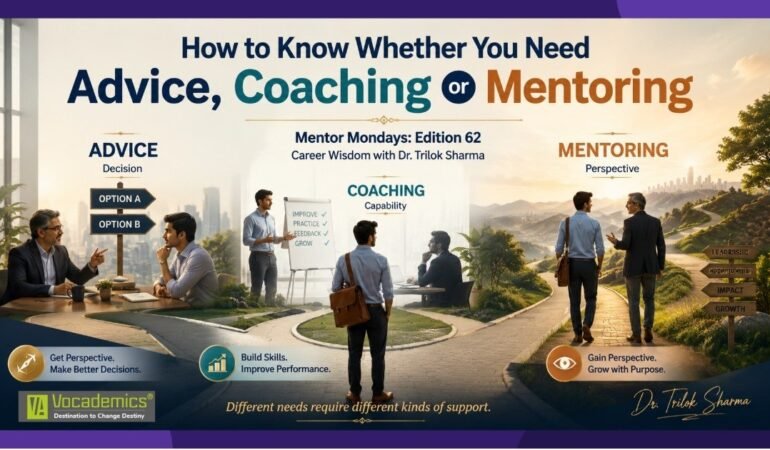
How to Know Whether You Need Advice, Coaching or Mentoring

How to Know Whether You Need Advice, Coaching or Mentoring

Advice may help you decide, coaching may help you improve, mentoring may help you grow. Wisdom lies in knowing what you need and when. – Dr. Trilok Sharma

“I need your guidance.”

It is one of the most common sentences students, professionals and young managers use when they approach someone more experienced.

But there is an important question hidden inside that sentence:

What kind of guidance do you actually need?

  • Do you need someone to suggest what you should do?
  • Do you need someone to help you improve a skill or performance?
  • Or do you need someone who can help you see your career, choices and possibilities from a wider perspective?

These are not the same needs.

Article content

And very often, people remain confused even after seeking help because they are either asking the right person for the wrong kind of support, or asking the wrong person for the right kind of support.

Before searching for the right person, it helps to first identify the right kind of help.

Article content

1. Advice : When You Need Perspective on a Decision

Advice usually begins with a reasonably clear situation.

You explain the problem, and someone with relevant knowledge, experience or judgement offers a suggestion, opinion or recommendation.

For example:

“I have offers from two companies. What factors should I compare before deciding?”

Or:

“Should I pursue an MBA immediately, or gain some work experience first?”

Or:

“Which certification would be more useful for the role I am targeting?”

In such situations, you may not need a long developmental relationship.

You may simply need a knowledgeable person who can help you look at the issue from another angle.

Advice is especially useful when:

  • the problem is reasonably clear;
  • you need information or perspective;
  • you are evaluating alternatives;
  • a decision needs to be made;
  • someone else has relevant experience.

Good advice can save time, prevent mistakes and reveal options you may not have considered.

But advice has a limitation.

Advice can give you an answer. It may not necessarily build your ability to find future answers yourself.

That requires something more.

Article content

2. Coaching : When You Need to Improve Performance

Suppose you already know what the problem is.

You know that your presentations are weak.

You know that you struggle with delegation.

You know that your interviews are not going well.

You know that your communication lacks clarity.

At this stage, collecting more opinions may not help.

You need structured improvement.

That is where coaching becomes valuable.

A coach may help you:

  • identify performance gaps;
  • set specific goals;
  • practise repeatedly;
  • receive feedback;
  • correct ineffective behaviour;
  • develop new habits;
  • measure improvement.

Consider a professional who wants to improve executive communication.

Telling that person,

“You should speak more confidently,”

is advice.

But observing a presentation, identifying specific weaknesses, practising delivery, improving structure, giving feedback and tracking progress is much closer to coaching.

This distinction is important:

Advice often addresses a decision. Coaching develops a capability.

A coach does not simply tell you what to do.

A good coach helps you perform better.

Article content

3. Mentoring : When You Need to See Further

Mentoring usually operates on a broader canvas.

A mentor brings experience, perspective, reflection and context.

The conversation may begin with one question, but gradually move toward larger questions:

Where is your career heading?

What strengths are you underusing?

Which opportunities are you overlooking?

What patterns are repeating in your professional life?

What risks can an experienced person see that you cannot yet see?

What kind of professional are you becoming?

A mentor may not always give you a direct answer.

In fact, sometimes the most valuable mentoring conversation ends not with an answer but with a better question.

A mentor may help you connect experiences that currently appear unrelated.

They may help you recognise potential you have not yet noticed.

They may challenge assumptions that are limiting you.

They may help you think beyond the immediate problem.

That is why I strongly believe:

A mentor should not become your decision-maker. A mentor helps you become a better decision-maker.

Mentoring is not about dependency.

It is about developing perspective, judgement and maturity.

The Simplest Way to Know What You Need

When you feel stuck, ask yourself three questions.

Do I need an answer or perspective on a specific issue?

Seek Advice.

Do I need to improve a capability or performance?

Seek Coaching.

Do I need direction, perspective and longer-term development?

Seek Mentoring.

This simple distinction can prevent a great deal of unnecessary confusion.

You May Need All Three

Advice, coaching and mentoring are not competing alternatives.

A person may need all three at different moments.

Imagine a young manager who has been offered a major leadership assignment.

The manager might ask:

Advice: “Should I accept this assignment?”

Later:

Coaching: “Can someone help me improve my delegation and executive communication?”

And eventually:

Mentoring: “How should I prepare myself for larger leadership responsibilities over the next five years?”

Same professional.

Same career.

Three different needs.

The important skill is knowing which kind of support is required at which stage.

Article content

One Person Does Not Have to Play Every Role

Another common mistake is expecting one senior person to become everything.

Mentor.

Coach.

Adviser.

Trainer.

Counsellor.

Sponsor.

Technical expert.

Problem-solver.

That is an unrealistic expectation.

A healthier approach is to gradually build what I call a Personal Guidance Ecosystem.

You may have:

  • an adviser for specialised decisions;
  • a coach for a particular skill;
  • a mentor for long-term perspective;
  • peers for mutual learning;
  • technical experts for specialised knowledge;
  • experienced professionals who occasionally provide valuable perspective.

Career development rarely comes from one person alone.

It comes from a network of meaningful learning relationships.

When the Wrong Kind of Help Creates More Confusion

Sometimes the problem is not the absence of guidance.

The problem is mismatched guidance.

If you need coaching but keep seeking advice, you may collect dozens of tips without improving your performance.

If you need mentoring but keep seeking short-term advice, you may solve individual problems without understanding your larger direction.

If you need a simple piece of advice but enter endless mentoring conversations, you may make an uncomplicated decision unnecessarily complex.

That is why:

Clarity about the support you need is itself a career skill.

The better you become at diagnosing your need, the easier it becomes for others to help you effectively.

Stop Saying Only, “Please Guide Me”

There is nothing wrong with asking for guidance.

But a more specific request produces a better conversation.

Instead of saying:

“Sir/Ma’am, please guide me.”

you could say:

“I am trying to make a decision between two options and would value your perspective.”

Or:

“I know which skill I need to improve, but I need structured feedback and practice.”

Or:

“I am thinking about the next stage of my career and would value your longer-term perspective.”

Notice the difference.

The moment you clarify your need, the other person understands how they can help.

And you demonstrate something equally important:

Professional maturity.

A Mentor Monday Reflection

Before asking:

“Who can help me?”

ask:

“What kind of help do I need?”

Sometimes you need an answer.

Sometimes you need practice.

Sometimes you need perspective.

And sometimes you need all three — but not necessarily from the same person or at the same time.

So the next time you feel stuck, do not merely search for guidance.

Diagnose the guidance you need.

Because clarity is not only about knowing where you want to go.

Sometimes clarity begins with knowing what kind of support will help you move forward.

Read More
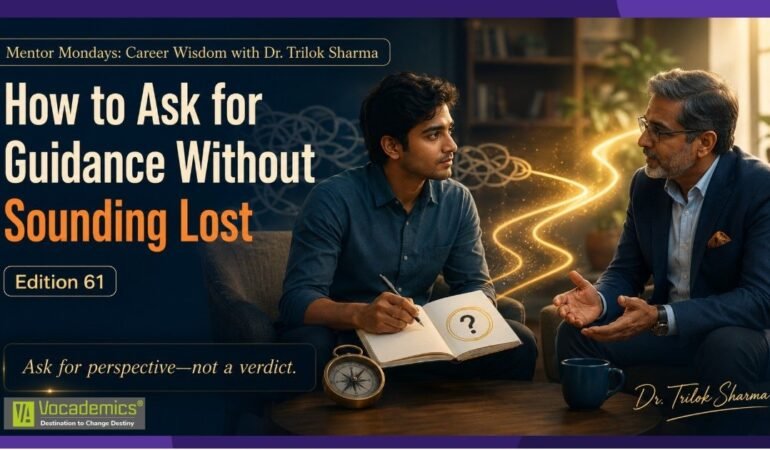
How to Ask for Guidance Without Sounding Lost

How to Ask for Guidance Without Sounding Lost

A thoughtful question does not reveal helplessness, it reveals preparation. – Dr. Trilok Sharma

At 10:42 p.m., a final-year student opens LinkedIn and begins typing:

“Good evening, Sir. I am completely confused about my career. Please guide me.”

He reads the message twice—and deletes it.

The next morning, a young professional drafts a similar message to a senior leader:

“Ma’am, I do not know what to do next. Please tell me which career option I should choose.”

She also decides not to send it.

Both genuinely need guidance. Yet both fear that asking for help may make them appear weak, dependent or directionless.

This fear prevents many capable people from approaching mentors.

The real problem, however, is not asking for guidance.

The problem is asking without preparation, context or a clear question.

Article content

Guidance Is Not the Same as Rescue

Compare these two requests:

Please tell me what I should do with my career.

and

I have explored two possible career paths. I am leaning towards one for these reasons, but I would value your perspective on one specific concern.

The first request transfers responsibility to the mentor.

The second demonstrates reflection, ownership and maturity.

A mentor can help you examine the road more clearly, but should not be expected to choose your destination or walk the road on your behalf.

Ask for perspective—not a verdict.

Ask for direction—not dependence.

What Makes a Guidance Request Sound Mature?

A mature request communicates five things:

  1. I have thought about my situation.
  2. I have already done some groundwork.
  3. I know why I am approaching you.
  4. I can explain the help I need.
  5. I will take responsibility for the final decision.

This is where the GUIDE Framework can help.

The GUIDE Framework

Article content

G : Get Clear About Your Need

Do not begin with, “I need guidance about my career.”

Career is a vast subject. Identify the actual decision, difficulty or question.

Are you:

•     Choosing between two courses?

•     Considering a career transition?

•     Preparing for a leadership role?

•     Trying to identify the next skill you should build?

•     Unsure whether to accept a particular opportunity?

The clearer your question, the more useful the guidance can be.

If you cannot explain your question in two sentences, think a little more before contacting the mentor.

U : Understand Why You Are Approaching This Mentor

Do not contact someone merely because the person is famous or senior.

Ask yourself:

Why is this person especially relevant to my question?

Perhaps the person has experience in your desired industry, has made a similar career transition, understands a profession you are exploring or possesses the perspective you currently need.

Mention this relevance briefly. It shows that your message is intentional—not a generic request copied and sent to twenty people.

I : Introduce the Context Briefly

A mentor does not need your entire life story in the first message.

Share only the context needed to understand your situation:

•     Who you are

•     What stage of your education or career you are in

•     What you have already explored

•     What decision or difficulty you now face

Clarity respects the mentor’s time.

D : Define a Specific Request

Never leave the mentor wondering what you expect.

Instead of writing, “Please guide me,” ask:

Could I request fifteen minutes to understand which entry-level experience would prepare me better for this field?

Or:

Would you be willing to share your perspective on the two options I am currently evaluating?

A focused request is easier to understand—and easier to accept.

E : End with Respect and Ownership

A respectful request does not demand an immediate response.

Acknowledge the mentor’s schedule. Give the person the freedom to decline. Make it clear that the final responsibility remains yours.

You may write:

I understand that you have a demanding schedule. Even a brief response, whenever convenient, would be valuable. I will use your perspective to make a more informed decision.

Humility creates openness. Ownership creates confidence.

Article content

Before and After: The Difference Preparation Makes

Before

Hello Sir, I am very confused about my future. Please guide me. It is urgent.

This message is sincere, but it gives the mentor no context, no specific question and no easy starting point.

After

Dear Dr. Mehta, I am a final-year commerce student exploring careers in financial analysis and management consulting. After researching both fields and speaking with two professionals, I am currently leaning towards financial analysis. Since you have worked in this area for several years, I would value your perspective on one question: Which entry-level experience would help me build the strongest foundation during my first two years? If convenient, may I request fifteen minutes of your time? I understand that your schedule may not permit it, and I would also be grateful for a brief response whenever possible. Thank you for considering my request.

This message does not sound lost.

It sounds thoughtful, prepared and respectful.

Five Expressions to Avoid

Avoid vague or demanding expressions such as:

  1. “Please tell me what to do.”
  2. “I need guidance about my entire career.”
  3. “Can I pick your brain?”
  4. “It is urgent. Please reply immediately.”
  5. “I will do whatever you suggest.”

A mentor’s role is to improve your thinking—not replace it.

Article content

What You Do After Receiving Guidance Matters

Mentorship does not end when the mentor answers your question.

After receiving guidance:

  • Thank the mentor sincerely.
  • Mention the insight that was most useful.
  • Explain the action you intend to take.
  • Share a brief progress update later.
Article content

A simple follow-up could be:

Thank you for helping me understand the importance of gaining practical experience before pursuing another qualification. I have now applied for three relevant internships and will update you after taking the next step.

This tells the mentor that the conversation created value.

Mentors are more willing to continue guiding people who listen, act and return with learning—not merely with another problem.

The Mentor Monday Reflection

Before approaching a mentor, ask yourself:

  • Am I seeking clarity or transferring responsibility?
  • Have I done some groundwork of my own?
  • Can I explain my question in two sentences?
  • Why is this particular mentor relevant?
  • Am I prepared to act on the guidance I receive?

There is no weakness in seeking guidance.

Knowing when to ask, whom to ask and how to ask is a mark of professional maturity.

Approach your mentor with humility—but carry your own compass.

Because the best mentors do not decide your destination.

They help you see your path more clearly.

Reflection question: If you could approach one mentor this week, what specific question would you ask?

For structured career counselling and career-option guidance, visit:

https://vocademics.edumilestones.com

For one-to-one mentoring with Dr. Trilok Sharma—online or offline—visit:

Driving Students, Professional & Organizations From Confusion to Clarity.

Read More
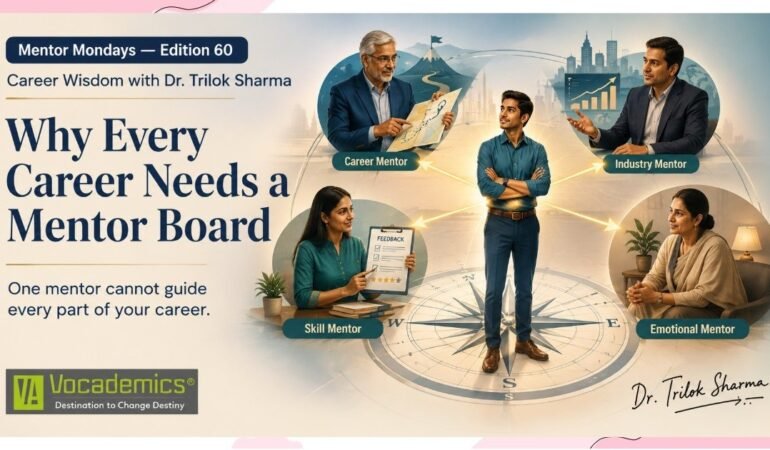
Why Every Career Needs a Mentor Board

Why Every Career Needs a Mentor Board

One mentor cannot guide every part of your career

For many years, we have been encouraged to “find a mentor.” The advice is valuable—but incomplete.

It creates the impression that somewhere there is one experienced person who will understand our ambitions, improve our skills, guide our career decisions, introduce us to opportunities, support us emotionally and tell us what to do whenever we feel confused.

That person rarely exists.

Article content

Even the most experienced mentor cannot understand every industry, solve every workplace problem, develop every skill or remain available at every important turning point in our career.

Instead of searching endlessly for one perfect mentor, we may need to build something more practical:

A Mentor Board

A Mentor Board is a small circle of people who guide different dimensions of your professional journey.

Just as an organization does not depend upon one director for every decision, your career should not depend upon one person for every kind of guidance. – Dr. Trilok Sharma

Article content

Different career questions require different forms of wisdom.

The person who helps you decide whether to change your career may not be the best person to improve your presentation skills.

The person who understands your industry may not fully understand your emotional struggles.

The senior professional who can open doors for you may not have enough time to help you reflect deeply on your choices.

This is why a strong career needs not one mentor, but a thoughtful circle of guidance.

The Four Seats on Your Mentor Board

Your Mentor Board does not have to be large. Four kinds of mentors can provide a strong foundation.

1. The Career Mentor

A career mentor helps you look at the larger direction of your professional life.

This person may help you think through questions such as:

  • Am I moving towards the right kind of work?
  • Should I continue in this role or explore something new?
  • What capabilities must I build for the next stage?
  • Am I making this decision from clarity, fear or frustration?
  • What could be the long-term consequence of my present choice?

A career mentor does not decide your future for you.

A good career mentor helps you examine your situation more honestly, understand your options and take responsibility for your decisions.

2. The Skill Mentor

A skill mentor helps you become better at a specific capability.

It may be communication, leadership, technical expertise, writing, negotiation, data analysis, teaching, sales or any other skill relevant to your career.

A skill mentor may observe your work, identify gaps, recommend practice and give you direct feedback.

This relationship is often practical and focused.

You are not asking:

“What should I do with my life?”

You are asking:

“How can I perform this part of my work better?”

Career growth requires both direction and competence. A career mentor helps you choose the road; a skill mentor helps you become capable of travelling it.

3. The Industry Mentor

Every profession has realities that cannot be understood fully through textbooks, courses or online information.

An industry mentor helps you understand how a particular sector actually works.

This person may guide you on:

  • Emerging opportunities
  • Industry expectations
  • Unwritten professional norms
  • Important networks
  • Changing roles
  • Future skills
  • Common career mistakes
  • The difference between an attractive opportunity and a sustainable one

Students especially need this form of guidance.

A course may tell you what a profession is supposed to be. An industry mentor can explain what that profession feels like in practice.

For experienced professionals, an industry mentor can provide perspective about changes that may not yet be visible from inside one organization.

4. The Emotional Mentor

Careers are not built only through qualifications and opportunities.

They are also shaped by rejection, uncertainty, comparison, pressure, disappointment and self-doubt.

At such times, you may not need another strategy. You may need perspective.

An emotional mentor is someone with whom you can speak honestly without feeling judged.

This person may help you regain balance when:

  • An interview does not go well
  • A promotion is delayed
  • A project fails
  • You begin doubting your abilities
  • Workplace relationships become difficult
  • You feel exhausted or directionless
  • Everyone appears to be moving ahead except you

An emotional mentor does not encourage dependency. The right person helps you process the experience, separate facts from emotions and return to the situation with greater stability.

Your Mentor Board May Already Exist

Building a Mentor Board does not always mean approaching four famous or highly influential people.

Some of these mentors may already be present in your life.

Your career mentor may be a former manager.

Your skill mentor may be a colleague who performs one task exceptionally well.

Your industry mentor may be an alumnus, client or senior professional.

Your emotional mentor may be a teacher, trusted friend, family elder or experienced colleague.

Mentoring does not always begin with a formal statement:

“Will you become my mentor?”

Sometimes it begins with a thoughtful question, a meaningful conversation and the willingness to act on what you learn.

Your mentors may not even know that you consider them part of your Mentor Board.

What matters is not the title you give the relationship. What matters is the quality of the guidance, the trust between you and the seriousness with which you use it.

Article content

A Mentor Board Is Not a Contact List

It is easy to confuse networking with mentoring.

A network may give you access to people.

A Mentor Board gives you access to perspective.

Collecting phone numbers, sending connection requests or meeting influential people does not automatically create mentoring relationships.

Mentoring develops when you:

  • Approach people with specific questions
  • Respect their experience and time
  • Listen without becoming defensive
  • Apply relevant guidance
  • Return with progress rather than repeated confusion
  • Keep them updated about meaningful developments
  • Express gratitude without using excessive flattery

The strength of your Mentor Board depends less on the status of its members and more on the quality of your engagement with them.

Article content

Do Not Ask Every Mentor the Same Question

  • One of the reasons people remain confused is that they seek guidance from the wrong source. They ask family members about industries the family has never experienced.
  • They ask technical experts to resolve emotional dilemmas.
  • They ask friends to validate major career decisions.
  • They ask successful people to provide answers without sharing enough context.

Before seeking guidance, ask yourself:

  • What kind of help do I actually need?
  • Do I need information?
  • Do I need feedback?
  • Do I need emotional support?
  • Do I need an independent perspective?
  • Do I need career counselling?
  • Do I need someone to challenge my assumptions?

Clarity about the support you need will help you approach the right person with the right question.

Conduct Your Mentor Board Audit

Take a few minutes and complete this simple reflection.

  1. Career Direction : Who helps me think about my long-term career decisions?
  2. Skill Development : Who gives me honest and useful feedback on my capabilities?
  3. Industry Understanding : Who helps me understand the realities and future of my profession?
  4. Emotional Perspective : Who can help me remain balanced during uncertainty, rejection or pressure?
Article content

Now ask yourself:

  • Which position on my Mentor Board is currently empty?
  • Am I depending too heavily on one person?
  • Am I receiving guidance only from people who think like me?
  • When was the last time I updated or thanked someone who guided me?
  • Have I acted upon the guidance I received?

An empty seat on your Mentor Board does not mean that you are failing – It simply reveals where you may need to build a meaningful relationship.

Mentors Do Not Remove Every Confusion

A mentor is not expected to provide instant certainty.

  • Some questions need time.
  • Some decisions involve risk.
  • Some career transitions require experimentation.

The role of a mentor is not always to give you the answer.

Sometimes, the most valuable contribution of a mentor is to help you see:

  • The question you have been avoiding
  • The assumption you have never challenged
  • The strength you have underestimated
  • The pattern you have repeatedly ignored
  • The option you have not considered
  • The consequence you are unwilling to acknowledge

Good mentoring does not make you dependent on another person’s wisdom; It gradually develops your own judgement.

Begin with One Meaningful Conversation

You do not need to build your entire Mentor Board immediately. Begin with one gap.

  1. Identify the area in which you currently need the greatest clarity.
  2. Then identify one person who may be able to guide you.
  3. Approach that person respectfully. Explain your situation briefly.
  4. Ask a specific question. Listen carefully.
  5. Reflect upon the guidance. Take action.

One meaningful conversation may not solve your entire career – But it can help you see your next step more clearly. And sometimes, the next clear step is all that a person needs.

This Monday’s Reflection

Do not ask only: “Do I have a mentor?”

Ask: “Do I have the right circle of guidance for the career I am trying to build?”

Your career does not need one all-knowing mentor. It needs a thoughtful circle of people who help you see what you may not see alone.

And when such a circle is not yet available, a structured mentoring conversation can become the first step towards building it.

Article content

Seeking Greater Clarity?

If you are navigating an important career decision, professional transition, workplace challenge or leadership dilemma, you may explore a confidential one-on-one mentoring conversation with Dr. Trilok Sharma, available online or offline through Vocademics International LLP.

Explore mentoring and appointment options: https://vocademicsinternational.com

Vocademics International LLP : Driving Students, Professional & Organizations From Confusion to Clarity

Read More
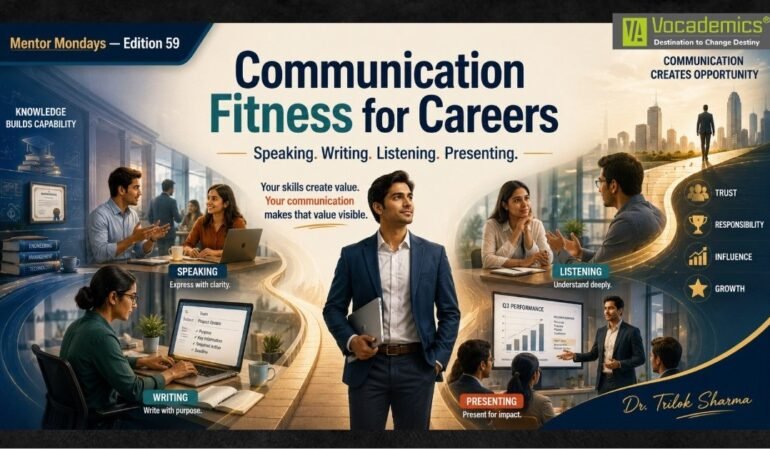
Communication Fitness for Careers

Communication Fitness for Careers

Speaking, Writing, Listening and Presenting Are No Longer Optional Skills

Your skills create value, but your communication makes that value visible. – Dr. Trilok Sharma

A professional may have excellent qualifications, strong technical knowledge and years of experience.

But can that person explain an idea clearly?

Can they write a professional email without creating confusion?

Can they listen carefully enough to understand what has not been directly said?

Can they present their work in a way that earns attention, trust and support?

In today’s workplace, knowledge may help you enter a career. Communication determines how far you travel within it.

Communication is no longer merely a “soft skill.” It is a career survival skill.

Just as physical fitness helps the body perform under pressure, communication fitness helps a professional think, respond and contribute effectively in demanding situations.

You do not become physically fit by exercising once before an important event. In the same way, you cannot become a powerful communicator by attending one workshop just before an interview or presentation.

Communication fitness requires regular practice.

Article content

Communication Is How Your Capability Becomes Visible

Many professionals quietly assume: “My work should speak for itself.”

Unfortunately, work does not always speak for itself.

Someone has to explain:

  • What was done
  • Why it was important
  • What problem was solved
  • What value was created
  • What should happen next

Two people may possess similar knowledge, but the person who communicates more clearly is often trusted with greater responsibility.

This does not mean that style is more important than substance.

It means that substance must be communicated before it can be recognised.

A strong idea that remains trapped inside someone’s mind cannot influence a meeting, guide a team, reassure a customer or support a decision.

Communication is the bridge between your capability and other people’s understanding of that capability.

The Four Muscles of Communication Fitness

A career-ready professional must continuously strengthen four communication muscles:

1. Speaking: Turning Thoughts into Clear Expression

Speaking is not about using impressive vocabulary, copying a foreign accent or dominating every conversation.

Professional speaking means being able to organize your thoughts and express them with clarity, confidence and respect.

Article content

You need speaking fitness when you:

  1. Introduce yourself
  2. Participate in a meeting
  3. Explain a technical issue
  4. Speak with a customer
  5. Ask for support
  6. Disagree with a colleague
  7. Give feedback
  8. Respond to an unexpected question

Many capable people remain silent because they are waiting to speak perfect English.

But careers do not require perfect sentences every time. They require meaningful participation.

A person who speaks in simple, structured and relevant sentences is often more effective than someone who uses complicated language without clarity.

Before speaking, organize your message around three questions: What is the issue? Why does it matter? What action do I recommend?

Speaking improves when thought becomes structured.

2. Writing: Creating a Professional Record of Your Thinking

Your spoken words may be forgotten. Your written words remain.

Emails, reports, messages, proposals, meeting notes and presentations create a permanent record of your professionalism.

A poorly written email can delay a decision, damage a relationship or create unnecessary work. A clear email can save hours of explanation. Professional writing is not about writing more. It is about making the reader work less.

Article content

Before sending any professional message, check whether it answers four questions: Why am I writing? What does the reader need to know? What action is required? By when is it required?

Avoid hiding the purpose of the message beneath long introductions.

Instead of writing: “This is with reference to our previous discussion and the various points discussed during the meeting…”

Write:

“As discussed, please share the revised production schedule by 4:00 p.m. today.”

Clear writing respects the reader’s time.

Your emails and reports silently communicate your discipline, judgment and reliability—even when you are not present.

3. Listening: Understanding Before Responding

Many people listen only long enough to prepare their reply.

That is not listening. That is waiting for a speaking opportunity.

Professional listening requires attention, patience and interpretation.

It means understanding:

  • The words being spoken
  • The concern behind the words
  • The information that may be missing
  • The emotional tone of the conversation
  • The action expected from you

Listening becomes especially important during conflict, customer complaints, feedback discussions and performance reviews.

Article content

When people feel unheard, even a technically correct response may fail. A communication-fit professional does not immediately defend, interrupt or conclude.

They pause and confirm: “Let me make sure I have understood your concern correctly.”

That one sentence can prevent misunderstanding and reduce emotional tension.

Listening is not a passive skill. It is an active form of professional intelligence.

The best communicators are not always the people who speak the most. They are often the people who understand the most.

4. Presenting: Converting Knowledge into Influence

A presentation is not a collection of slides. It is a guided journey from information to understanding and from understanding to action.

Presentation fitness is required far beyond conference halls. You are presenting whenever you:

  • Explain an idea to your manager
  • Share project progress
  • Recommend a solution
  • Brief a customer
  • Defend a budget
  • Propose a change
  • Report an achievement
  • Teach someone a process

A professional presentation should answer three questions: Where are we now? What does the information mean? What should we do next?

Article content

Too many presentations contain data without direction. Charts, numbers and technical details may demonstrate effort, but they do not automatically create understanding.

The presenter must interpret the information. Do not merely say: “Customer complaints increased by 18 per cent.”

Explain: “Customer complaints increased by 18 per cent, mainly because of delayed responses. We recommend assigning one escalation owner for the next 30 days.”

Presenting is the ability to make knowledge usable.

Communication Fitness Is Not the Same as Fluency

People frequently say: “My communication is weak because my English is weak.”

Language proficiency certainly helps, but communication fitness is broader than fluency.

A person may speak grammatically correct English and still communicate poorly.

Another person may use simple language but communicate with remarkable clarity.

Communication fitness depends on:

  • Clear thinking
  • Logical structure
  • Relevant information
  • Respectful tone
  • Active listening
  • Audience awareness
  • Confidence to participate
  • Ability to invite action

Do not measure your communication only by vocabulary. Measure it by results.

  • Did the listener understand?
  • Did the reader know what to do?
  • Did the meeting move forward?
  • Did the presentation support a decision?
  • Did the conversation strengthen trust?

That is the real test.

Article content

Warning Signs of Poor Communication Fitness

You may need to strengthen your communication fitness when:

  • People frequently ask you to explain again
  • Your emails generate long clarification chains
  • You avoid speaking in meetings
  • You know the answer but hesitate to contribute
  • Your presentations contain too much text
  • You interrupt before others complete their point
  • You speak without understanding the audience
  • Your messages do not contain a clear action
  • You confuse confidence with speaking loudly
  • You use technical language that others cannot understand

These are not permanent weaknesses.

They are communication habits—and habits can be improved through practice.

A 15-Minute Daily Communication Workout

You do not need two hours every day to become communication-fit.

Begin with fifteen focused minutes.

Speak for Three Minutes

Select one workplace topic and explain it aloud:

  • What I worked on today
  • A problem I recently solved
  • One improvement my department needs
  • A product or service offered by my organization
  • A lesson I learned this week
  • Record yourself occasionally.

Do not initially judge your accent. Check your clarity, structure and confidence.

Write for Four Minutes

Write one short professional message every day. Practice:

  • Requesting information
  • Sharing an update
  • Reporting a delay
  • Confirming a decision
  • Thanking a colleague
  • Following up on an action

Keep the purpose and expected action clear.

Listen for Four Minutes

Listen to a short professional conversation, interview, meeting extract or presentation. Note:

  • How the speaker begins
  • How ideas are connected
  • Which words create clarity
  • How the speaker concludes

Listening to good communication gradually improves your own communication patterns.

Present for Four Minutes

Take one idea and explain it using this structure:

Situation → Meaning → Recommendation

For example: “Our response time has increased from two hours to five hours. This may reduce customer confidence. I recommend introducing a daily pending-query review at 4:00 p.m.”

Small daily practice creates visible professional improvement.

The Communication Fitness Audit

Ask yourself honestly:

1.       Can I introduce myself professionally in 60 seconds?

2. Can I explain my work to someone outside my department?

3.       Can I write a clear email with a specific action?

4.       Can I disagree without sounding disrespectful?

5.       Can I listen without interrupting?

6.       Can I summarize a discussion accurately?

7.       Can I present an idea without reading from slides?

8.       Can I answer an unexpected question calmly?

9.       Can I adapt my language for a customer, colleague or senior leader?

10.  Can I conclude a conversation with clear next steps?

Do not treat this as an examination.

Treat it as a personal development map.

Select one area and practice it consistently for the next 30 days.

Communication Fitness Builds Career Trust

Organizations do not promote people only because they complete assigned tasks.

They promote people who can:

  • Coordinate with others
  • Explain problems
  • influence decisions
  • Manage disagreements
  • Represent the organization
  • Guide team members
  • Communicate during uncertainty
  • Build confidence among stakeholders

As responsibilities increase, communication becomes even more important.

At entry level, you may be responsible primarily for your own work.

At managerial level, you become responsible for shared understanding.

At leadership level, you become responsible for meaning, direction and confidence.

The higher you move, the more your career depends on your ability to communicate through people—not merely work around them.

Your Degree May Open the Door. Communication Helps You Remain in the Room.

A degree can demonstrate what you studied.

Communication demonstrates whether you can apply, explain and share what you know.

Technical knowledge may make you employable.

Communication fitness makes you dependable, visible and promotable.

Do not wait for an interview, appraisal, presentation or crisis to begin improving.

Build your communication muscles before the moment demands them.

  • Speak a little more clearly.
  • Write a little more carefully.
  • Listen a little more deeply.
  • Present a little more purposefully.

Because in the modern workplace, communication is not an additional career skill.

It is how almost every other career skill becomes useful.

This Week’s Mentor Monday Challenge

For the next seven days, complete one communication workout every day:

  • Monday: Give a 60-second professional introduction.
  • Tuesday: Rewrite one unclear email.
  • Wednesday: Listen to someone without interrupting.
  • Thursday: Explain a technical idea in simple language.
  • Friday: Present one workplace improvement in three minutes.
  • Saturday: Ask a colleague for communication feedback.
  • Sunday: Record what improved and what needs further practice.

Communication fitness is not built through intention.

It is built through repetition.

Reflection Question

Which communication muscle currently limits your career the most: speaking, writing, listening or presenting?

Read More
Micro-Internships and Mini-Projects

Micro-Internships and Mini-Projects

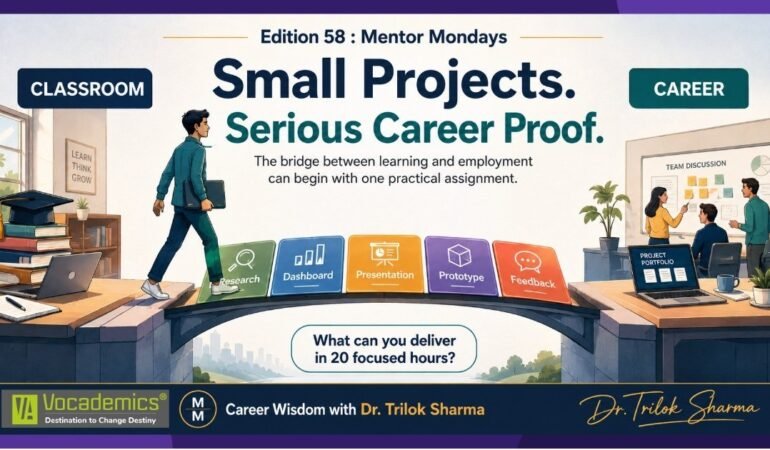
Small Projects – Serious Career Proof!

The bridge between learning and employment can begin with one practical assignment – Dr. Trilok Sharma

If an employer gave you 20 hours and one real problem, what could you deliver?

Last week, we discussed the importance of building evidence before you need it.

But that raises an important question: Where does career evidence come from when you have not yet received your first major opportunity?

Many students believe that experience begins only after they secure a formal internship or full-time job. Until then, they keep collecting courses, certificates and qualifications.

Learning is valuable. But employers eventually want to know:

What have you done with what you have learned?

This is where micro-internships and mini-projects can change the early-career journey.

The Experience Problem

Students often find themselves trapped in a frustrating cycle:

“I need experience to get an opportunity, but I need an opportunity to gain experience.”

Traditional internships remain valuable, but they may involve limited positions, fixed recruitment periods, location restrictions and lengthy selection processes. Students who cannot secure one may feel that their career development has stopped.

It has not.

Experience does not always have to begin with a two-month internship in a large organization. It can begin with a short, carefully defined assignment completed for a startup, small business, NGO, professor, community organization or working professional.

A micro-internship is generally a short-term professional project. On the Parker Dewey platform, for example, these assignments typically involve approximately 10 to 40 hours of work and resemble tasks given to interns or entry-level employees.

The idea is simple:

Give a student a real problem, a clear output, a deadline and professional feedback.

That small experience can become the first bridge between academic knowledge and workplace contribution.

Micro-Internship or Mini-Project?

The terms are related, but they should not be used carelessly.

A micro-internship is usually assigned by an organization or professional. It involves genuine work, a defined deliverable and interaction with a workplace stakeholder. Ideally, it should also be paid.

A mini-project may be initiated by the student, designed by a faculty member or completed as a practical simulation. It may not involve formal employment, but it can still demonstrate competence when it addresses a realistic problem and produces a visible result.

Students should represent both honestly.

Do not describe a self-created assignment as an internship. Instead, present it as an:

  • Independent project
  • Faculty-guided project
  • Client project
  • Community project
  • Applied academic project
  • Professional simulation

Credibility begins with accurate communication.

Article content

From Classroom Knowledge to Career Evidence

India’s UGC internship guidelines emphasize the integration of classroom, workshop and laboratory learning with actual workplaces, including businesses, startups, NGOs, research organisations and local enterprises. The guidelines also recognise that graduates frequently struggle because they lack practical skills and experience expected in recruitment.

The solution is not to abandon classroom learning.

The solution is to complete the learning cycle:

Learn → Do → Document → Demonstrate

Learn: Understand a concept, method or tool.

Do: Apply it to a specific problem.

Document: Record your process, decisions and results.

Demonstrate: Explain the work confidently to another person.

A student who has merely studied market research may struggle to explain the subject during an interview.

A student who has surveyed 50 customers, analysed their responses and prepared a three-page recommendation note has a career story.

The difference is not always knowledge.

The difference is application.

What Can a Student Actually Do?

A mini-project does not need to be large or glamorous. It needs to be useful, complete and explainable.

A management student could:

  • Conduct a competitor analysis for a local business.
  • Prepare a customer-feedback questionnaire.
  • Design an employee-onboarding checklist.
  • Create a simple sales or expense dashboard.
  • Map the customer journey of a small service company.
  • Develop a social-media content calendar.
  • Document a basic operating procedure.
  • Analyse publicly available industry data.
  • Prepare a recruitment or training communication kit.

An engineering student could:

  • Redesign a workflow.
  • Study the causes of a recurring production problem.
  • Create a preventive-maintenance checklist.
  • Prepare a technical explainer for non-technical users.
  • Develop and test a small prototype.
  • Conduct a product or process comparison.
  • Document safety or quality-improvement suggestions.

A commerce student could:

  • Categorize expenses for a small enterprise.
  • Create an inventory-control sheet.
  • Prepare a basic cash-flow forecast.
  • Study pricing patterns.
  • Analyze financial ratios from published reports.
  • Design a simple invoice or payment-tracking system.

The objective is not to pretend to be an experienced consultant.

The objective is to practice solving a bounded problem professionally.

Article content

The Mini-Project Quality Checklist

Before accepting or starting a project, ask six questions:

1. Is there a real problem?

“Learn digital marketing” is not a project.

“Prepare a four-week Instagram content plan for a neighbourhood café” is a project.

2. Is the output clearly defined?

The final output could be a report, presentation, dashboard, process map, prototype, training module, research brief or recommendation note.

3. Is there a deadline?

Open-ended projects are frequently abandoned. A short deadline creates seriousness and momentum.

4. Is someone expecting the result?

Accountability improves quality. The stakeholder may be a business owner, professor, mentor, department head or community leader.

5. Will you receive feedback?

Feedback turns activity into learning.

6. Can you explain what you contributed?

A project becomes career evidence only when you can describe your decisions, challenges, contribution and learning.

Article content

Build a Proof-of-Work Audit Card

After completing every project, create a one-page record containing:

Problem: What needed to be solved?

Context: Who was affected and why did it matter?

Deliverable: What exactly did you produce?

Skills Used: Which technical and human skills did you apply?

Tools Used: Which software, research methods or frameworks helped you?

Feedback: What did the stakeholder say?

Improvement: What did you change after receiving feedback?

Result: What became clearer, faster, easier or more useful?

Reflection: What would you do differently next time?

This record can later become a portfolio page, interview answer, LinkedIn post or résumé bullet.

Do not merely write:

“Good knowledge of Excel.”

Write:

“Created a sales dashboard from three months of transaction data, identified the highest-performing product categories and presented the findings to the business owner.”

The second statement gives the employer something to evaluate.

Article content

A Seven-Day Mini-Project Sprint

Students who are waiting for experience can begin with a simple seven-day challenge.

Day 1: Select one problem

Choose a problem connected to your preferred career direction.

Day 2: Define the deliverable

Decide exactly what you will submit and to whom.

Days 3–5: Complete the work

Research, analyze, design, test and document your decisions.

Day 6: Request feedback

Ask one knowledgeable person to review the work.

Day 7: Improve and record

Revise the output and prepare your proof-of-work audit card.

Seven days may not make you an expert.

But seven focused days can produce more career evidence than another month of passive intention.

Article content

How to Find Micro-Opportunities

Do not begin by asking:

“Can you give me an internship?”

That request places the entire responsibility on the other person.

Instead, make a project-first proposal:

“I am studying marketing and want to develop practical experience in customer research. I can prepare a short competitor and customer-review analysis for your business within ten days. The final deliverable will be a concise presentation with observations and recommendations. May I undertake this as a small learning project and request fifteen minutes of feedback after completion?”

This approach shows preparation, clarity and respect for the professional’s time.

Possible project sources include:

  • Local businesses
  • Startups
  • NGOs and community organizations
  • Faculty members
  • Alumni
  • Professional associations
  • Campus departments and student clubs
  • Family enterprises
  • Research centers
  • Independent professionals

Start close to where you are.

Your first practical opportunity may not come from a famous company. It may come from someone who trusts you with one small but meaningful responsibility.

Protect Your Professional Integrity

Micro-opportunities should not become an excuse for organizations to obtain endless unpaid labor.

Before beginning, clarify:

  • The scope of work
  • Expected hours
  • Deadline
  • Ownership of the output
  • Confidentiality requirements
  • Payment or other agreed recognition
  • Availability of feedback or a testimonial

NACE has specifically highlighted the equity problems associated with unpaid internships and supports paid internship opportunities.

Students should be open to learning, but they should also learn to recognise boundaries.

Professional experience must build confidence—not exploitation.

The New Career Question

The world of work is changing quickly, and employers are reassessing the skills people will need as technology transforms roles and responsibilities.

In this environment, students cannot depend entirely on qualifications to communicate readiness.

The new career question is becoming:

Can you show me how you think, work, communicate and improve?

Micro-internships and mini-projects help answer that question.

They provide students with more than a line on a résumé. They create:

  • A work sample
  • A professional conversation
  • A feedback experience
  • A clearer career preference
  • A stronger interview example
  • A potential mentor or reference
  • Greater confidence in applying knowledge

One small assignment may not transform your career immediately.

But five or six well-chosen projects can transform the way you understand yourself—and the way employers understand your potential.

This Monday’s Career Challenge

Choose one skill that you claim on your résumé.

Now design a small project that proves it.

Do not wait for a perfect internship, a prestigious organization or the end of your degree.

Find one problem.

Produce one useful result.

Ask for one piece of feedback.

Document one career story.

Because your career does not begin when someone finally gives you a job.

It begins when you start using your knowledge to create value.

Read More
The Proof-of-Skill Portfolio

The Proof-of-Skill Portfolio

Don’t Just Claim Skills – Show Them.

There comes a point in every career journey when qualifications alone stop answering the most important question.

For a student, that question may be: “How do I stand out before my first job?”

For a fresh graduate, it may be: “How do I prove that I am ready for the workplace?”

For a job seeker, it may be: “How do I show capability beyond my resume?”

For an early-career professional, it may be: “How do I demonstrate growth, learning and future readiness?”

And for someone planning a career shift, the question becomes even sharper: “How do I convince others that I can move into a new role, new function or new industry?”

The answer is increasingly clear : You need more than a resume. You need more than certificates. You need more than claims. You need a Proof-of-Skill Portfolio.

Article content

A resume tells people what you have studied or where you have worked. A portfolio shows what you have actually created, analyzed, solved, presented, improved and learned.

In a competitive career environment, skills become powerful only when they become visible.

The Problem: Many People Have Skills, But Very Little or NO Proof

Most students and young professionals are not short of ability.

They attend courses. They complete assignments. They participate in projects. They do internships. They attend workshops. They learn tools. They make presentations. They solve workplace problems. They take part in events. They write, speak, design, organize, analyze and coordinate.

But after all this, one problem remains : The evidence is scattered.

A project stays in an old folder. A presentation is forgotten after delivery. An internship becomes only a certificate. A workplace learning remains only a memory. A LinkedIn post is never written. A case analysis is never documented. A problem solved at work is never converted into a learning note.

As a result, when an opportunity comes, many capable people are unable to show the depth of their capability.

They say: “I have communication skills.” “I am good at analysis.” “I can work in teams.” “I have leadership qualities.” “I am interested in marketing.” “I want to move into HR.” “I have learned digital tools.” “I handled responsibilities during internship.”

These statements may be true, but in career conversations, truth becomes stronger when it is supported by evidence. That is where a Proof-of-Skill Portfolio makes a difference.

What Is a Proof-of-Skill Portfolio?

A Proof-of-Skill Portfolio is a simple, organized collection of real work that demonstrates your capabilities.

Article content

It is not only for designers, writers or creative professionals. It is useful for management students, engineers, commerce graduates, HR professionals, marketing aspirants, analysts, consultants, trainers, entrepreneurs, job seekers and anyone who wants to show professional readiness.

It may include: Projects Case notes Presentations Internship reflections Workplace learning notes Research summaries Client or customer insights Problem-solving examples LinkedIn learning posts Certificates with short reflections Before-after examples of improvement Feedback received and acted upon

The purpose is simple: When someone asks, “What can you do?” your portfolio should help answer that question with confidence.

A good portfolio does not need to be complicated. It does not need expensive design. It does not need a personal website in the beginning. It does not need perfect achievements. It needs structure, honesty and visible evidence.

Why This Matters Now

The world of work is moving from qualification-based confidence to evidence-based confidence.

Degrees still matter. Marks still matter. Certifications still help…But employers, clients, mentors and collaborators increasingly want to see how you think, how you apply learning, how you communicate, how you solve problems and how seriously you take your own growth.

  • For students, a portfolio builds employability before placement season.
  • For fresh graduates, it adds weight to a limited resume.
  • For job seekers, it helps create differentiation in a crowded market.
  • For early-career professionals, it shows growth beyond the job title.
  • For career switchers, it creates a bridge between past experience and future direction.

The portfolio is not a substitute for competence. It is a way of making competence visible.

Five Sections Every Proof-of-Skill Portfolio Should Have

You can begin with a simple digital folder. Name it: My Proof-of-Skill Portfolio

Article content

Inside it, create five sections.

1. Project Evidence

Every project should leave behind a proof file. Whether it is an academic project, a workplace assignment, a consulting note, a research task, a team activity or a self-initiated experiment, document it properly.

For each project, capture: Project title Problem or objective, Your role, Method used, Key findings, Outcome or recommendation, Skill demonstrated, One learning from the process.

  • For example, a student may document a market research project on consumer behavior.
  • A fresh graduate may document a process improvement idea from an internship.
  • An early-career professional may document how they helped streamline reporting, improve coordination or analyze customer feedback.

Even a small project becomes powerful when it is presented as evidence of thinking and action.

2. Case Notes

A case note shows how you think. It is especially useful for students, management learners, consultants, analysts, HR professionals and anyone preparing for interviews or career transitions.

A good case note does not need to be long. One page is enough.

You can structure it around five questions: 1. What was the situation? 2. What was the core problem? 3. What options were available? 4. What decision or recommendation would I make? 5. What did I learn from this case?

Case notes demonstrate judgement. They show whether you can move beyond information and reach insight. This is important because careers are not built only on knowledge. They are built on the quality of decisions we are able to make with that knowledge.

3. Presentation Records

Many people prepare presentations, deliver them once and then forget them. That is a missed opportunity. Every meaningful presentation should become part of your portfolio.

Save the final deck. Write a short note about the purpose. Mention your contribution. Capture the audience or context. Record the feedback received. Add one point you would improve next time.

This section is useful for almost everyone.

  • A student can include class or project presentations.
  • A fresh graduate can include internship review presentations.
  • A professional can include internal presentations, client decks, training material or review documents.
  • A job seeker can include a self-created presentation on an industry, company or function of interest.

Presentation records show communication, structure, confidence and preparation. They also show that you can convert thinking into a shareable format.

4. Internship and Workplace Learning Diary

An internship is not just a certificate. A job is not just a designation. Both are learning environments. The real value comes from observation, participation, feedback and reflection. During an internship or early professional role, maintain a weekly learning diary.

Write short notes on: What did I observe? What task was given to me? What problem did I understand? What skill did I use? What feedback did I receive? What did I learn about workplace behavior? What would I do differently next time?

This habit can change the quality of your career conversations. Instead of saying, “I did an internship in marketing,” you can say: “During my internship, I observed how customer objections were handled. I prepared a short note on five recurring objections and suggested response points for the sales team.”

Instead of saying, “I worked in operations,” you can say: “I noticed delays in daily coordination and created a simple tracking format that helped the team follow pending tasks more clearly.”

That is the difference between experience and evidence.

5. LinkedIn Learning Posts

LinkedIn is not only a place for job updates and achievements. It can also become your public learning journal. Once a week, write a short post about something you learned, observed, analyzed or reflected upon.

It could come from: A project, A book, An internship, A workplace incident, A guest lecture, A case discussion, A client interaction, A training program, A failed attempt, A professional conversation, A problem you solved.

Keep it simple. What happened? What did you learn? Why does it matter? How can others apply it?

You do not need to sound like an expert. In fact, early in your journey, it is better to sound like a sincere learner. Over time, these posts become a visible record of your thinking, growth and professional seriousness.

This is how people move from being invisible to being discoverable.

Article content

Before and After: The Difference a Portfolio Makes

Without a portfolio, a candidate says: “I am interested in HR.”

With a portfolio, the same person can show: A short note on employee engagement, A case reflection on workplace conflict, An internship diary on recruitment coordination, A presentation on performance appraisal, A LinkedIn post on feedback culture.

Without a portfolio, a marketing aspirant says: “I understand branding.”

With a portfolio, the person can show: A competitor analysis, A campaign review, A customer persona sheet, A social media content calendar, A reflection on consumer behaviour.

Without a portfolio, an early-career professional says: “I am ready for a bigger role.”

With a portfolio, the person can show: Projects handled, Problems solved, Improvements suggested, Feedback received, Skills developed, Learning documented.

The difference is not only in ability. The difference is in visibility.

How to Start This Week

Do not wait for a perfect portfolio. Start with one folder. Then add one proof every week.

  • One project note.
  • One case reflection.
  • One presentation record.
  • One internship learning.
  • One workplace insight.
  • One LinkedIn post.
  • One problem-solving example.
  • One feedback note. One before-after improvement.

In three months, you will have evidence. In six months, you will have a story. In one year, you will have a professional identity.

The habit is more important than the format. The consistency is more important than the design. The reflection is more important than the decoration.

A Simple Portfolio Audit

Ask yourself these five questions:

  1. Can I show three projects that demonstrate my skills?
  2. Can I show two examples of how I analyze problems?
  3. Can I show one presentation that reflects my communication ability?
  4. Can I show what I learned from my internship or job role?
  5. Can my LinkedIn profile reflect my learning journey, not just my qualifications?

If the answer is NO, there is no need to feel discouraged. It simply means your next career task is clear. Start documenting.

Article content

In the modern career world, potential must be supported by proof.

Your resume may open the first conversation. Your portfolio can deepen it. Your degree may show where you studied. Your portfolio can show how you think. Your certificate may show that you attended. Your portfolio can show what you understood, applied and improved.

Skills become powerful when they are visible through work. So do not only prepare for interviews.

Prepare evidence, because the future will favour those who can not only say, “I can do this,” but also show, “Here is how I have already begun.”

Proof builds careers.

Proof builds confidence.

Proof builds credibility.

Read More
Employability Is Not a Degree — It Is a Daily Practice

Employability Is Not a Degree — It Is a Daily Practice

Your degree is history, your practice is your future. – Dr. Trilok Sharma

Dear Thinking Professional,

Your degree may have opened the first door. But it will not keep every future door open.

This is the uncomfortable truth of today’s workplace: employability is no longer something we earn once and preserve forever. It is something we practise, renew, and prove every day.

For decades, we told young people:

Get a degree. Get a job. You are set for life.

That idea was never fully true. But today, it is dangerously outdated.

Let me say it directly: Your degree is not your employability. Your daily practice is.

Article content

A degree is evidence that you studied something at a particular stage of life. Employability is evidence that you are still learning, still adapting, still solving problems, and still adding value.

A degree is a milestone. Employability is movement. And movement has to continue.

The Big Lie We Believed

We were trained to think of careers like fixed ladders. Study well. Get a qualification. Enter a good organization. Work hard. Move upward. Retire respectfully.

That model still has emotional appeal, but the world of work has changed.

Article content

This is not a small shift. It is a complete rewiring of how we must think about careers.

The question is no longer only: “What qualification do I have?”

The better question is: “What value can I create today?”

The Five Pillars of Daily Employability Practice

Employability is not one skill. It is a combination of habits, abilities, attitudes, and awareness.

In today’s workplace, I see five pillars that every professional must strengthen consistently.

Not once a year.

Not only before an interview.

Not only when a job is at risk.

Every day.

Pillar 1: Skill Currency

Your technical skills have a shelf life.

This is difficult to accept, especially when we have worked hard to acquire those skills. But every professional must understand one truth: skills expire when they are not updated.

A tool that was powerful five years ago may be basic today. A method that was respected ten years ago may be inefficient now. A qualification that once made you stand out may now be common.

Recent global employer research, including the World Economic Forum’s Future of Jobs Report 2025, points toward a changing skill landscape. Skills connected with AI, data, cybersecurity, digital fluency, analytical thinking, and technological literacy are becoming increasingly important across many sectors.

This does not mean every person must become a coder. It means every person must become skill-aware.

You must know which skills are rising in your field, which skills are becoming ordinary, and which skills are slowly becoming irrelevant.

Daily Practice: Spend at least 30 minutes a day strengthening one current skill.

It could be data analysis. It could be AI tool usage. It could be writing better prompts. It could be project management. It could be automation. It could be digital communication. It could be learning how your industry is changing.

The skill does not matter as much as the habit.

Your salary is not a reward for your degree. It is a reward for the problems you can solve today.

Pillar 2: Human Capability

Technology can make you faster. But humanity makes you trusted.

AI can write, analyze, summarize, predict, and automate. It can support our work in powerful ways. But there are still areas where human capability remains central.

AI cannot build genuine trust in a team. AI cannot take moral responsibility for a decision. AI cannot show real empathy to a distressed colleague. AI cannot inspire people through lived experience. AI cannot understand the silent emotional climate of a workplace the way a sensitive leader can.

This is why human capability is not becoming less important. It is becoming more visible.

Communication, emotional intelligence, accountability, collaboration, resilience, ethical judgment, and respect for others are no longer “soft” skills in the weak sense. They are survival skills.

In many workplaces, people do not fail only because they lack technical knowledge. They fail because they cannot communicate clearly, handle feedback, manage conflict, collaborate with maturity, or take responsibility.

Article content

Daily Practice: Every day, practise one human skill consciously.

Listen without interrupting. Respond instead of reacting. Give credit where it is due. Accept feedback without defensiveness. Help one person without expecting immediate return. Take responsibility without excuses.

AI may make you efficient. But humanity makes you indispensable.

Pillar 3: Learning Agility

The World Economic Forum’s Future of Jobs Report 2025 notes that employers expect 39% of workers’ core skills to change by 2030.

That is not a distant warning. That is already happening.

The professionals who will thrive are not necessarily those who know the most today. They are those who can learn, unlearn, and relearn faster.

Learning agility has three simple steps:

  1. Unlearn: Let go of outdated methods, assumptions, and ego.
  2. Learn: Absorb new tools, concepts, frameworks, and perspectives.
  3. Relearn: Apply new learning in real work until it becomes useful.

Many professionals are willing to learn. Fewer are willing to unlearn.

That is where the real difficulty lies.

Because unlearning often hurts the ego. It forces us to admit that what once worked may no longer be enough. It asks us to move from comfort to curiosity.

But without unlearning, learning becomes decoration.

Daily Practice: Read one useful article. Watch one short tutorial. Study one job description in your field. Ask one intelligent question. Reflect on one mistake. Learn one small thing that makes tomorrow better than today.

No day without learning. Small learning, repeated daily, becomes career strength.

Pillar 4: Work Integrity

Your character is your most portable career asset. Skills may get you noticed. Integrity makes you trusted.

In every organization, people quietly observe who can be relied upon. They notice who shows up on time, who delivers what they promise, who takes responsibility, who speaks respectfully, who handles pressure with dignity, and who does the right thing even when no one is watching.

Employability is not only about being skilled. It is also about being dependable.

A brilliant but unreliable person creates risk. A talented but arrogant person creates friction. A capable but dishonest person destroys trust.

Work integrity is built through small daily acts.

Keeping commitments. Owning mistakes. Respecting deadlines. Being honest about limitations. Not blaming others casually. Treating juniors, peers, and seniors with equal dignity.

Article content

Daily Practice: At the end of each working day, ask yourself:

Did I bring my best self to work today?

Did I act with honesty and ownership?

Did I add value or simply pass time?

Did someone trust me more because of how I behaved today?

Your resume may speak before the interview.

But your integrity speaks after people work with you.

Pillar 5: Career Awareness

You cannot navigate a map you have not looked at.

Yet many professionals spend more time planning a weekend trip than planning their career.

Career awareness means knowing what is happening around you.

Where is your industry moving?

Which roles are growing?

Which skills are being demanded repeatedly?

Which technologies are entering your profession?

Who are the people worth learning from?

What kind of work gives you energy?

What kind of work is slowly becoming unsuitable for you?

What is your next possible move?

A person without career awareness becomes dependent on chance.

A person with career awareness makes better choices.

Career awareness does not mean anxiety. It means alertness.

It does not mean changing jobs every year. It means understanding where you stand and where the world is moving.

Daily Practice: Spend 10 minutes a day scanning your professional environment.

Read LinkedIn posts from thoughtful professionals. Look at job descriptions in your field. Notice recurring skills in vacancies. Follow industry reports. Observe what clients, employers, and students are asking for. Speak to mentors and peers. Stay curious.

Do not wait for a crisis to understand your career.

The Daily Employability Checklist : Print this. Pin it above your desk. Or simply write it in your notebook. Tick one box every day.

Article content

This checklist is not meant to create pressure. It is meant to create direction. You do not need to transform your career in one day. You only need to stop neglecting it daily.

Article content

The Career Audit Card

Once a week, sit quietly with yourself. No audience. No performance. No self-deception.

Ask these six questions:

  1. What new skill did I learn this week?
  2. What feedback did I receive, and what did I do with it?
  3. Did I solve a problem or merely complete a task?
  4. Did I help someone grow this week?
  5. What is one thing I could have done better?
  6. Am I more valuable today than I was last Monday?

The last question is the most important. If you cannot answer it with a quiet “yes,” do not panic. Just begin again.

Employability does not disappear in one week. But it weakens slowly when we stop growing. It strengthens again when we return to daily practice.

Your Personal Career Dashboard

Imagine your career like a car dashboard.

Article content

You do not wait for the engine to fail before checking the fuel. You do not ignore a warning light for months. You do not drive confidently with no idea of speed, direction, or balance.

Your career also has gauges.

Skill Fuel: Are your technical skills current? Human EQ: Are your people skills strong? Learning Speed: Are you adapting fast enough? Integrity Compass: Are you trusted? Career Awareness: Do you know where you are going?

Rate yourself honestly on each gauge.

Not to impress anyone.

Only to understand yourself.

Maybe your Skill Fuel is strong, but your Human EQ needs attention.

Maybe your Integrity Compass is steady, but your Career Awareness is low.

Maybe you are hardworking, but not learning fast enough.

Maybe you are experienced, but repeating the same year again and again.

That honest diagnosis is the beginning of growth.

A Gentle Truth From Your Mentor

Your degree opened a door.

Respect it.

Be grateful for it.

But do not worship it.

The world does not owe us lifelong relevance because we studied well once. The workplace rewards those who continue to become useful.

The people who will thrive in the next five years are not necessarily those with the longest resumes or the most impressive titles.

They are the ones who wake up and ask:

“What can I learn today that makes me more useful tomorrow?”

Employability is not a destination. – it is a direction.

And that direction is chosen every day through small, repeated practices.

Reflection Question for This Week

Ask yourself honestly:

“If I lost my current job today, would my skills get me a better one tomorrow?”

If the answer is yes, continue strengthening your edge.

If the answer is no, do not feel defeated. Feel awakened.

Then ask the next question:

“What will I start doing today?”

Write your answer. Do not just think it. Writing makes it real.

Five Actions for This Monday

  1. Choose one skill to strengthen this week.
  2. Practise one human capability consciously every day.
  3. Spend 10 minutes daily observing where your industry is moving.
  4. Complete your weekly Career Audit Card.
  5. Pick your weakest career gauge and move it one step forward.

Do not wait for the annual appraisal. Do not wait for the next interview. Do not wait for a career shock. Start today!


Repost it to help someone in your network.

Share your answer to the reflection question in the comments.

Subscribe to Mentor Mondays so you never miss an edition.

Read More

Future-Proofing Yourself Every 90 Days

A Quarterly Career Review Framework for Staying Relevant

Your future is not protected by what you achieved yesterday. It is protected by what you choose to learn, build, and become today.- Dr. Trilok Sharma

Most professionals conduct a performance review once a year.

Unfortunately, the world no longer changes once a year.

Technology evolves every few months. Industries transform rapidly. New skills emerge. Old skills lose relevance. Business models shift. Customer expectations change.

Yet many professionals continue to operate with an outdated assumption:

“If I keep working hard, my career will automatically move forward.”

Hard work remains important.

But today, hard work without periodic reinvention can quietly lead to stagnation.

The professionals who thrive in the coming decade will not necessarily be the most intelligent, the most experienced, or even the most qualified.

They will be the ones who consistently adapt.

That is why I encourage professionals to adopt a simple habit:

Conduct a personal career review every 90 days.

Not every year.

Every quarter.

Because career growth is no longer an annual event. It is a continuous process.

Article content

Why Every 90 Days?

Think about how much can change in three months.

A new technology enters your industry.

A competitor launches a disruptive product.

A new leadership team arrives.

Customer expectations shift.

A skill that was considered advanced six months ago becomes a basic expectation.

Three months is long enough to make meaningful progress.

At the same time, it is short enough to correct mistakes before they become expensive.

Organizations conduct quarterly business reviews because markets move quickly.

Professionals should do the same for their careers.

If companies need quarterly reviews to remain competitive, individuals need them to remain employable.

The Biggest Career Risk Today

Many people believe their biggest career risk is losing a job.

I disagree.

The biggest risk is becoming professionally outdated without realizing it.

Career decline rarely happens suddenly.

It usually happens quietly.

One year without learning.

A few years without meaningful networking.

Several years relying on old expertise.

Gradually, the market moves forward while the individual stays where they are.

Experience remains valuable.

But experience without evolution eventually becomes history.

The question is not:

“How many years of experience do I have?”

The more important question is:

“How relevant is my experience today?”

Article content

The 90-Day Career Review Framework

Every quarter, review yourself in four areas:

Learn

Apply

Connect

Position

These four dimensions create a practical system for long-term career relevance.

1. LEARN

What Have You Learned During the Last 90 Days?

Learning is no longer a phase of life.

It is a permanent professional responsibility.

Article content

Ask yourself:

  • What new skill have I learned?
  • What industry trend do I understand better today?
  • What book, course, certification, podcast, workshop, or project expanded my thinking?
  • What knowledge will make me more valuable in the next three years?

Many professionals proudly discuss what they learned ten years ago.

Future-ready professionals can explain what they learned during the last ten weeks.

Continuous learning is no longer a competitive advantage.

It is becoming a survival skill.

2. APPLY

What Have You Actually Used?

Learning creates potential.

Application creates value.

Many people consume endless content but never convert knowledge into capability.

Ask yourself:

  • Which new skill have I applied?
  • What process have I improved?
  • What problem have I solved differently?
  • What measurable result was created because I learned something new?

Reading about leadership does not develop leadership.

Leading people does.

Studying communication does not improve communication.

Practicing communication does.

The market rewards demonstrated capability, not accumulated information.

3. CONNECT

Who Knows You and Trusts You?

Career opportunities often arrive through relationships before they appear through job portals.

Networking is frequently misunderstood.

It is not about collecting contacts.

It is about building credibility and trust.

Article content

Every 90 days ask:

  • Which professional relationships have I strengthened?
  • Which former colleagues have I reconnected with?
  • Which industry conversations have I participated in?
  • Who have I helped without expecting immediate returns?

Relationships compound over time just like investments.

Many career opportunities emerge not because someone was searching for a job, but because someone remembered them when an opportunity appeared.

Your network is not merely a list of contacts.

It is your professional ecosystem.

4. POSITION

Can Others Clearly See Your Growth?

One of the most common career mistakes is invisible excellence.

Many professionals do excellent work.

Very few communicate it effectively.

Ask yourself:

  • Have I updated my LinkedIn profile recently?
  • Have I shared meaningful insights?
  • Have I documented my achievements?
  • Can someone easily understand my expertise?

Visibility is not self-promotion.

Visibility is clarity.

If people cannot understand your value, they cannot recommend you, hire you, promote you, or collaborate with you.

The objective is not to become famous.
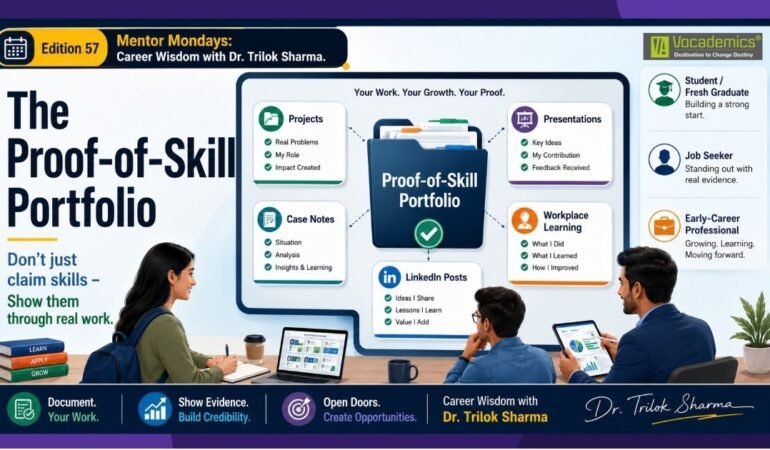
The objective is to become discoverable.

The Quarterly Career Scorecard

At the end of every 90 days, rate yourself from 1 to 10.

Area

Score

Learning ___ /10

Application ___ /10

Networking ___ /10

Positioning ___ /10

Total Score: ___ /40

Track your score every quarter.

Do not compare yourself with others.

Compare yourself with the person you were 90 days ago.

Small improvements repeated consistently create extraordinary results over time.

A Simple Rule for the Next Decade

If every 90 days you:

✔ Learn one meaningful thing

✔ Apply one new capability

✔ Strengthen a few professional relationships

✔ Improve your professional visibility

You will remain ahead of most professionals.

Not because you are working harder.

But because you are evolving faster.

Article content

Final Reflection

The future cannot be predicted perfectly.

But it can be prepared for consistently.

Career security no longer comes from a designation.

It no longer comes from a degree earned years ago.

It no longer comes from staying in the same organization for decades.

Career security now comes from adaptability.

And adaptability is built through small, regular upgrades.

So before the next quarter begins, ask yourself one simple question:

“If my industry changes tomorrow, how prepared am I today?”

Then schedule a meeting with the most important person responsible for your career -“Yourself”

Because the most successful professionals are not those who resist change.

They are the ones who review, learn, adapt, and grow—every 90 days.

Read More